Solar Overtakes Gas in California While Europe Accelerates Its Renewable Buildout
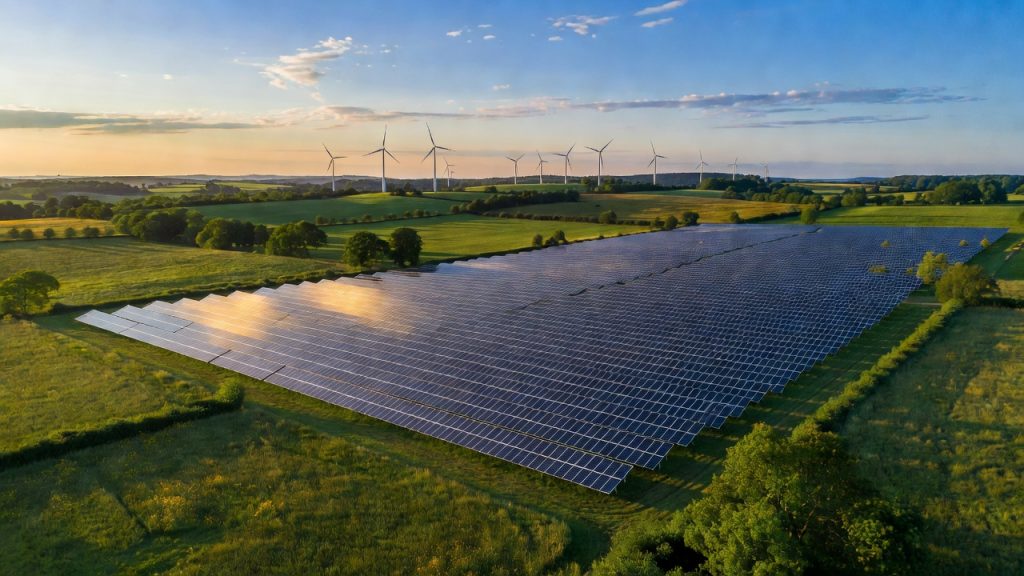
For the first time in California’s history, solar energy generation outpaced natural gas across the first five months of 2026 — a milestone that would have seemed ambitious just a decade ago. Reported by Canary Media, the shift signals not just a local success story, but a broader acceleration in the global energy transition that is also reshaping Europe’s power landscape in real time.
A Turning Point in the Energy Mix
California’s solar surge is more than a statistic. It reflects years of sustained investment in utility-scale solar farms, rooftop panels, and — critically — battery energy storage systems that allow renewable generation to cover demand even after sunset. The state’s grid now demonstrates something that skeptics long questioned: that variable renewable energy, when paired with smart storage and grid management, can reliably displace fossil fuels at scale.
This matters for Europe, where similar dynamics are playing out. In the United Kingdom, the government recently approved the One Earth solar farm, set to become the second-largest solar installation in the country. Separately, Hartlepool Council unanimously greenlit a 193-acre solar farm and energy storage project — a pairing that mirrors California’s winning formula. These are not isolated decisions; they reflect a continental shift in how governments and investors view renewable energy as the backbone of future resource management.
Green Hydrogen and Storage: Europe’s Industrial Bet
Beyond solar, Europe is making decisive moves in technologies that will define the next phase of decarbonisation. French industrial gases giant Air Liquide has taken a final investment decision on a 200-MW green hydrogen electrolyser at the Port of Rotterdam — one of the largest such commitments on the continent. With TotalEnergies as a major offtaker, the project targets zero-carbon fuel for heavy industry: steel, chemicals, and shipping, sectors notoriously difficult to electrify directly.
Green hydrogen scaling for these hard-to-abate industries is one of the most closely watched trends in energy policy right now. Rotterdam, already Europe’s largest port, is positioning itself as a hydrogen hub — a strategic move that aligns with the EU’s ambition to import and produce 10 million tonnes of renewable hydrogen annually by 2030.
Meanwhile, Bulgaria’s International Power Supply (IPS) received strategic project status under the EU Net-Zero Industry Act for its fully integrated battery energy storage system, branded Exeron. This designation, reserved for projects that meaningfully boost net-zero technology production capacity in Europe, underlines how battery storage is now considered critical infrastructure — not just a complement to solar and wind, but a pillar of grid stability in its own right.
A Global Momentum That Reaches Beyond Europe
The energy transition is clearly not a European phenomenon alone. New Zealand passed its Offshore Renewable Energy Bill, opening the door to large-scale offshore wind development in the South Pacific. Laos and Myanmar signed a joint agreement to study a new hydropower project on the Mekong River — though that development will require careful scrutiny given the river’s ecological sensitivity and its role as a shared water resource for millions of people across Southeast Asia.
On the technology frontier, perovskite and tandem solar cells are pushing conversion efficiencies above 30%, a threshold that could dramatically reduce the land and material requirements for future solar farms. Higher efficiency means more energy from the same footprint — a crucial advantage as competition for land and resources intensifies.
What This Means for Citizens and Decision-Makers
The convergence of these developments points to a clear direction:
- Solar paired with storage is becoming the default model for new energy capacity, from California to Kent.
- Green hydrogen is moving from pilot projects to industrial-scale investment, with European ports leading the way.
- Policy frameworks like the EU Net-Zero Industry Act are proving effective at accelerating strategic technologies and attracting capital.
- Emerging economies are joining the transition, though projects involving shared water systems like the Mekong demand rigorous environmental and social assessment.
For European citizens, the practical implication is a faster-changing energy system — one that promises lower emissions and greater energy efficiency, but also requires investment in grids, storage, and workforce skills. For decision-makers, the message from California and Rotterdam alike is that ambition, backed by clear policy and private capital, delivers results.
The race is no longer about whether renewables can compete — it’s about how fast we can build.