From Carbon Waste to Construction Material: The Green Tech Breakthroughs Reshaping Industry in 2025
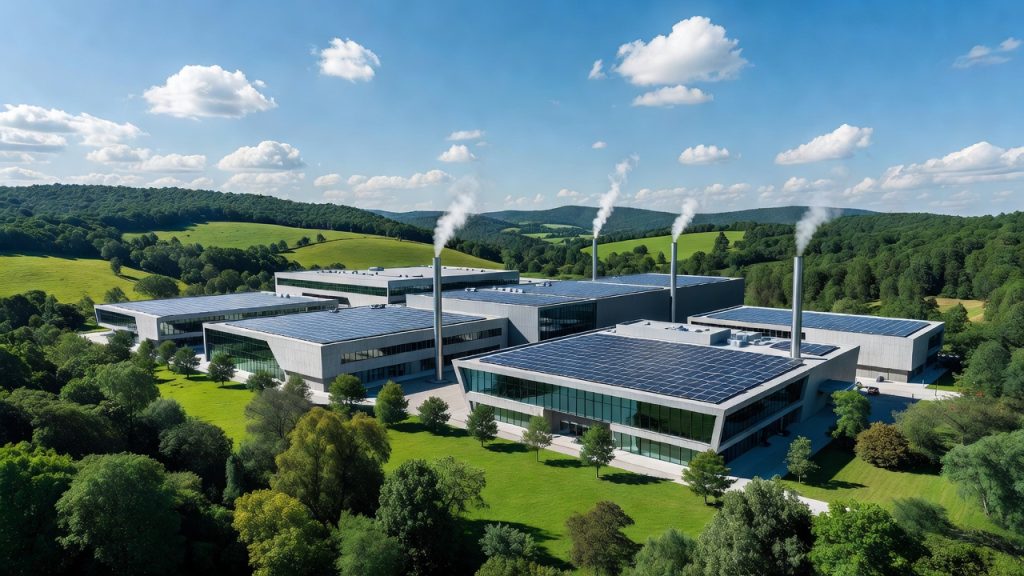
The pace of green innovation is accelerating — and 2025 is shaping up to be a landmark year. From Australia’s industrial carbon refinery to 10-nanometer solar cells embedded in skyscraper glass, a wave of cleantech breakthroughs is moving beyond the laboratory and into the real economy. For Europe, which has staked its industrial future on the Green Deal and a net-zero target by 2050, these developments offer both inspiration and a competitive challenge.
Australia’s Carbon Refinery: Turning Emissions Into Building Blocks
The most headline-grabbing development comes from Australia, where the world’s first fully integrated carbon refinery has officially opened. The facility captures industrial CO2 emissions and waste materials, then converts them into usable construction products — essentially closing the loop on one of heavy industry’s most persistent problems. According to reports from Impactful Ninja, the refinery can cut net emissions by up to 90% for participating industrial operators.
This is not a pilot project or a proof-of-concept. It is a functioning, commercial-scale operation — and its implications for the energy transition are significant. The construction sector alone accounts for roughly 37% of global CO2 emissions, according to the UN Environment Programme. A technology that transforms industrial exhaust into low-carbon building materials directly addresses two of the most stubborn decarbonisation challenges at once.
Europe is not standing still on this front. Italy’s Politecnico di Milano recently launched POLICAP, a mobile carbon capture pilot facility designed to test CO2 capture technologies directly at industrial sites — a flexible, scalable approach that could help European manufacturers adopt Carbon Capture and Utilization (CCU) without requiring permanent infrastructure overhauls. The mobility of the system is a smart design choice: it allows researchers and industry partners to gather real-world performance data across different sectors and geographies, accelerating the path to commercial adoption.
Solar Cells in Glass and Data Centres Under the Sea
Two other innovations deserve particular attention for their relevance to smart cities and digital infrastructure. Researchers have developed solar cells just 10 nanometres thin — thin enough to be embedded directly into window glass. Skyscrapers could generate electricity across their entire façade without any visible change to their appearance. For dense urban environments like Milan, Paris, or Amsterdam, where rooftop space is limited and aesthetic regulations are strict, this technology could be transformative for low-carbon construction and smart city energy integration.
Meanwhile, off the coast of Shanghai, an undersea data centre is now operational, cooled by seawater and powered by offshore wind. As artificial intelligence drives exponential growth in data centre energy demand — the International Energy Agency projects global data centre electricity consumption could double by 2026 — this model offers a genuinely cleaner, land-efficient alternative. European offshore wind capacity, already the strongest in the world, makes this concept particularly worth exploring on this side of the Atlantic.
Water, Minerals, and the Resource Recovery Opportunity
A third breakthrough addresses a crisis that is quietly intensifying across Southern Europe and beyond: water scarcity. A newly developed solar-powered desalination system converts seawater into fresh drinking water while producing no toxic brine waste — the environmentally damaging byproduct that has long limited conventional desalination’s sustainability credentials. More remarkably, the system also recovers valuable minerals from the process, including lithium, a critical raw material essential for electric mobility and battery storage.
For a European Union actively working to secure its critical minerals supply chain — reducing dependence on imports from China and other third countries — this kind of dual-purpose technology represents exactly the kind of strategic cleantech investment worth watching closely.
What This Means for Europe’s Green Transition
Taken together, these developments point to a maturing cleantech landscape where green technology is no longer about incremental efficiency gains but systemic reinvention. Key implications for European policymakers, businesses, and cities include:
- Industrial decarbonisation now has scalable, commercial tools — CCU and carbon refineries are ready for broader deployment with the right regulatory and financial frameworks.
- Smart city planning should integrate next-generation solar and building materials from the design stage, not as retrofits.
- Water and mineral security can be addressed simultaneously through innovative desalination — relevant for Mediterranean member states facing growing drought risk.
- Digital infrastructure needs a sustainability strategy: offshore, sea-cooled data centres powered by renewables could align AI growth with climate goals.
The key takeaway: the technologies needed to decarbonise industry, cities, and digital infrastructure are arriving faster than policy frameworks can absorb them. Europe’s competitive advantage lies in its ability to regulate intelligently, fund strategically, and deploy at scale — before others set the global standard first.