Beyond the Headlines: Why Europe’s Food System Transformation Is Gradual, Not Sudden
Not every important shift in sustainable agriculture arrives as a headline. This week, no single verified breakthrough emerged in the last 48 hours across sustainable food systems, agroecology, plant-based innovation, or supply chain reform. Yet the absence of a dramatic announcement does not mean stagnation. If anything, the current moment reveals something more telling: the transition toward resilient food systems is increasingly incremental, institutional, and structural rather than driven by single dramatic events.
For readers across Europe—farmers, policymakers, food businesses, and citizens alike—this is a useful reminder. Genuine transformation in agriculture rarely looks like a single policy signed or a technology unveiled overnight. It looks like accumulating pressure from climate volatility, tightening governance frameworks, and slow but steady farmer adoption of new practices. Understanding this rhythm matters for anyone trying to separate real progress from noise.
Agroecology’s Quiet Momentum
According to the FAO and the international Agroecology Coalition, the case for agroecology as a scalable systems approach continues to strengthen, even without a single dramatic policy win this week. The emphasis has shifted from proving the concept to solving practical adoption barriers: farmer economics, land tenure, financing access, and integration with breeding innovation and digital tools.
This matters because agroecology is often framed—especially in Brussels policy circles under the EU’s Farm to Fork ambitions—as a pathway that can simultaneously restore soil health, reduce input dependency, and maintain productivity. But the evidence base increasingly shows that success depends less on technical design and more on whether smallholders and mid-sized European farms can afford the transition period. Policy design, not just science, is now the binding constraint.
- Farmer income stability during transition years remains the top adoption barrier
- Digital tools (soil sensors, satellite monitoring) are increasingly bundled with agroecological training programs
- Breeding innovation for climate-resilient crop varieties is accelerating in parallel with agronomic reform
Climate Resilience Tools Are Becoming Standard, Not Novel
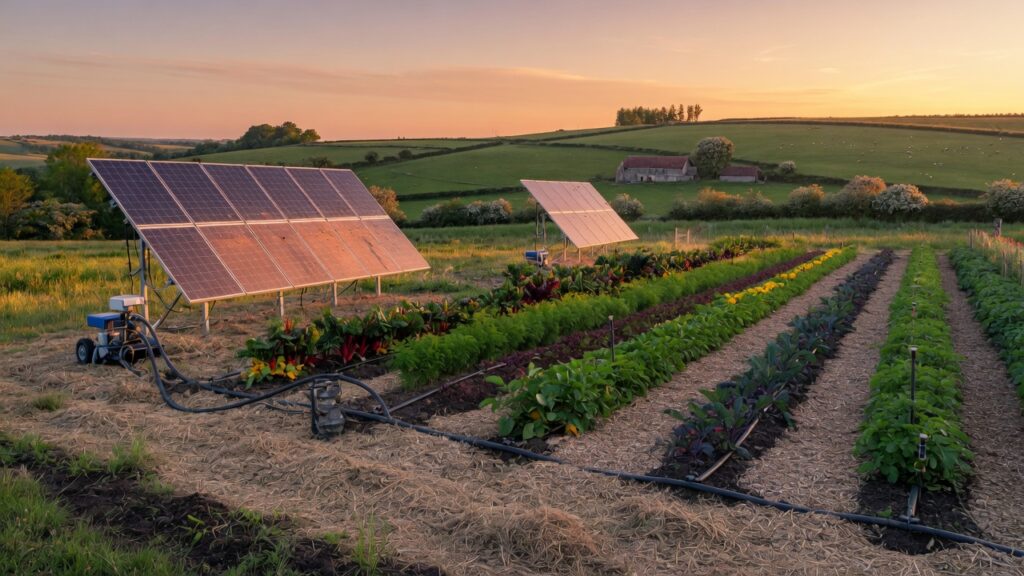
Solar-powered irrigation, mulching techniques, and organic input substitution are no longer experimental—they are becoming baseline expectations for producers seeking to remain viable amid climate volatility. This shift matters enormously for supply chain sustainability, since buyers across Europe and globally are increasingly conditioning contracts on climate-risk mitigation at the farm level.
The practical implication is that resilience investment is migrating from a public-good narrative to a commercial necessity. Retailers and food manufacturers, under mounting pressure from both regulation (such as the EU Corporate Sustainability Due Diligence Directive) and consumer expectation, are pushing risk-reduction requirements upstream. A farm that cannot demonstrate water efficiency or climate adaptation planning risks losing buyer relationships—independent of whether a formal sustainability mandate applies to that specific supply chain tier.
Plant-Based Innovation: Steady, Not Stalled
Coverage of plant-based foods and alternative proteins did not produce a fresh market or policy shock in the past two days, but this reflects market maturation rather than decline. After several years of rapid product launches and investment surges, the sector across Europe is now in a consolidation phase—refining cost structures, improving taste parity, and navigating regulatory clarity on labeling and novel food approval, particularly for precision-fermentation and cultivated ingredients.
This slower pace should not be mistaken for reduced relevance. Plant-based diversification remains a core lever for reducing the environmental footprint of European food systems, particularly given that livestock-related emissions remain a central target in national climate strategies.
What This Means for Businesses and Policymakers
The lack of a singular breakthrough this week underscores a broader truth: sustainable transformation in food and agriculture is a governance and financing challenge as much as a technological one. For European decision-makers, the priority is translating agroecological evidence and resilience tools into accessible financing mechanisms for farmers of all scales. For businesses, supply chain sustainability is shifting from voluntary commitment to structural requirement.
Key takeaway: Progress in sustainable agriculture and food systems this week was steady rather than spectacular—but steady, systemic change, backed by agroecological evidence and resilience investment, is precisely what durable transformation requires.