Europe’s Farms Face a €2.3 Billion Heat Bill — And a Race Toward Climate-Resilient Agriculture
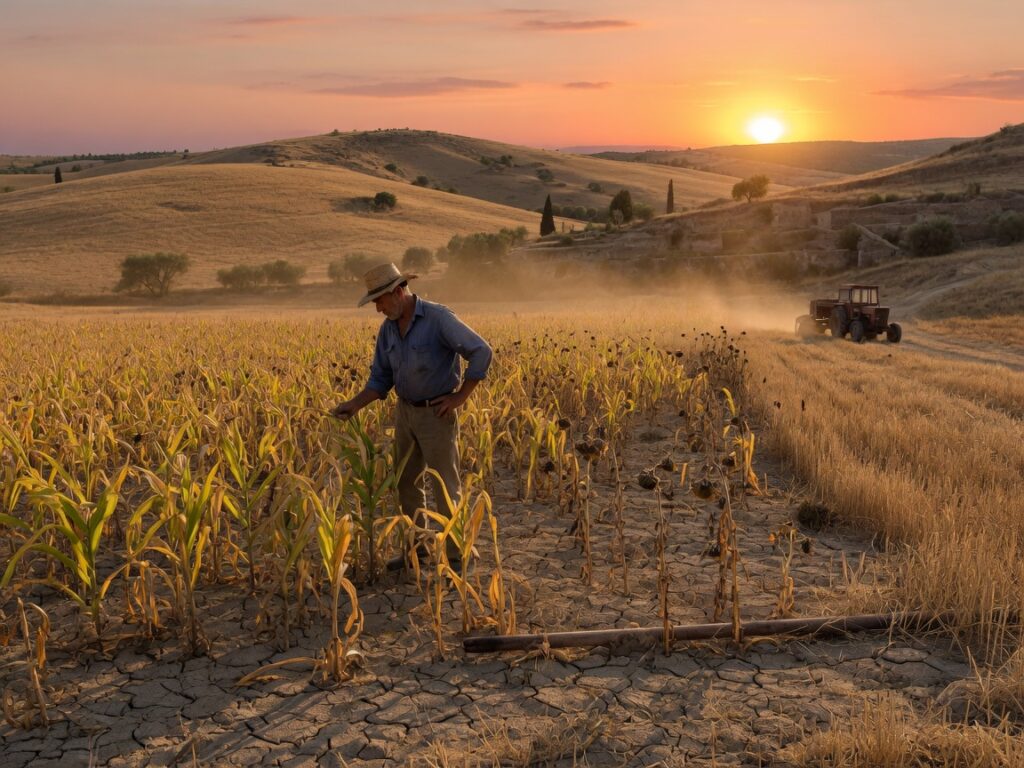
Europe’s farmers are facing an increasingly hot reckoning. According to Reuters, heatwave-driven crop losses across the EU and Britain could reach as much as €2.3 billion this season alone, a figure that underscores how climate volatility is no longer a distant risk but a recurring line item on Europe’s agricultural balance sheet. From withered wheat fields in France to stressed vineyards in Spain and heat-hit dairy herds in the Netherlands, the pressure is accelerating a shift toward sustainable agriculture and climate-resilient food systems across the continent.
This is not an isolated shock. It is the latest signal in a broader transformation of how Europe grows, sources, and regulates food — one that blends adaptation, compliance, and innovation into a single, urgent agenda.
Policy Under Pressure: CAP Flexibility Meets Climate Reality
Brussels is responding with short-term firefighting measures. EU agriculture policy is increasingly leaning on eased Common Agricultural Policy (CAP) rules, faster liquidity support, and reserve funding to help farmers absorb fertiliser and energy price shocks compounded by heat losses. These measures buy time, but they also expose a structural tension: emergency relief can only go so far when droughts, heatwaves, and erratic rainfall are becoming the norm rather than the exception.
Analysts increasingly argue that resilience funding must evolve into long-term investment in agroecology — diversified cropping systems, soil health management, and water-efficient irrigation — rather than repeated liquidity patches. The European Environment Agency has repeatedly warned that southern and central Europe face rising drought frequency, meaning today’s emergency reserve could become tomorrow’s permanent budget line unless adaptation is embedded structurally into farm policy.
Supply Chains Under Scrutiny: Compliance, Litigation, and Trade Risk
Climate stress is colliding with a second pressure point: tightening regulation. Food and beverage importers are navigating renewed uncertainty from shifting tariff regimes, while companies face growing scrutiny over human-rights and sourcing claims tied to their raw material origins. This is reshaping supply chain sustainability from a voluntary commitment into a legal and reputational necessity.
Due diligence obligations — echoing the EU’s deforestation regulation and corporate sustainability reporting requirements — mean that traceability is no longer optional. Buyers of coffee, cocoa, soy, and palm oil must now demonstrate verifiable sourcing, and litigation risk is prompting food companies to audit supply chains more rigorously than ever before. For decision-makers, this signals that climate resilience and regulatory compliance are converging into a single risk category.
Regenerative Agriculture and Innovation as Business Strategy
Amid the pressure, a more optimistic narrative is emerging. Global food and beverage groups are increasingly backing regenerative agriculture — not purely as an environmental gesture, but as a hedge against supply instability. Healthier soils retain more water, buffer against drought, and support more stable yields, making regenerative practices a pragmatic climate adaptation tool as much as an ecological one.
Innovation is reinforcing this shift. Vertical farming and water-saving salad production are reducing dependence on open-field vulnerability, while agritech challenges are fast-tracking new fertiliser solutions designed to cut nutrient pollution without sacrificing productivity. Meanwhile, the growth of plant-based food categories continues to offer a lower-water, lower-emissions protein alternative, appealing to both climate-conscious consumers and companies seeking to diversify supply risk away from heat-vulnerable livestock and feed crops.
- Heatwave losses in EU/UK crops estimated at up to €2.3 billion
- CAP flexibility measures aim to provide short-term liquidity relief
- Supply chain due diligence is becoming a legal requirement, not a choice
- Regenerative agriculture is gaining corporate and financial backing as a resilience strategy
- Vertical farming and precision fertilisers are cutting resource use while protecting yields
What This Means for Europe — and Beyond
The implications extend well beyond farm gates. Rising heat losses threaten food price stability, a politically sensitive issue across Europe following recent inflation shocks. They also strain rural livelihoods, particularly in Mediterranean regions already grappling with water scarcity. Globally, Europe’s experience is a preview of challenges facing food systems in North America, South Asia, and Sub-Saharan Africa, where climate volatility is similarly disrupting production.
For policymakers, the lesson is clear: reactive subsidies must be paired with proactive investment in resilient food systems — from soil regeneration to water infrastructure. For businesses, supply chain transparency and regenerative sourcing are becoming competitive differentiators, not just compliance checkboxes. And for consumers, the shift toward diversified, plant-forward diets is increasingly framed not just as an ethical choice, but as a practical response to a warming world.
Key takeaway: Europe’s mounting heat losses are accelerating a structural shift in agriculture — from emergency relief toward genuine resilience. The winners in this transition will be those who treat sustainability, traceability, and adaptation not as costs, but as the foundation of future food security.