US Farm Funding Cuts Reveal a Global Weak Spot: Why Food System Resilience Can’t Wait
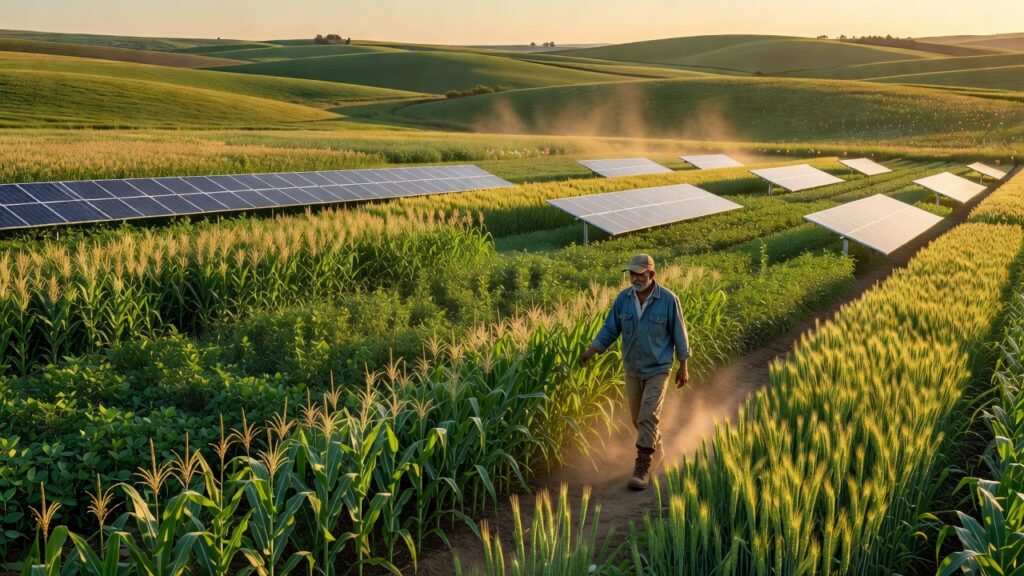
When the Trump administration quietly cancelled funding for nearly two dozen farm and food resilience projects in the United States — from solar-powered greenhouses to Indigenous-led wild rice restoration — the immediate impact was local. But the ripple effects reach far beyond American fields. For a continent like Europe, deeply entangled in global commodity flows and climate diplomacy, the episode is a reminder that sustainable agriculture policy is never purely domestic. It is infrastructure for a stable food future, and it is fragile.
When Climate Adaptation Loses Its Funding
According to reporting by Civil Eats, the cancelled US projects covered a wide spectrum: renewable-energy-powered growing systems, water-efficiency pilots, and traditional food systems tied to Native communities. These weren’t abstract research grants — they were the on-the-ground experiments that help farmers withstand droughts, price shocks, and soil degradation. Cutting them doesn’t just remove a subsidy; it removes an early-warning and adaptation layer from the food system precisely when climate volatility is intensifying.
Europe has faced its own version of this tension. The EU’s Common Agricultural Policy has been criticized for lagging behind on agroecology incentives, even as droughts in Spain, floods in Central Europe, and heat stress across the Mediterranean basin make climate-adapted farming a matter of food security, not just environmental preference. The US retreat is a cautionary signal: resilience funding is easy to cut and hard to rebuild once local knowledge networks and pilot infrastructure disappear.
Technology and Policy Moving in Different Directions
Interestingly, the same news cycle that brought funding cuts also brought technological progress. Researchers at the University of Illinois developed a satellite- and machine-learning-based framework to track tillage practices over time — a tool that could let businesses and regulators verify soil-management claims with real data rather than self-reported estimates. This matters enormously for supply chain sustainability: as European buyers, from food manufacturers to retailers, face incoming due-diligence and deforestation-linked disclosure rules, verifiable, satellite-based monitoring is becoming the new baseline for credible sourcing claims.
The same Illinois team also assessed the economics of agrivoltaics — combining solar panels with crop or livestock production — across the US Midwest, adding evidence that dual-use land systems can boost farm revenue while supporting decarbonization goals. Agrivoltaics is gaining traction in Italy, Germany, and France too, where land-use competition between solar expansion and food production is an increasingly sensitive policy issue.
Meanwhile, US federal policy is pulling in multiple directions at once. The EPA’s new “Feed It Onward” initiative aims to cut food waste and improve food security nationally, echoing goals long embedded in the EU’s Farm to Fork strategy. But the EPA has simultaneously proposed sharply higher Renewable Fuel Standard volumes for 2026 and 2027 — a move that could redirect crops toward biofuel markets rather than food or feed, with knock-on effects for global commodity prices that European importers and livestock producers would feel directly.
What This Means for Food Systems Beyond the US
Three implications stand out for European citizens, businesses, and policymakers:
- Interdependence is real: Cuts to US resilience programs and shifts in biofuel policy can alter global grain and oilseed markets, affecting European feed costs and, indirectly, the price and availability of both animal-based and plant-based food products.
- Monitoring technology is becoming a trust mechanism: Tools like satellite-based tillage tracking could soon underpin EU sustainability certifications, giving companies and regulators sharper instruments to distinguish genuine soil stewardship from marketing claims.
- Resilience funding needs political durability: Whether in Washington or Brussels, agri-food transition programs tied to single administrations remain vulnerable to reversal, undermining long-term investment in climate-adapted farming.
For agroecology advocates, the lesson is not that American policy failed uniquely, but that resilient food systems require institutional continuity, not just innovation. A brilliant pilot project means little if it’s defunded before scaling.
Key Takeaway
The US funding cuts, paired with contradictory biofuel and food-waste policies, illustrate how fragmented governance can undercut sustainable agriculture even as science and technology advance. For Europe, the message is clear: durable resilience funding, robust monitoring tools, and coherent policy — not isolated initiatives — are what will keep food systems stable in a warming, increasingly interconnected world.