From Carbon Credits to Algae Fertilisers: How Sustainable Agriculture Is Shifting in 2025
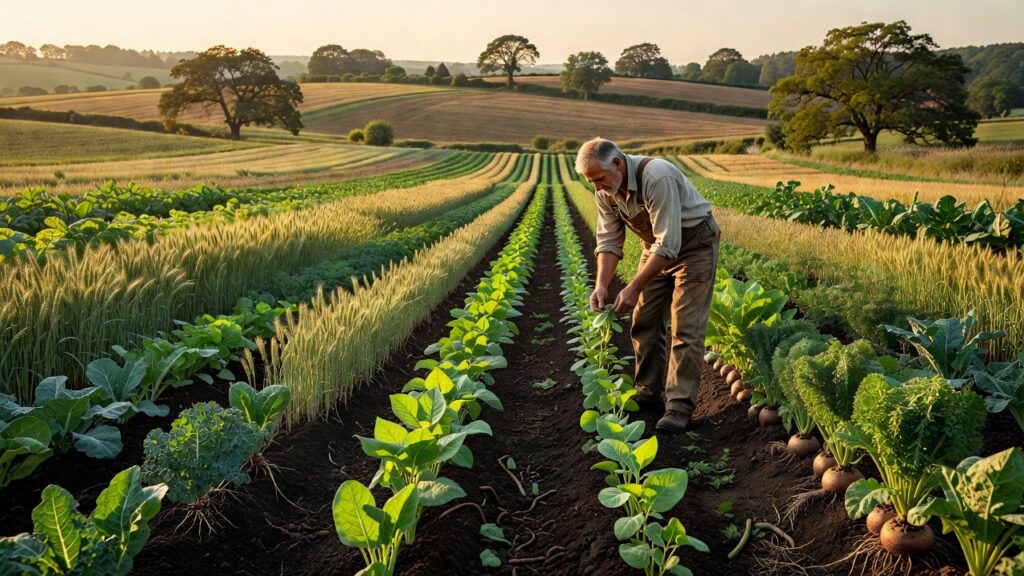
Sustainable agriculture is rarely transformed by a single breakthrough. Instead, it evolves through the accumulation of regulatory nudges, scientific experiments, and market incentives — each one modest on its own, but collectively reshaping how the world grows food. A cluster of recent developments, from Japan’s livestock carbon-credit scheme to algae-based fertiliser trials showing a 21% yield increase, suggests that 2025 could mark a meaningful inflection point for more resilient, lower-impact food systems.
Putting a Price on Methane: Japan’s Carbon-Credit Signal for Livestock
Japan’s Ministry of Agriculture, Forestry and Fisheries has approved a new carbon-credit methodology that allows livestock producers to earn tradeable credits by feeding cattle methane-reducing feed additives. The move is significant because it creates a direct financial incentive for farmers to adopt low-emissions practices — something that voluntary sustainability pledges alone have consistently failed to deliver at scale.
Livestock farming accounts for roughly 14.5% of global greenhouse gas emissions, according to the UN Food and Agriculture Organisation, with enteric fermentation — essentially, cattle burping — responsible for the largest share. Feed additives such as 3-nitrooxypropanol (3-NOP) have demonstrated methane reductions of up to 30% in controlled trials. By embedding these additives into a carbon-market framework, Japan is testing whether economic logic can do what environmental messaging could not.
For Europe, the lesson is instructive. The EU’s Farm to Fork Strategy and the Carbon Removal Certification Framework are both moving toward rewarding farmers for environmental outcomes, but progress has been slow. Japan’s model — simple, measurable, and linked to existing credit markets — offers a template worth studying for European policymakers designing agricultural carbon schemes under the Green Deal.
Bio-Based Inputs and the Quiet Revolution in Agroecology
While carbon markets attract headlines, a quieter revolution is under way in farm inputs. Algae-based fertiliser trials, highlighted by the BBC’s sustainable agriculture coverage, have reportedly delivered yield increases of 21% compared to conventional inputs in early-stage experiments. Algae fertilisers are rich in micronutrients, improve soil microbial activity, and require significantly less energy to produce than synthetic nitrogen fertilisers — whose manufacture alone accounts for around 1–2% of global energy consumption.
This fits squarely within the principles of agroecology: designing food systems that work with natural processes rather than against them. Across Europe, agroecological approaches are gaining institutional support, with the European Commission’s Horizon Europe programme funding research into bio-based inputs, crop rotation, and integrated pest management. If algae fertilisers can be scaled and made cost-competitive, they could meaningfully reduce agriculture’s dependence on fossil-fuel-derived inputs — a key vulnerability exposed by the energy price shocks of recent years.
The broader trend toward nature-based farm inputs also intersects with plant-based food systems. Healthier, more biodiverse soils support the diverse crop varieties that underpin plant-rich diets — closing a loop between how we grow food and what we choose to eat.
Regulatory Pressure: Pesticides, Partnerships, and Supply Chain Sustainability
Regulatory action is tightening on another front. The US Environmental Protection Agency has announced stronger protections governing over-the-top dicamba use on cotton and soybeans for the next two growing seasons. Dicamba, a herbicide notorious for drifting onto neighbouring crops and causing widespread damage, has been the subject of legal battles and scientific controversy for years. Stricter controls signal that regulators are increasingly willing to intervene where agricultural chemicals pose systemic risks — a trend mirrored in Europe by the ongoing revision of the Sustainable Use of Pesticides Regulation (SUR).
Meanwhile, a renewed memorandum of understanding between the EPA and the Pennsylvania Department of Agriculture underscores the importance of cross-agency collaboration in translating sustainability policy into on-farm practice. Outreach, training, and compliance support are often the unglamorous but essential connective tissue between regulation and real-world change — and they matter enormously for supply chain sustainability, particularly as food companies face growing pressure to verify environmental claims across their supplier networks.
Implications for Europe and the Path Ahead
Taken together, these developments point toward a food system in transition, driven by three converging forces: market mechanisms (carbon credits), scientific innovation (bio-based inputs), and regulatory evolution (pesticide controls). Europe is well-positioned to lead on all three — but only if ambition is matched by implementation speed.
- Carbon-credit frameworks for agriculture need clearer rules and farmer-friendly access points.
- Public investment in agroecological research must be sustained and scaled.
- Pesticide regulation must be grounded in science and accompanied by viable alternatives for farmers.
Key takeaway: Sustainable agriculture is no longer a niche aspiration — it is becoming an economic and regulatory reality. The signals arriving from Tokyo, Washington, and European research labs all point in the same direction: the food systems of the future will be lower in emissions, richer in biodiversity, and far more accountable across the supply chain. The question for Europe is not whether to make that transition, but how quickly and equitably it can be done.