EU Green Deal 2025: CBAM Goes Live and ETS2 Expands to Homes and Cars
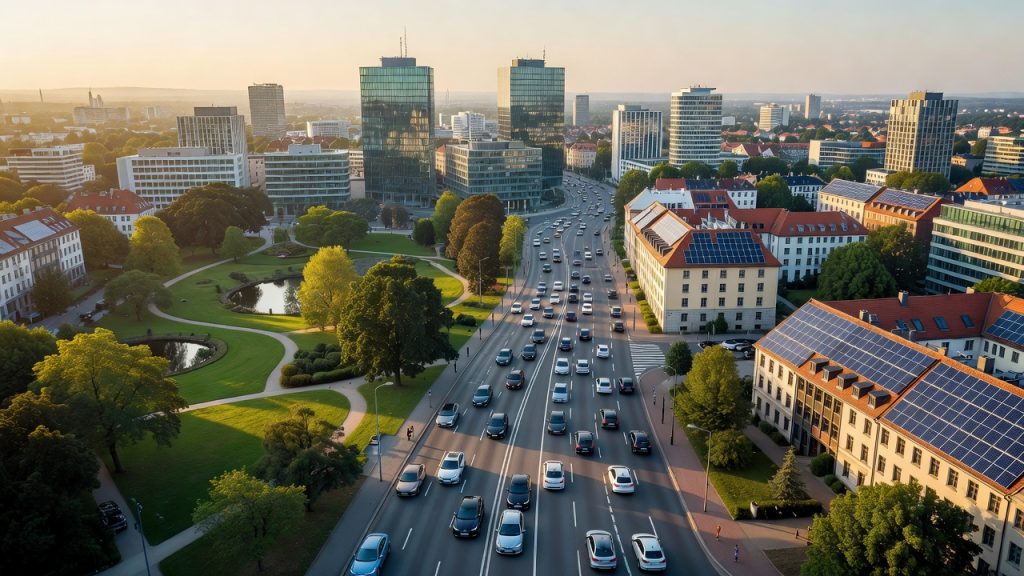
The EU Green Deal — Europe’s flagship framework for reaching climate neutrality by 2050 — is entering one of its most consequential phases. As of early 2025, two landmark carbon market instruments are reshaping the rules of the game: the Carbon Border Adjustment Mechanism (CBAM) is moving toward full operational status by 2026, and the expanded Emissions Trading System (ETS2) now reaches into buildings and road transport for the first time. Together, they mark a decisive shift from policy ambition to economic reality.
CBAM: Putting a Price on Carbon at Europe’s Borders
For years, critics of European climate policy warned of “carbon leakage” — the risk that stricter EU regulations would simply push polluting industries outside the bloc, undermining global emissions reductions. The Carbon Border Adjustment Mechanism is the EU’s direct answer to that concern.
Under CBAM, non-EU manufacturers exporting goods such as steel, cement, aluminium, fertilisers, and electricity to the European market must now account for the carbon embedded in their production processes. If their home country lacks equivalent carbon pricing, they pay a tariff that mirrors the EU carbon price. The mechanism entered its transitional reporting phase in 2023 and is on track to become fully operational by 2026, according to the European Commission.
The global implications are significant. Trading partners from China to India to the United States are watching closely, and some are already accelerating domestic carbon pricing schemes to avoid competitive disadvantage. From a climate policy standpoint, CBAM is arguably the EU’s most ambitious attempt to export its environmental standards — not through diplomacy alone, but through market incentives.
ETS2: Carbon Pricing Comes Home — Literally
While the original EU Emissions Trading System has regulated heavy industry and aviation since 2005, the new ETS2 expands the carbon market to cover buildings and road transport — two sectors that together account for a substantial share of European greenhouse gas emissions but had largely escaped direct carbon pricing until now.
The expansion is expected to generate over €200 billion in revenue for green transition funds, according to data from the Stockholm Environment Institute. A portion of these revenues is earmarked for the Social Climate Fund, designed to cushion the impact on lower-income households who spend a higher share of their income on heating and fuel.
This is where environmental regulation meets social policy — and where tensions are sharpest. Consumer-facing carbon costs on gas heating and petrol are politically sensitive, and several member states have pushed hard for safeguards. Policymakers have responded with an “emergency brake” mechanism, allowing delays in restoration targets under exceptional socioeconomic conditions, alongside exemptions for renewable energy projects and national defence activities.
Green Deal Implementation: Progress, Bottlenecks, and Flexibility
The broader EU Green Deal is showing real legislative momentum, but the road ahead remains complex. As of January 2025, 98 out of 168 Green Deal initiatives have been formally adopted by the European Parliament and Council. Another 37 remain under active negotiation, while only 5 have been withdrawn — a relatively low attrition rate for a package of this scale and ambition.
Still, implementation bottlenecks are real. Sustainability reporting requirements under frameworks like the Corporate Sustainability Reporting Directive (CSRD) are facing pushback from business groups citing compliance costs, while some member states are seeking greater flexibility in meeting nature restoration and emissions targets. The political landscape following the 2024 European elections has also shifted the centre of gravity slightly rightward, adding pressure on the Commission to balance green ambition with economic competitiveness.
What This Means for Citizens, Businesses, and Policymakers
For European citizens, ETS2 will gradually make the carbon cost of heating a home or driving a fossil-fuel car more visible — and more expensive. The Social Climate Fund aims to offset this for vulnerable households, but effective implementation will vary by country.
For businesses, especially those in global supply chains, CBAM introduces new compliance obligations and a strong incentive to decarbonise production. Companies importing into the EU must now integrate carbon market dynamics into their procurement and sourcing strategies.
For policymakers beyond Europe, the message is clear: the EU is no longer willing to absorb the competitive cost of its climate ambition alone. CBAM is a signal that carbon pricing is becoming a structural feature of international trade.
- CBAM fully operational by 2026, covering steel, cement, aluminium, and more
- ETS2 generates €200B+ for green funds; covers buildings and road transport
- 98 of 168 Green Deal initiatives already adopted as of January 2025
- New flexibilities introduced to manage socioeconomic pressures
Key takeaway: The EU Green Deal is no longer just a vision document — it is becoming enforceable economic architecture. Whether Europe can hold its course while managing social tensions and global trade friction will define the credibility of its climate leadership for the decade ahead.