From CO₂ to Concrete: How the World’s First Carbon Refinery Is Rewriting the Rules of Green Innovation
For years, the hardest question in the energy transition has not been how to power a solar panel or charge an electric car — it has been what to do with the industries that cannot simply be unplugged and rewired. Steel mills, cement plants, chemical refineries: these are the stubborn core of our carbon problem. Now, a landmark development from Australia is offering one of the most credible answers yet, and its implications stretch far beyond the Southern Hemisphere.
The Carbon Refinery: Turning Pollution Into Product
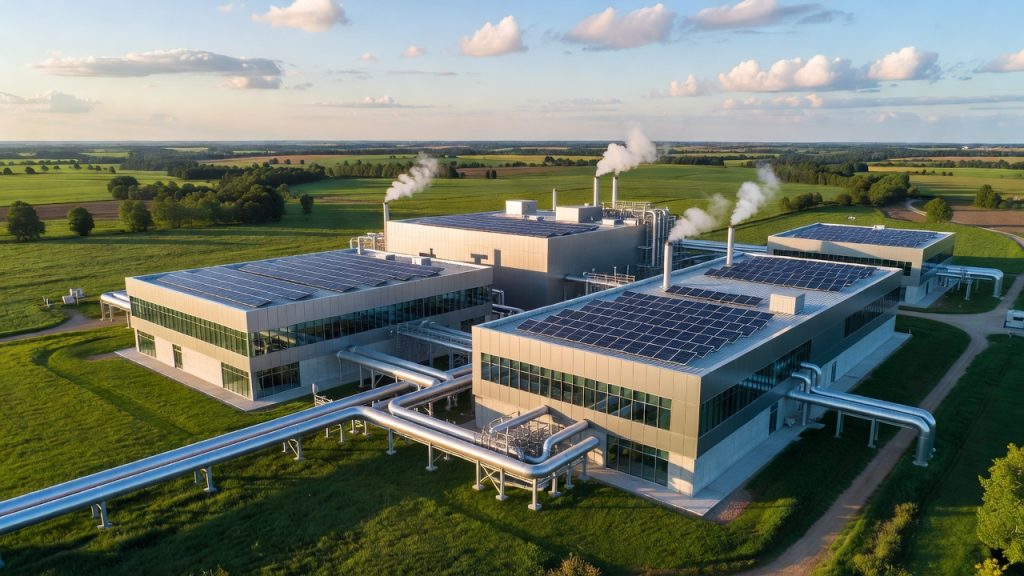
Australia has inaugurated what is officially the world’s first fully integrated carbon refinery — a facility that captures industrial CO₂ emissions and waste materials and converts them directly into construction products. According to reports from Impactful Ninja, the technology can reduce a heavy industry site’s net emissions by up to 90%, while simultaneously generating marketable building materials from what was previously atmospheric pollution.
This is not carbon capture in the traditional sense, where CO₂ is compressed and buried underground with no economic return. This is a circular economy solution that closes the loop between industrial waste and the construction supply chain — two sectors that together account for a significant share of global greenhouse gas emissions. The concept of carbon-negative construction, once a niche ambition in green innovation circles, is beginning to look like a scalable industrial reality.
For Europe, where the Carbon Border Adjustment Mechanism (CBAM) is already reshaping trade incentives and heavy industry faces mounting pressure under the EU Emissions Trading System, this kind of cleantech breakthrough deserves serious attention. If the model proves replicable, it could offer European manufacturers a route to compliance that generates value rather than simply imposing costs.
A Week of Signals: The Cleantech Landscape Is Shifting Fast
The Australian carbon refinery did not emerge in isolation. The same week brought a cluster of developments that together paint a picture of green technology accelerating across multiple fronts:
- A deep geothermal site in Cornwall, England is now generating electricity from heat more than three miles underground, while simultaneously extracting battery-grade lithium — a dual-output model that addresses both clean energy generation and Europe’s critical minerals dependency in a single project.
- An undersea data centre off Shanghai is operating on seawater cooling and offshore wind power, pointing toward a land-efficient, lower-carbon architecture for the AI infrastructure boom that is straining energy grids worldwide.
- A new wave of integrated green energy technologies — including solar panels with built-in storage, hydrogen-powered logistics fleets, and smart microgrids — is gaining commercial traction, with over 70% of medium-sized businesses in North America and Europe planning renewable technology investments before the end of 2026.
These are not isolated pilot projects. They represent a maturing cleantech ecosystem where solutions are converging: storage meets generation, waste meets resource, digital infrastructure meets renewable energy.
The AI Paradox: Innovation’s Carbon Shadow
Against this backdrop of green innovation, one disclosure stands out as a sharp reminder of unfinished business. Microsoft reported a 27% increase in greenhouse gas emissions in its latest fiscal year, driven by the explosive growth of AI infrastructure. Data centres require enormous and continuous power; the computational demands of large language models and AI services are growing faster than the renewable capacity being built to serve them.
This tension is not unique to Microsoft. It is a structural challenge for the entire digital economy, and it makes developments like the Shanghai undersea data centre — and the broader push toward AI-driven energy optimisation for smart cities and grid management — all the more urgent. The same AI systems driving emissions growth are also being deployed to improve wind farm forecasting, optimise smart grid distribution, and accelerate climate modelling. The technology is both the problem and part of the solution.
What This Means for Europe’s Green Transition
Europe enters 2026 with ambitious climate legislation on the books but persistent questions about industrial competitiveness and energy security. The developments of this week suggest that the cleantech market is beginning to answer those questions in practical terms: homegrown lithium from geothermal sites, construction materials made from captured carbon, hydrogen logistics reducing transport emissions, and smart microgrids enabling distributed renewable integration.
The policy environment — from CBAM to the Net-Zero Industry Act — is designed to attract exactly this kind of investment. The challenge now is speed and scale.
Key takeaway: The world’s first carbon refinery is more than a technical milestone — it is a proof of concept that the energy transition can be economically generative, not just economically costly. For citizens, businesses, and policymakers across Europe, the question is no longer whether these technologies work. It is how quickly they can be adopted, adapted, and deployed at the scale the climate requires.