Climate Tech Funding Hits $40.5 Billion in 2025: AI and Deep-Tech Lead the Green Innovation Rebound
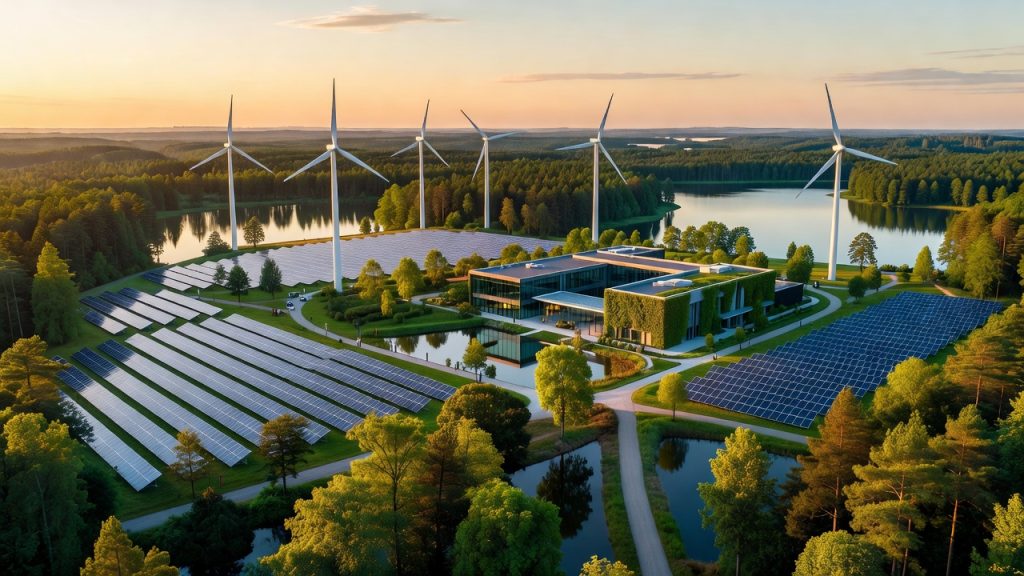
After two difficult years of declining investment, the global climate technology sector has staged a remarkable comeback. In 2025, climate tech funding reached $40.5 billion, backed by a record 179 fund closes and a decisive pivot toward artificial intelligence and deep-tech hardware. For European citizens, policymakers, and green innovators, this rebound is more than a financial headline — it signals a fundamental shift in how the world is approaching the energy transition.
AI Becomes the Engine of Green Innovation
Perhaps the most striking development in this year’s funding landscape is the dominance of AI-enabled climate solutions. Nearly 28% of all climate equity dollars flowed into technologies that integrate artificial intelligence — from grid optimisation and carbon measurement to smart cities infrastructure and predictive climate modelling. Data centres alone attracted close to $2 billion, reflecting the growing recognition that computational power, when deployed responsibly, can accelerate the energy transition rather than hinder it.
This trend carries significant implications for Europe. The EU’s Green Deal and its digital strategy have long positioned the continent as a leader in both cleantech and AI governance. The convergence of these two domains — sometimes called green AI — opens new opportunities for European startups and research institutions to lead in areas such as smart energy management, precision agriculture, and low-carbon industrial automation. However, it also raises urgent questions about the energy footprint of AI infrastructure itself, a debate that European regulators are increasingly taking seriously.
Deep-Tech Breakthroughs: Geothermal and Hardware Make Their Move
Beyond software and data, 2025 has also been a landmark year for hard science. US-based startup Quaise Energy achieved a significant milestone, drilling 118 metres into granite using millimeter-wave energy — a technology that could eventually unlock deep geothermal heat as a reliable, clean baseload power source anywhere on the planet. Unlike solar or wind, geothermal energy is not intermittent, making it a potentially transformative piece of the global energy puzzle.
This kind of deep-tech green innovation is precisely what European energy policy has been calling for. Countries like Iceland have long demonstrated geothermal’s potential, and nations such as Germany, the Netherlands, and Italy are actively exploring their own subsurface resources. Quaise’s drilling progress, though still in early stages, validates the investment thesis that patient capital in hardware and life sciences can yield breakthrough results — a message that Europe’s own deep-tech ecosystem, from France’s Station F to Germany’s Helmholtz centres, would do well to amplify.
Across the Atlantic, Tech Nation unveiled its 2026 UK climate tech cohort: 25 startups that have collectively raised over $220 million, averaging £9 million per company. The cohort spans sectors from electric mobility to circular economy platforms, underscoring that post-Brexit Britain remains a competitive node in the European cleantech network.
Policy as a Catalyst: Lessons for European Decision-Makers
One underappreciated driver of the 2025 rebound is policy clarity. In the United States, the passage of the “One Big Beautiful Bill Act” — despite its controversial name — provided investors with clearer signals on AI infrastructure, domestic materials sourcing, and climate resilience spending. The result was a measurable reallocation of capital toward long-term, policy-aligned assets.
Europe should take note. The EU’s regulatory environment, while ambitious, has sometimes been perceived as uncertain or slow-moving by institutional investors. Accelerating the implementation of the Corporate Sustainability Reporting Directive (CSRD), finalising taxonomy frameworks for green finance, and streamlining permitting for renewable energy projects could unlock a similar wave of investor confidence on this side of the Atlantic. Smart cities, green infrastructure, and carbon measurability tools are all areas where European policy leadership could directly translate into investment flows.
What This Means for Europe’s Green Transition
The $40.5 billion climate tech rebound is a global signal, but its implications are deeply local. For European citizens, it means that the technologies shaping tomorrow’s energy systems — from AI-optimised grids to deep geothermal plants — are moving from laboratory to market faster than many expected. For professionals in cleantech, energy, and urban planning, it highlights where talent and capital are converging. And for decision-makers, it reinforces a simple truth:
- Policy clarity attracts investment. Regulatory certainty is a competitive advantage.
- AI and clean energy are converging. Europe must shape this convergence, not just observe it.
- Deep-tech requires patient capital. Public and private actors must co-invest in long-horizon solutions like geothermal and advanced materials.
Key takeaway: The climate tech funding rebound of 2025 is not a cyclical blip — it reflects a maturing sector where green innovation, artificial intelligence, and policy alignment are increasingly inseparable. Europe has the talent, the ambition, and the regulatory framework to lead this next chapter. The question is whether it will move fast enough to seize it.