Solar and Wind to Overtake Nuclear by 2026: What the IEA Report Means for Europe’s Energy Future
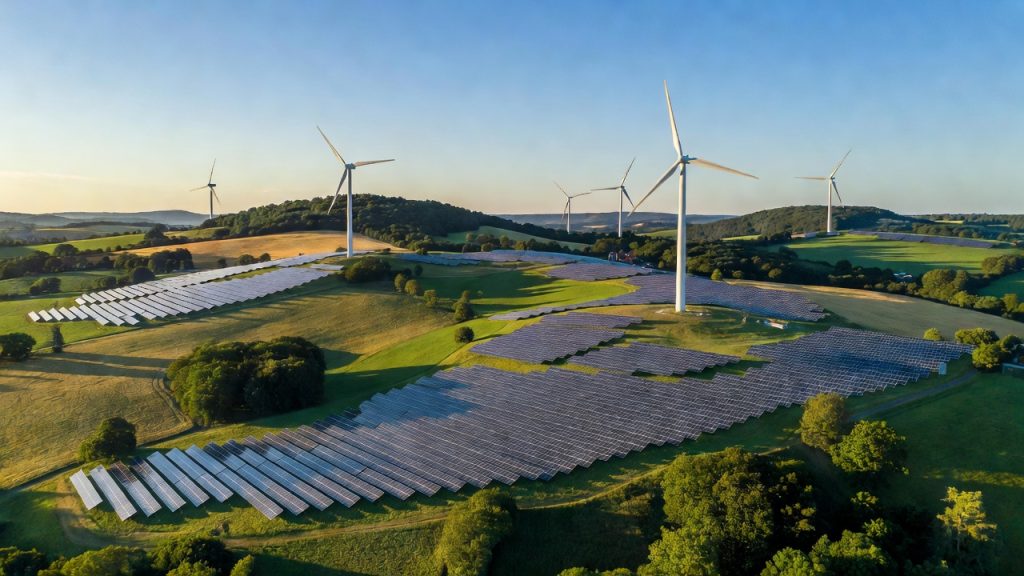
The energy transition is no longer a distant promise — it is arriving ahead of schedule. The International Energy Agency (IEA) has published its annual Renewables Market Report, and the findings are striking: renewables-based electricity generation will overtake coal as early as 2025, while both wind and solar power are each projected to surpass nuclear generation by 2026. For Europe, already deep in the process of reshaping its energy system, the report is both a validation and a call to move faster.
A Tipping Point for Renewable Energy Globally
The IEA’s data paints a picture of accelerating momentum. Solar photovoltaic (PV) is set to become the largest single renewable power source worldwide by 2029, driven by sustained policy support in China, the European Union, the United States, and India. Crucially, the cost of concentrating solar power has dropped by 70% since 2010, making large-scale deployment increasingly viable even in markets with complex grid infrastructure.
Wind energy is following a similarly steep trajectory. Onshore and offshore wind capacity additions are accelerating across multiple continents, although the path is not without obstacles. Norway’s Equinor recently announced it would exit its offshore wind operations in Japan — closing its Tokyo office in 2026 after failing to secure leases in successive government auctions. The episode is a reminder that even well-capitalised European energy companies face significant regulatory and market barriers when expanding internationally. Scaling renewable energy is as much a policy challenge as a technological one.
Europe’s Strategic Response: From Policy to Projects
The European Union is not simply watching these global shifts — it is actively engineering them. Under the Net-Zero Industry Act, the EU has begun awarding strategic project status to key clean energy infrastructure. One of the latest recipients is Bulgaria’s International Power Supply (IPS), recognised for its fully integrated battery energy storage system (BESS). This kind of project is essential: as solar and wind capacity grows, so does the need for flexible, large-scale energy storage to manage intermittency and ensure grid stability.
Meanwhile, innovation is reshaping what solar technology can deliver. Perovskite solar cells — long a subject of laboratory excitement — are moving closer to commercial deployment, with major industry milestones expected in 2025. These next-generation cells promise dramatic efficiency improvements over conventional silicon panels, potentially lowering costs further and expanding the range of surfaces and environments where solar generation is feasible. For dense European urban environments and industrial rooftops alike, this could be transformative.
On the other side of the Atlantic, the US Department of the Interior’s decision to settle with Invenergy affiliates — terminating wind leases and redirecting funds toward domestic geothermal and other energy sources — signals a notable shift in federal resource management priorities. While geothermal remains a niche technology in most of Europe, it holds significant untapped potential in countries like Italy, Iceland, and parts of Central Europe, and deserves greater attention in the continent’s diversified clean energy mix.
The Gap Between Progress and Net-Zero Targets
Despite the encouraging trajectory, the IEA report is explicit: current capacity additions are still insufficient to align with the Net-Zero Emissions (NZE) Scenario required to limit global warming to 1.5°C. The gap between where the market is heading and where it needs to be remains significant. This has direct implications for European policymakers and investors.
- Grid infrastructure must be upgraded urgently to absorb growing volumes of variable renewable energy.
- Energy efficiency measures across buildings, industry, and transport need to accelerate in parallel with supply-side growth.
- Green hydrogen and long-duration storage solutions must scale to decarbonise sectors where direct electrification is difficult.
- Water resource management will become increasingly critical as solar thermal, hydropower, and cooling systems compete for freshwater in a warming climate.
Key Takeaway
The IEA’s 2026 Renewables Report confirms that the global energy transition has reached an irreversible inflection point. Solar and wind are no longer alternative energy sources — they are becoming the backbone of the world’s electricity system. For Europe, the opportunity is clear: lead on technology, policy, and investment to turn these projections into reality. The decade’s defining challenge is not whether renewables will win, but whether they will scale fast enough to matter.