Solar Overcapacity Warnings and Europe’s Storage Surge: What the Latest Clean Energy Signals Mean
The global clean energy transition is accelerating — but not uniformly. Two contrasting signals emerged this week that together reveal the growing complexity of the renewable energy landscape: India’s government is urging financial caution around new solar manufacturing capacity, while Europe is doubling down on grid-scale battery storage and offshore wind. For citizens, businesses, and policymakers, understanding both trends is essential to navigating what comes next.
India Pumps the Brakes on Solar Manufacturing Finance
India’s clean energy ministry has issued a notable advisory to financial institutions, urging caution when financing new solar photovoltaic module manufacturing capacity. The signal reflects growing concern about industrial overcapacity — a risk that has already reshaped global supply chains after China’s dominant position drove module prices to historic lows.
The move is significant for several reasons. First, it suggests that even in a country aggressively expanding its renewable energy base, policymakers are wary of repeating the overinvestment cycles seen elsewhere. Second, it is likely to steer lenders toward projects with stronger balance sheets and clearer demand pipelines, effectively raising the bar for new entrants. Third, it adds a layer of policy risk to what many investors had considered a straightforward growth story in one of the world’s largest solar markets.
For European manufacturers and investors watching India as a potential diversification market away from Chinese supply chains, this is a moment to reassess. The Net-Zero Industry Act is pushing the EU to build domestic clean-tech manufacturing capacity, and understanding where demand signals are genuinely robust — versus where enthusiasm has outpaced fundamentals — is critical to sound resource management.
Europe Accelerates: Offshore Wind Milestones and the Battery Storage Surge
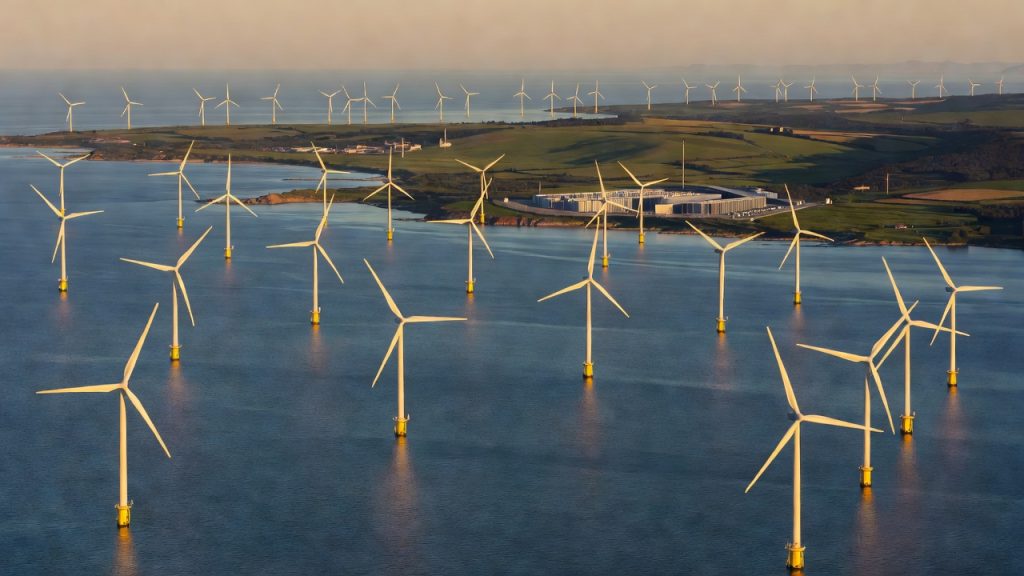
While India recalibrates, Europe is pressing forward at scale. RWE completed the installation of all 100 turbines at its Sofia offshore wind farm, each rated at 14 MW — a landmark moment that underscores the sheer capital commitment now flowing into utility-scale renewables across the continent. Projects of this magnitude are reshaping electricity grids, coastal economies, and long-term energy pricing for millions of households.
Equally important is what is happening alongside generation: grid-scale battery storage is moving from pilot project to mainstream infrastructure. Recent milestones include:
- Greenvolt inaugurating Hungary’s largest operating battery energy storage system, strengthening grid flexibility in Central Europe.
- Eurowind securing construction permits for a hybrid wind-solar park in Romania, combining generation and storage in a single project.
- Mulilo reaching financial close on a 77 MW battery storage system in South Africa — a reminder that the storage revolution extends well beyond European borders.
These developments reflect a maturing understanding: energy efficiency and grid reliability depend not just on how much wind and solar capacity is installed, but on how intelligently that power can be stored and dispatched. Battery storage is becoming the connective tissue of the modern energy system.
The Bigger Picture: Renewables Set to Overtake Coal in 2025
Zooming out, the IEA projects that renewables-based electricity generation will surpass coal globally in 2025 — a historic threshold. Wind and solar are each expected to exceed nuclear output by 2026. These are not distant forecasts; they are near-term realities already shaping investment decisions, electricity prices, and industrial strategy from Brussels to Beijing.
Europe’s challenge is to balance rapid clean-energy expansion with supply-chain competitiveness. Dependence on imported solar panels, critical minerals, and battery components remains a vulnerability — one the Net-Zero Industry Act explicitly seeks to address by supporting domestic manufacturing of technologies including solar, wind, and emerging sectors like hydrogen electrolysers.
What This Means for Businesses, Households, and Policymakers
The convergence of these trends carries practical implications:
- Investors should expect policy signals — from India’s lending advisory to EU industrial strategy — to increasingly shape which clean-tech projects attract capital.
- Energy consumers will benefit from lower and more stable electricity prices as storage smooths out the intermittency of wind and solar generation.
- Policymakers must ensure permitting, grid infrastructure, and water and land-use planning keep pace with the speed of clean energy deployment.
Key takeaway: The clean energy transition is no longer just about building more capacity — it is about building the right capacity, in the right places, backed by credible industrial strategy. Europe’s storage surge and India’s manufacturing caution are two sides of the same coin: a global energy system learning, sometimes painfully, to grow up.