From Targets to Rules: How the EU Green Deal Is Reshaping Business, Energy, and Everyday Life
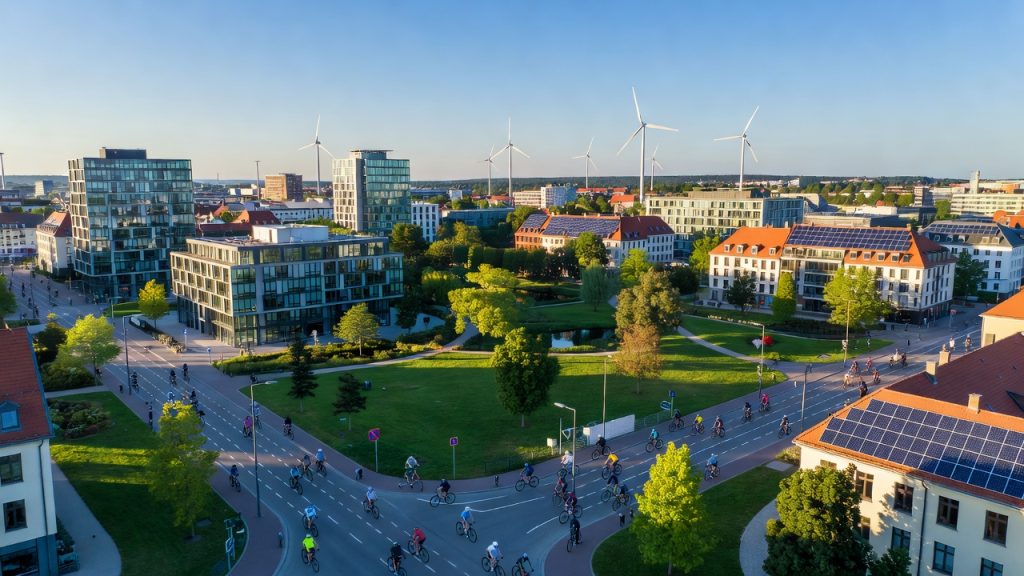
For years, the EU Green Deal was defined by its ambitions: climate neutrality by 2050, a 55% cut in emissions by 2030, a greener industrial base. Those headline numbers still matter. But the real story of 2024 and beyond is different — it is about implementation. The architecture is locked in. Now comes the hard part: making it work across supply chains, energy bills, corporate balance sheets, and city streets.
Carbon Pricing Moves Into Everyday Life
The most consequential near-term shift in EU climate policy is the expansion of carbon markets beyond heavy industry. Under the revised Emissions Trading System (ETS), buildings and road transport fuels will enter the carbon pricing framework from 2027. This means that the cost of heating a home with gas or filling a tank with diesel will increasingly reflect a carbon price — not just the cost of the fuel itself.
This is a structural change. For years, carbon pricing was something that happened in power plants and steel mills, largely invisible to ordinary citizens. The new ETS 2 brings that logic directly into sectors that touch millions of households and small businesses across Europe. To cushion the impact, the EU has established the Social Climate Fund, explicitly designed to support vulnerable households, small businesses, and transport users facing higher costs during the transition. The fund signals that European policymakers are aware of the distributional risks — but its adequacy will be tested as carbon prices rise.
On the industrial side, the Carbon Border Adjustment Mechanism (CBAM) is adding a trade dimension to climate policy, ensuring that imports from countries with weaker carbon rules face equivalent pricing. This is not just an environmental measure — it is a competitiveness tool, and it is reshaping procurement and export strategies for firms inside and outside the EU.
Stricter Rules on Methane, Gases, and Corporate Disclosure
Carbon dioxide is not the only focus. The EU has reached a provisional deal on methane emissions tracking and reduction in the energy sector, a critical move given that methane is responsible for roughly 30% of current global warming. Rules phasing down fluorinated gases — potent warming substances used in refrigeration and air conditioning — are also advancing, tightening the regulatory environment for a wide range of industries.
For companies, the policy direction is equally clear on transparency. The EU’s sustainability reporting and due diligence frameworks are expanding the scope of what businesses must disclose and verify across their value chains. Climate disclosure is no longer a voluntary signal of good intent — it is becoming a compliance requirement that affects financing decisions, procurement relationships, and market access. Firms that treat sustainability reporting as a box-ticking exercise are increasingly exposed to both regulatory and reputational risk.
The EU has also agreed to raise the renewables share to 42.5% of final energy consumption by 2030, with an indicative ambition of 45%, alongside a target to cut final energy consumption by 11.7% by 2030. These are not aspirational figures — they are binding commitments that will drive investment decisions, grid upgrades, and building retrofits across the continent for the rest of the decade.
Simplification and Investment: The New Regulatory Tone
One of the more notable shifts in EU climate policy rhetoric is the growing emphasis on regulatory simplification paired with stricter enforcement. The Commission is aware that the sheer volume of green legislation risks creating compliance fatigue, particularly for smaller firms. Streamlining reporting requirements and aligning timelines is now part of the political conversation — without, at least officially, weakening the underlying targets.
At the same time, clean industrial competitiveness has become a dominant narrative. Innovation funds, transition support mechanisms, and investment frameworks for low-carbon technologies are increasingly presented alongside regulatory requirements — a recognition that the stick alone is not enough. The EU’s long-term goal of a 90% emissions reduction by 2040, now proposed as an intermediate milestone toward 2050 neutrality, signals that the policy tightening cycle is far from over.
What This Means for Citizens, Businesses, and Policymakers
- Households will feel the Green Deal most through energy prices and transport costs, with support mechanisms available but unevenly distributed across member states.
- Companies face a convergence of carbon pricing, disclosure obligations, and supply-chain accountability that makes climate strategy a core business function, not a communications exercise.
- Policymakers at national and local level must translate EU frameworks into practical measures — on retrofitting, public transport, renewable deployment — or risk missing both targets and public trust.
The key takeaway: The EU Green Deal has moved from vision to enforcement. The rules are real, the timelines are set, and the costs of inaction — regulatory, financial, and physical — are rising. For anyone operating in Europe, understanding this policy landscape is no longer optional.