Batteries, Wind, and Solar Break Records: What the Clean Energy Surge Means for Europe and Beyond
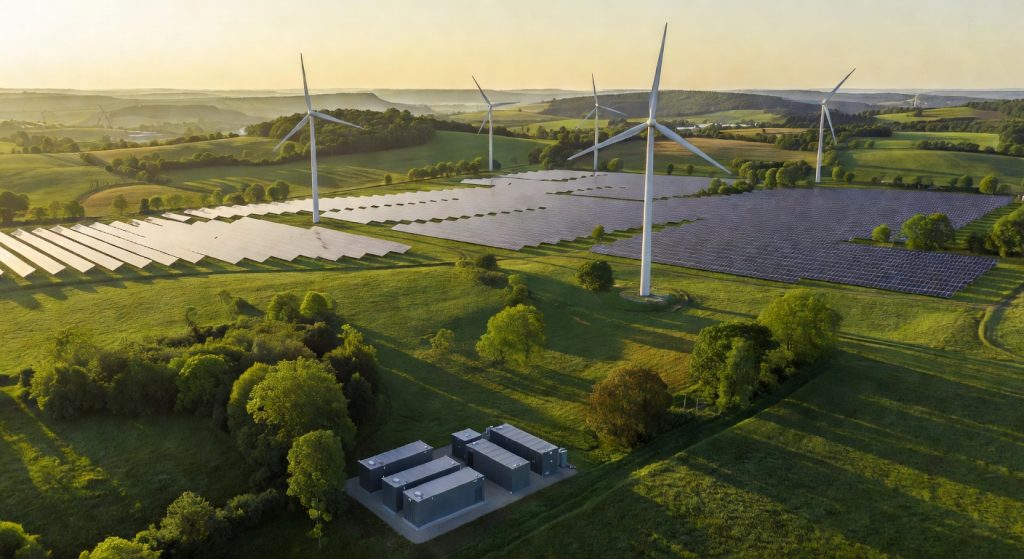
Something significant is happening across the world’s power grids. From the sun-baked plains of Australia to the wind corridors of Texas, renewable energy systems are breaking records — and this time, the story is not just about how much clean power is being generated, but about how well grids are learning to handle it. For European citizens, businesses, and policymakers, the signals are both encouraging and instructive.
Record-Breaking Grids: Storage and Wind Lead the Way
Australia’s main electricity grid recently set new benchmarks for wind energy output alongside fresh peaks in large-scale battery charging and discharging. This dual record matters because it addresses one of the central challenges of the energy transition: variability. Solar and wind produce power when nature allows, not necessarily when demand peaks. Battery storage bridges that gap, absorbing surplus renewable energy and releasing it when it is needed most — reducing costly curtailment and improving grid reliability for consumers.
Across the Pacific, Texas is on track for utility-scale solar to surpass coal in electricity generation within its main grid by 2026. In a state long defined by fossil fuel production, this is a remarkable market shift. It signals that the business case for renewables is no longer a future projection — it is an operational reality reshaping fuel demand and investment decisions in one of the world’s largest energy markets.
Europe’s Industrial Policy Bets on Domestic Clean Tech
Europe is watching these global developments closely — and acting. Under the EU Net-Zero Industry Act, Bulgaria-based IPS recently received strategic project status for its X-BESS battery energy storage system. This designation is more than symbolic. It reflects a deliberate industrial policy choice: Europe wants to build its own clean-technology supply chains rather than depend on imports for the batteries and components that underpin the energy transition.
The move is part of a broader pattern. As grid-scale storage becomes central to integrating higher shares of solar and wind, the ability to manufacture batteries domestically becomes a question of both economic competitiveness and strategic resilience. For European businesses and investors, strategic project status under the Net-Zero Industry Act can unlock faster permitting, access to public financing, and stronger visibility in procurement processes.
Meanwhile, the hydrogen economy continues to take concrete shape. Air Liquide has taken a final investment decision on a 200-MW electrolyser project in Rotterdam, with TotalEnergies signed on as offtaker. This is one of the largest green hydrogen commitments in Europe to date, and it demonstrates that long-term offtake contracts — agreements where buyers commit to purchasing output in advance — can unlock the capital needed for major industrial decarbonisation infrastructure. Rotterdam, as Europe’s largest port and a critical hub for energy-intensive industry, is a telling location for this kind of investment.
What This Means for Resource Management and Energy Efficiency
The convergence of these developments points to a maturing clean energy system, one where resource management is becoming as important as generation capacity. Smarter grids, larger batteries, and better forecasting tools are reducing waste — both of energy and of capital. For households and businesses, this translates into more stable electricity prices and a lower risk of blackouts during periods of high renewable output or demand spikes.
There are broader environmental co-benefits too. Reduced curtailment means less wasted renewable generation. More efficient energy storage and distribution eases pressure on water-intensive thermal backup plants. And as green hydrogen scales up, it opens pathways to decarbonise sectors — steel, chemicals, shipping — where direct electrification remains difficult.
- Grid-scale batteries are reducing curtailment and improving reliability across multiple continents.
- Solar energy is on track to overtake coal in Texas by 2026 — a major market signal.
- EU industrial policy is prioritising domestic battery and electrolyser manufacturing for supply-chain resilience.
- Green hydrogen investment in Rotterdam shows industrial decarbonisation is moving from pilot to scale.
Key takeaway: The clean energy transition is no longer waiting for technology to catch up — it is waiting for policy, investment, and infrastructure to move at the same pace. Europe has the tools and the frameworks. The records being set today in Australia and Texas are a preview of what integrated, storage-backed renewable grids can deliver. The question for Europe is not whether to build this future, but how quickly.