Green Tech at a Crossroads: How the EU’s 90% Climate Target Is Reshaping Innovation
The European Union has just locked in one of the most ambitious climate commitments in its history: a legally binding target to cut greenhouse-gas emissions by 90% by 2040, compared to 1990 levels. Approved by EU member states and reported by Reuters, this milestone does more than set a political direction — it sends a clear, long-term signal to industries, investors, and innovators that the energy transition is no longer optional. For the green technology sector, it is both a challenge and an extraordinary opportunity.
From Policy Signal to Market Reality: Where Green Innovation Is Heading
The 2040 target sits between the EU’s current 2030 goal (a 55% net emissions reduction under the Fit for 55 package) and the overarching 2050 climate neutrality objective. Bridging that gap will require a dramatic scaling of cleantech solutions across every sector of the economy.
According to current innovation trends, green-tech development is concentrating in five critical areas:
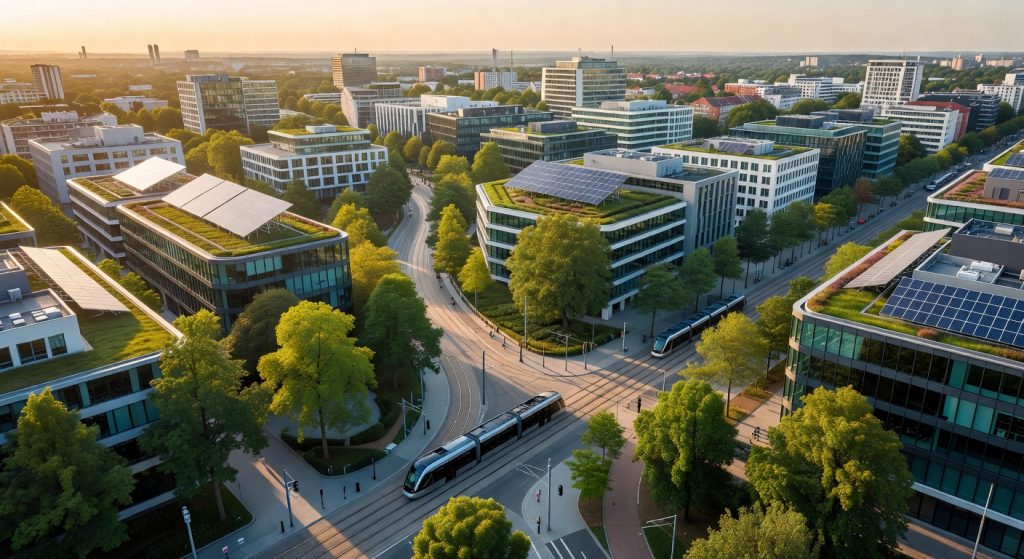
- Low-carbon construction and smart buildings — adaptive glazing, building-energy optimization systems, and heat and wastewater recovery technologies are already reducing electricity use and operating costs in offices, homes, and public infrastructure.
- Long-duration energy storage — essential for balancing grids increasingly powered by variable renewables like wind and solar.
- Carbon capture and utilization (CCU) — moving from pilot projects to commercial deployment, with systems capturing industrial emissions and converting them into usable products.
- Hydrogen transport infrastructure — positioning green hydrogen as a fuel for hard-to-electrify industries and heavy mobility.
- Circular-economy solutions — redesigning supply chains to eliminate waste and embed recycled or carbon-negative materials into manufacturing.
These are not distant concepts. They are being deployed today, and the 90% target will accelerate their commercial rollout significantly over the next 15 years.
Smart Buildings and Carbon Capture: The Near-Term Climate Levers
Two areas stand out as particularly actionable in the short-to-medium term: smart building technologies and carbon capture and utilization.
Buildings account for roughly 40% of energy consumption and 36% of CO₂ emissions in the EU, according to the European Commission. Smart building technologies — from AI-driven energy management platforms to advanced insulation and dynamic window systems — are emerging as one of the most cost-effective demand-side levers available. For urban planners and property developers, this aligns directly with the EU’s revised Energy Performance of Buildings Directive (EPBD), which mandates progressive renovation standards across the continent. In the context of smart cities, connected building infrastructure is becoming a foundational layer of urban climate strategy.
Meanwhile, carbon capture and utilization is quietly crossing the threshold from concept to commerce. Industrial sites — particularly in steel and cement, sectors notoriously difficult to decarbonize — are now deploying CCU systems that capture emissions at the source and convert them into materials such as synthetic fuels, aggregates, or chemical feedstocks. This creates a practical pathway for heavy industry to reduce its footprint without waiting for full electrification, which may take decades in some sub-sectors.
One notable policy wrinkle: the EU recently dropped plans for an emissions label for steel in its upcoming ‘Made in Europe’ legislation. While broader green-industrial ambitions remain intact, this decision may slow the explicit rewarding of low-carbon steel in public procurement and industrial policy — a missed opportunity to use market signals to drive faster decarbonization in one of Europe’s most carbon-intensive industries.
Implications for Businesses, Citizens, and Decision-Makers
The 90% target is not an abstract number. It translates into concrete changes across the economy:
- For businesses: Accelerated pressure to decarbonize operations, electrify fleets and processes, and audit supply chains for carbon intensity. Companies that invest early in green innovation and low-carbon infrastructure will gain competitive advantage as regulatory requirements tighten.
- For citizens: Deeper shifts in transport (the rise of electric mobility), housing (renovation incentives and energy efficiency standards), and the cost of everyday goods as industries adapt.
- For decision-makers: A policy environment that rewards long-term investment in the energy transition — but also demands coherence. Dropping the steel emissions label while championing industrial decarbonization risks sending mixed signals to markets.
Key takeaway: The EU’s 2040 climate target is the most powerful accelerant the European green-tech sector has ever received. From smart buildings reducing urban energy demand to carbon capture enabling industrial transformation, the technologies needed to reach 90% emissions cuts already exist in early commercial form. The task now is scale — and the policy, investment, and public will to get there. Europe has set the destination; the race to build the infrastructure is already underway.