From Pilot to Mainstream: How Green Technology Is Reshaping Europe’s Energy and Cities in 2026
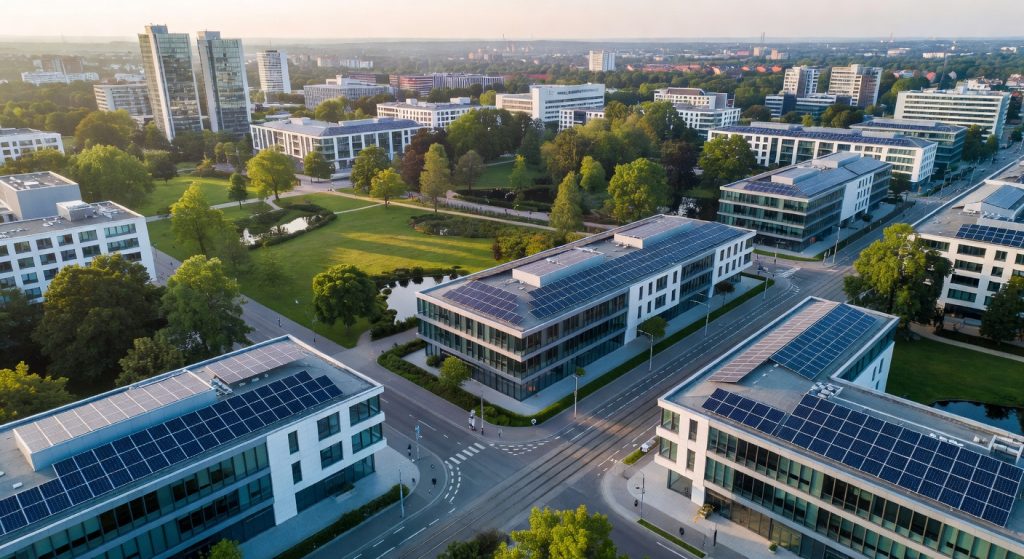
Something significant shifted in the cleantech landscape as 2026 got underway. For years, green technology lived in the realm of promising pilots, carefully managed demonstrations, and cautious institutional trials. That era is ending. Across Europe and beyond, integrated clean solutions are moving into mainstream deployment — and the pace is accelerating faster than many analysts predicted.
This is not just a story about technology. It is a story about commercial readiness meeting policy pressure, about cities and businesses discovering that cutting emissions and cutting costs are increasingly the same decision. From solar-paired storage systems to hydrogen-powered logistics fleets, the infrastructure of a low-carbon economy is being built in real time.
Integrated Energy Systems: Solar, Storage, and the Rise of Smart Microgrids
The most immediate signal of this shift is the rapid uptake of solar-plus-storage systems combined with smart microgrids. Where solar panels alone once represented the ceiling of local ambition, municipalities, businesses, and even individual households are now deploying integrated systems that store excess generation and distribute it intelligently across local networks.
Smart microgrids — small-scale, locally managed energy grids — are proving especially valuable for resilience. In regions prone to grid instability or extreme weather events, decentralized energy systems offer a practical buffer. For European cities pursuing both energy security and climate targets, this convergence of green innovation and infrastructure logic is compelling. The EU’s REPowerEU plan, which targets 600 GW of solar capacity by 2030, is providing significant policy tailwind for exactly these kinds of integrated deployments.
Meanwhile, AI-enabled sustainability tools are being layered on top of physical infrastructure. Predictive algorithms now help grid operators anticipate demand spikes, optimize storage dispatch, and reduce waste — turning smart cities from a concept into operational reality across urban centers from Amsterdam to Milan.
Hydrogen and Low-Carbon Construction: Two Sectors Crossing a Critical Threshold
Beyond electricity, green hydrogen is gaining serious traction in sectors where direct electrification remains difficult. Logistics is an early proving ground: hydrogen-powered heavy freight vehicles are entering commercial fleets in Germany, the Netherlands, and Scandinavia, offering a cleaner alternative for long-haul transport where battery weight and charging infrastructure create real constraints.
The European Hydrogen Bank, launched by the European Commission, is channeling investment toward green hydrogen production — prioritizing electrolytic hydrogen produced from renewable sources. While costs remain higher than fossil-based alternatives, the gap is narrowing, and scale is beginning to do its work.
In construction — one of the most emissions-intensive sectors globally — low-carbon materials are moving from laboratory curiosity to specification sheet. CO2-injected concrete, which permanently sequesters carbon dioxide within the material itself, and carbonated aggregates are being adopted in infrastructure projects across Europe. Embodied carbon, long ignored in favor of operational energy efficiency, is now a live concern for architects, developers, and procurement teams responding to tightening regulation under the EU’s Construction Products Regulation.
Circular Economy and the Materials Revolution
Underpinning many of these shifts is a broader rethinking of how materials flow through the economy. Circular economy principles — designing products for disassembly, reuse, and recycling — are reshaping sectors from electronics to packaging. Biodegradable plastics and electronics designed with end-of-life in mind are entering markets at scale, driven partly by EU legislation such as the Ecodesign for Sustainable Products Regulation.
Waste-to-energy solutions are also maturing, offering cities a way to extract value from residual waste streams while reducing landfill dependency. These are not perfect solutions — critics rightly note the hierarchy that places reduction and reuse above energy recovery — but as part of an integrated system, they represent meaningful progress.
What This Means for Citizens, Businesses, and Policymakers
The implications of this transition from pilot to mainstream are substantial. For citizens, decentralized energy systems and smarter buildings mean lower bills, greater energy independence, and more resilient communities. For businesses, the commercial case for cleantech adoption is strengthening: lower operating costs, regulatory compliance, and competitive differentiation in markets where sustainability credentials increasingly matter. For policymakers, the challenge is shifting from stimulating early adoption to managing rapid scaling — ensuring supply chains, grids, and skills keep pace with deployment.
The key takeaway is straightforward: green technology in 2026 is no longer waiting for permission to go mainstream. The energy transition, smart city infrastructure, and circular economy are converging into an integrated system that is commercially viable, politically supported, and increasingly irreversible. Europe’s role — as both a regulatory pioneer and an innovation hub — positions it to lead this next phase. The question now is not whether the transition happens, but how equitably and efficiently it unfolds.