Renewable Energy Is Booming — But Grids, Permits, and Recycling Are Holding It Back
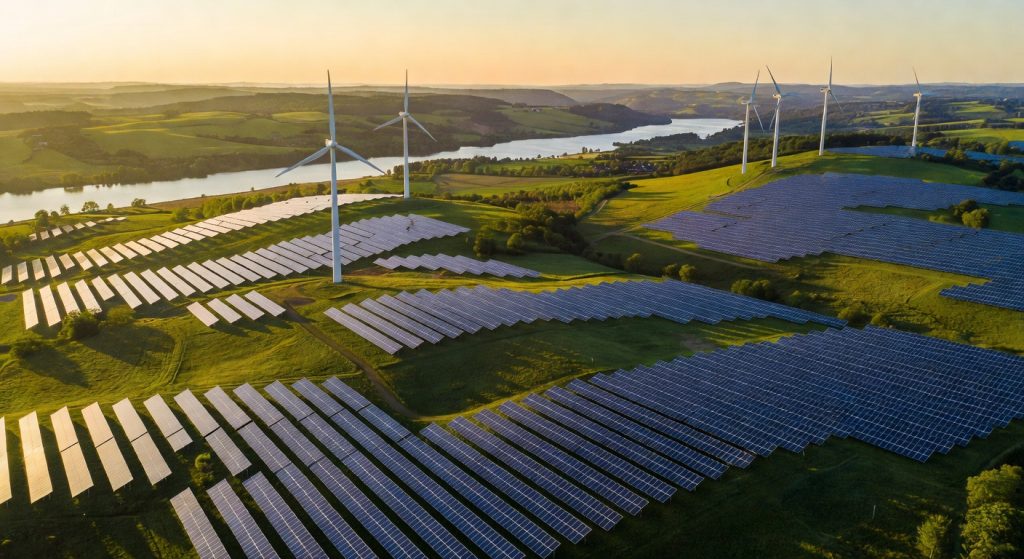
The global clean-energy transition is accelerating at a pace few predicted even five years ago. Solar panels are multiplying across rooftops and deserts, offshore wind farms are reshaping coastlines, and investments in green hydrogen and battery storage are reaching record levels. Yet beneath this impressive momentum, a more complex picture is emerging — one where the barriers to a fully clean power system are no longer just about building enough turbines and panels, but about connecting them, permitting them, and eventually disposing of them responsibly.
Solar and Wind Lead the Charge — With Milestones Worth Noting
The numbers tell a striking story. In the United States, the Energy Information Administration (EIA) projects that utility-scale solar will surpass coal generation in Texas for the first time in 2026 — a landmark moment for one of the world’s largest and historically fossil-fuel-dependent power systems. This shift reflects a broader trend: solar is now often the cheapest source of new electricity generation globally, and deployment is outpacing even optimistic forecasts.
In Europe, the momentum is equally strong. Major announcements in battery storage and electrolyser manufacturing — particularly in the Netherlands and across the EU — signal that the continent is moving beyond generation capacity alone and investing in the infrastructure needed to make renewable energy reliable around the clock. Green hydrogen, produced by splitting water using clean electricity, is emerging as a critical tool for decarbonising hard-to-electrify sectors like heavy industry and shipping. These electrolyser investments are a direct bet on hydrogen’s role in Europe’s long-term energy mix.
The Hidden Bottlenecks: Grids, Permits, and the Irish Example
Despite the growth headlines, industry insiders and policymakers are increasingly focused on a set of structural challenges that risk slowing the transition. Grid connection and permitting have quietly become as important as generation capacity itself — and in many countries, they are the binding constraint.
Ireland offers a telling case study. The country has some of the best offshore wind resources in Europe, with Atlantic winds capable of generating clean power far exceeding domestic demand. Yet progress on offshore wind development remains frustratingly slow, hampered by lengthy permitting processes, grid upgrade delays, and uncertainty over long-term investment frameworks. Ireland is not alone: similar bottlenecks affect projects across Germany, Italy, and beyond, where planning rules designed for a different energy era are struggling to keep pace with the speed of the clean-energy buildout.
Long-duration energy storage — the ability to store surplus solar and wind power for days or even weeks, not just hours — is another emerging priority. Current lithium-ion battery technology handles short-term grid flexibility well, but seasonal storage remains largely unsolved at scale. This is where green hydrogen and other long-duration technologies, such as iron-air or flow batteries, are attracting growing attention and capital.
The Circular Economy Problem No One Wants to Talk About
There is a third challenge that is only beginning to receive the attention it deserves: what happens to renewable energy infrastructure at the end of its life. Wind turbine blades, typically made from fibreglass composites, are notoriously difficult to recycle. As the first generation of large-scale wind farms reaches the end of its operational life — often 20 to 25 years — thousands of blades are being decommissioned, and most end up in landfill.
This is not a minor issue. It touches the credibility of the entire renewable sector and raises serious questions about resource management and waste. Several European companies and research institutions are working on chemical recycling processes and new blade materials designed for circularity, but scalable solutions are not yet commercially widespread. The EU’s push for a circular economy framework will need to explicitly address this gap if wind energy is to be genuinely sustainable from cradle to grave.
What This Means for Citizens, Businesses, and Policymakers
For citizens, the near-term implication is that cleaner, cheaper electricity is coming — but the timeline depends heavily on decisions made today about grid investment and planning reform. For businesses, the opportunities are expanding rapidly: project development, storage manufacturing, energy efficiency services, and circular economy solutions for end-of-life assets are all growth areas. For policymakers, the message is clear: permitting reform, grid investment, and circular economy regulation are no longer secondary concerns — they are the frontline of the energy transition.
- Grid and permitting reform must accelerate to match the pace of renewable deployment
- Long-duration storage and green hydrogen need scaled investment now to be ready when needed
- Turbine blade recycling and circular design must become industry standards, not afterthoughts
- European leadership in clean-energy manufacturing can strengthen both climate goals and strategic autonomy
The clean energy transition is real and unstoppable — but its speed and sustainability depend on solving the unglamorous problems that come after the ribbon-cutting. Getting the infrastructure, regulation, and circular economy right is not a footnote to the energy story. It is the story.