Climate Science Is Clear: The World Must Cut Emissions Now or Pay a Far Higher Price Later
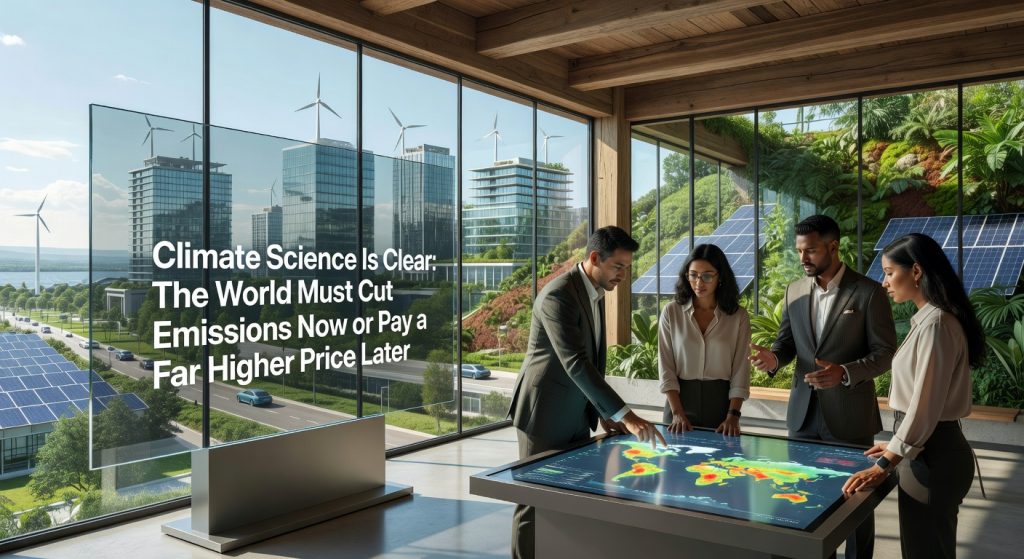
The scientific consensus has never been stronger — or more urgent. Leading climate institutions, from the Intergovernmental Panel on Climate Change (IPCC) to NASA and NOAA, are delivering a unified message: human-caused warming is accelerating, its impacts are already reshaping daily life, and the window for effective action is narrowing fast. For Europe and the wider world, this is not a distant warning. It is a present-tense reality with direct consequences for environmental policy, economic planning, and the health of ecosystems we all depend on.
What the Science Is Actually Telling Us
The IPCC has confirmed that human activity has already warmed the planet by approximately 1.1°C above pre-industrial levels. Without rapid, sustained cuts in greenhouse gas emissions, global temperatures are likely to reach or exceed the critical 1.5°C threshold within the coming decades — a limit that scientists associate with significantly heightened risks of extreme weather, biodiversity loss, and ecosystem collapse.
NASA and NOAA data reinforce this picture with striking detail. The Arctic is warming at nearly four times the global average rate, accelerating sea ice loss and glacier melt that contribute directly to rising sea levels. Extreme heat events — once considered statistical outliers — are becoming more frequent and more intense across every inhabited continent. Drought, wildfire risk, and water scarcity are no longer future projections; they are current, measurable trends disrupting agriculture, infrastructure, and public health from the Mediterranean to Central Europe.
The Paris Agreement framework, which commits signatory nations to keeping warming well below 2°C and ideally to 1.5°C, remains the cornerstone of global climate governance. But ambition on paper must translate into verified emissions reductions on the ground — and the gap between pledges and action remains dangerously wide.
Europe at the Intersection of Risk and Opportunity
Europe is both highly exposed to climate impacts and uniquely positioned to lead the response. The continent experienced its hottest summer on record in 2023, with heat-related mortality, crop failures, and river droughts underscoring just how vulnerable even wealthy, well-governed societies can be. Biodiversity loss compounds the crisis: the EU’s own assessments show that many protected habitats and species are in unfavourable conservation status, weakened by a combination of pollution, land-use change, and a shifting climate.
At the same time, Europe’s clean-energy transition is gathering momentum. Renewable energy — particularly solar and wind — now accounts for a growing share of the EU’s electricity mix, driven by both climate ambition and the hard lesson of energy security exposed by the 2022 energy crisis. The European Green Deal and its associated legislation, including the Fit for 55 package, set legally binding targets for emission reductions and frame the low-carbon economy not merely as an environmental imperative but as an industrial and competitive strategy.
This dual framing matters. When renewable energy investment is linked to job creation, energy independence, and lower consumer costs, it builds broader political coalitions — essential for sustaining the long-term environmental policy commitments that climate science demands.
What This Means for Businesses, Citizens, and Decision-Makers
The accelerating pace of climate change is translating into concrete economic and social pressures that can no longer be treated as externalities:
- Insurance and infrastructure costs are rising as extreme weather events become more frequent, with some European regions already facing difficulties obtaining affordable coverage.
- Supply chain disruption linked to heat stress, water scarcity, and crop risk is forcing companies to reassess sourcing strategies and invest in resilience planning.
- Adaptation finance is emerging as a critical policy priority, both within Europe’s regions and in support of climate-vulnerable nations whose emissions are minimal but whose exposure is severe.
- Net-zero planning is shifting from voluntary commitment to regulatory expectation, with EU sustainability reporting rules (CSRD) requiring large companies to disclose climate risks and transition strategies.
The Key Takeaway
The science is not ambiguous, and the costs of inaction are no longer abstract. Every fraction of a degree of warming avoided translates into measurable reductions in human suffering, biodiversity loss, and economic damage. For Europe, the path forward runs through faster emissions cuts, smarter environmental policy, accelerated renewable energy deployment, and serious investment in adaptation. The institutions have spoken clearly. The question now is whether political will and public pressure can match the scale of the challenge — before the margin for manoeuvre closes entirely.