Clean Energy at a Crossroads: Policy Risks, Carbon Removal, and the Race to Scale Green Innovation
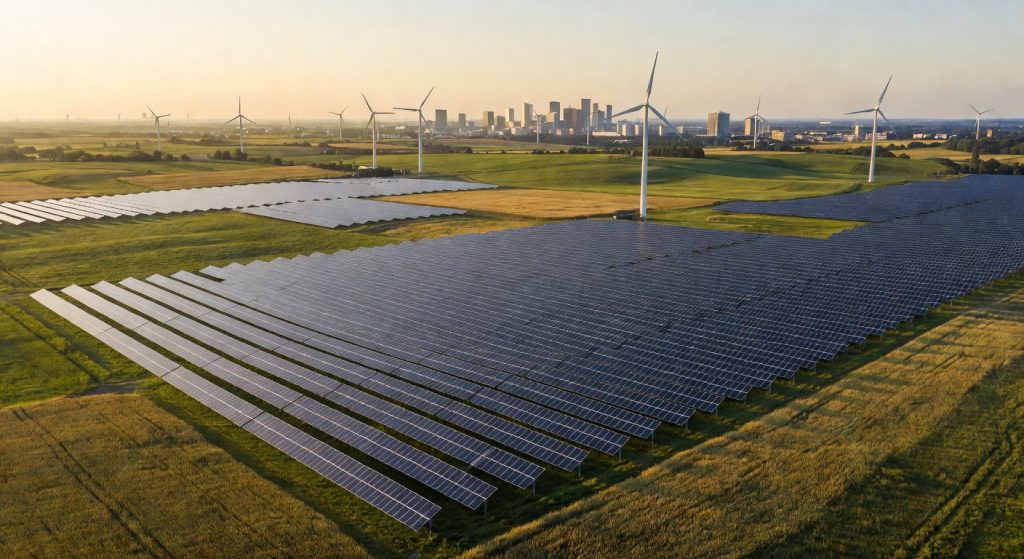
The global energy transition has never moved faster — and yet it has rarely felt more fragile. Across the world, record solar installations, booming electrolysis capacity, and surging corporate demand for carbon removal are painting a picture of unstoppable momentum. At the same time, policy turbulence — particularly from the United States — is casting a long shadow over clean-energy investment pipelines, reminding us that green technology alone cannot secure the transition. Political will matters just as much as engineering.
For European citizens, professionals, and policymakers watching these developments, the message is both cautionary and clarifying: the energy transition is real and accelerating, but its pace and fairness depend heavily on the regulatory environments we build around it.
Policy Uncertainty: The Hidden Risk Inside the Clean-Energy Boom
One of the clearest signals emerging from recent coverage is that permitting and policy risk remains one of the most significant barriers to clean-energy deployment — not technology, and not cost. In the United States, federal actions are reportedly blocking or delaying a substantial pipeline of renewable energy projects, putting billions in invested capital at risk and slowing the addition of gigawatts that were already in development.
This is not merely an American problem. Europe knows this challenge intimately. Despite the EU’s ambitious REPowerEU targets — aiming for 600 GW of solar capacity by 2030 — permitting bottlenecks have consistently been identified as a primary obstacle. The European Commission’s push to streamline permitting through the Net-Zero Industry Act and revised Renewable Energy Directive (RED III) is a direct response to this reality, setting maximum permitting timelines and designating renewable energy as an overriding public interest.
The lesson is structural: cleantech investment follows regulatory certainty. When governments signal instability — through policy reversals, subsidy uncertainty, or administrative delays — capital slows or redirects. Europe’s comparative advantage right now is the credibility of its long-term policy framework, and protecting that credibility is itself a form of green innovation.
Carbon Removal Markets: Corporate Demand Comes of Age
A quieter but significant development in recent weeks involves the carbon removal sector. Reports indicate that at least one major technology company has resumed or expanded its procurement of durable carbon removal credits after a period of pause — a signal that corporate climate commitments are maturing beyond simple offsetting toward investment in green innovation with long-term permanence.
Durable carbon removal — including direct air capture (DAC), enhanced weathering, and biochar — is an area where European startups and research institutions are increasingly competitive. Companies like Climeworks (Switzerland) and a growing ecosystem of industrial-scale DAC developers are positioning Europe as a leader in this emerging market. The voluntary carbon market, despite its controversies, is evolving: buyers are demanding higher-quality, verifiable removals, and that quality bar is pushing innovation forward.
For smart cities and industrial clusters across Europe, this matters practically. Carbon removal procurement is becoming a tool for hard-to-abate sectors — steel, cement, chemicals — to credibly reach net-zero targets. The growth of this market creates new revenue streams for green-tech developers and new decarbonization pathways for industries that cannot electrify easily.
Solar, Electrification, and the Industrial Decarbonization Surge
Zoom out to the global picture and the scale of clean-energy deployment is genuinely remarkable. China and India continue to install solar at record pace, with China alone expected to add over 200 GW of solar capacity in a single year — a figure that would have seemed implausible a decade ago. Green ammonia, electrolysis, and hydrogen-based industrial processes are moving from pilot scale toward commercial deployment across Asia, the Middle East, and Europe.
Electric mobility continues its expansion, with EV sales in Europe holding strong despite some market softening in specific segments. The broader electrification of transport, heating, and industry is creating new demand signals that are, in turn, justifying further investment in grid infrastructure, battery storage, and smart energy management — the connective tissue of the modern green technology ecosystem.
- Solar: Global capacity additions breaking annual records consecutively
- Green hydrogen: Electrolyser manufacturing scaling rapidly in Europe and Asia
- Electric mobility: EV infrastructure investment accelerating across EU member states
- Carbon removal: Corporate procurement shifting toward durable, high-quality solutions
Implications for Europe: Opportunity Inside the Uncertainty
The convergence of these trends presents Europe with a clear strategic opportunity — but only if it acts on it. Policy instability elsewhere is a competitive advantage for regions that can offer stable, long-term frameworks for clean-energy investment. The EU’s Green Deal Industrial Plan and state-aid flexibility are designed precisely to capture this moment.
Fresh scientific reporting on record heat events and underestimated sea-level rise only reinforces the urgency. The physical risks of inaction are no longer abstract projections — they are present-tense economic and social realities that should be sharpening, not softening, political ambition.
Key takeaway: Green technology and cleantech innovation are scaling faster than most forecasts predicted. The bottleneck is no longer invention — it is deployment, and deployment depends on policy courage. Europe has the frameworks; the task now is to defend and accelerate them, even as global headwinds test the resolve of the broader transition.