From Giant Batteries to Zero-Carbon Cement: The Green Tech Breakthroughs Reshaping the Energy Transition
The energy transition is no longer a distant promise — it is an engineering challenge being solved in real time, on multiple fronts simultaneously. From a record-breaking battery activated in the Australian outback to a pilot plant converting CO₂ directly into gasoline, the pace of green technology innovation is accelerating in ways that matter for businesses, policymakers, and citizens alike. This week’s developments offer a telling snapshot of where cleantech stands today — and where the hard work still lies ahead.
The Storage Revolution: Australia’s Giant Battery Points the Way
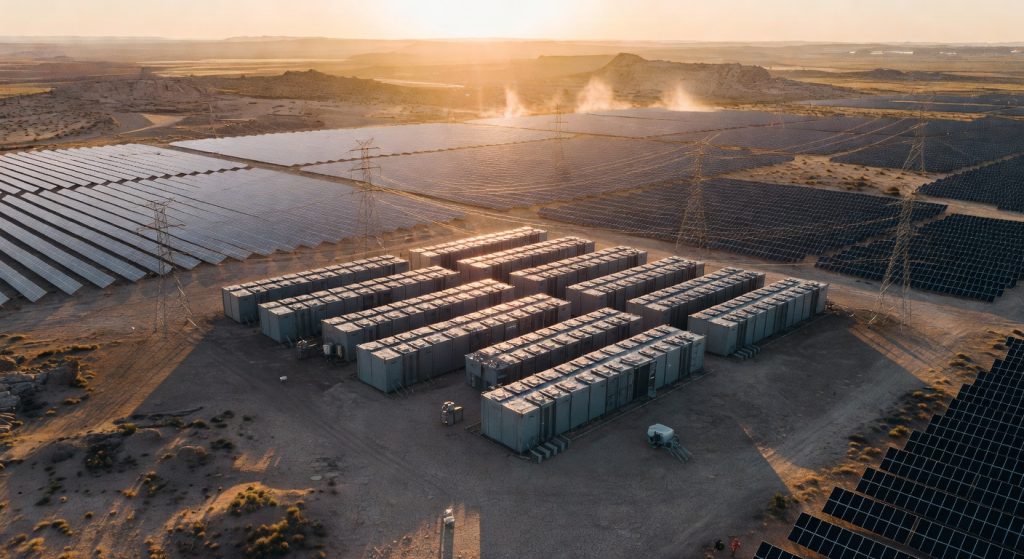
The most concrete symbol of this moment came from South Australia, where the government has activated a A$1 billion battery project backed by BlackRock — currently described as the world’s most powerful grid-scale battery. The facility is designed to store surplus renewable electricity and discharge it during peak demand, directly addressing one of the central paradoxes of the energy transition: we are building clean generation faster than we can use it.
China illustrates this paradox at scale. Despite constructing renewable capacity at a record pace, Reuters reports that grid bottlenecks are causing significant volumes of clean electricity to go to waste — a phenomenon known as curtailment. When wind turbines are switched off or solar panels disconnected because the grid cannot absorb their output, the economic and environmental case for renewables is undermined. The lesson is clear: generation alone is not enough. Transmission infrastructure and large-scale storage must grow in parallel.
For Europe, this is not an abstract warning. The EU’s own renewable buildout is increasingly running into similar constraints, particularly in southern and eastern member states where grid investment has lagged behind solar and wind deployment. The Australian battery model — combining private capital from a major asset manager with public policy ambition — offers a replicable blueprint that European regulators and utilities would do well to study closely.
Industrial Decarbonization: Cracking the Hard-to-Abate Sectors
While batteries dominate headlines, some of the most consequential green innovation is happening in industries that rarely trend on social media. Two recent research developments deserve particular attention from anyone tracking industrial decarbonization.
First, scientists have demonstrated a process for producing cement with almost no carbon footprint. This matters enormously: the cement industry is responsible for roughly 8% of global CO₂ emissions, making it one of the largest single sources of greenhouse gases on the planet. A scalable low-carbon cement process would transform construction supply chains, reduce the embodied carbon of buildings and infrastructure, and help European firms meet tightening sustainability reporting requirements under the EU’s Corporate Sustainability Reporting Directive (CSRD).
Second, a pilot plant has reached 50 kg per day of gasoline produced directly from CO₂ — a direct carbon-to-fuel conversion process. While still far from commercial scale, this technology hints at a future where captured carbon becomes a feedstock rather than a liability, potentially offering low-emissions fuel options for aviation, shipping, and heavy transport sectors that cannot yet be fully electrified.
- Low-carbon cement could reshape construction and infrastructure procurement across Europe.
- CO₂-to-fuel conversion offers a pathway for hard-to-electrify transport sectors.
- Both technologies align with the EU’s industrial decarbonization strategy and the goals of the European Green Deal.
Electric Mobility: Consolidation Signals Maturity
In electric mobility, the news that Hyundai and GM plan to co-develop five vehicles — including an electric van — is more significant than it might first appear. Joint platform development between major automakers signals that the EV market is entering a phase of consolidation and cost discipline, moving beyond the early-adopter phase into mass-market competition.
For fleet buyers, urban logistics operators, and smart cities planning zero-emission transport networks, this kind of industrial partnership accelerates the availability of affordable electric commercial vehicles. Europe, which has set a 2035 deadline for ending sales of new combustion-engine cars, stands to benefit from a more competitive and diversified global EV supply chain — provided its own manufacturers keep pace.
What This Means for Europe’s Green Transition
Taken together, this week’s developments reinforce a single, urgent message: the technical solutions for decarbonization are arriving faster than the infrastructure and policy frameworks needed to deploy them. Grid investment, storage capacity, industrial procurement standards, and EV charging networks all need to accelerate — not in isolation, but as an integrated system.
The key takeaway: Green technology is no longer the bottleneck. The challenge now is building the physical, regulatory, and financial architecture to put these innovations to work at the speed the climate requires.