EU Green Deal Enters Delivery Mode: What Carbon Pricing, Clean Energy, and Industrial Policy Mean for Europe in 2025
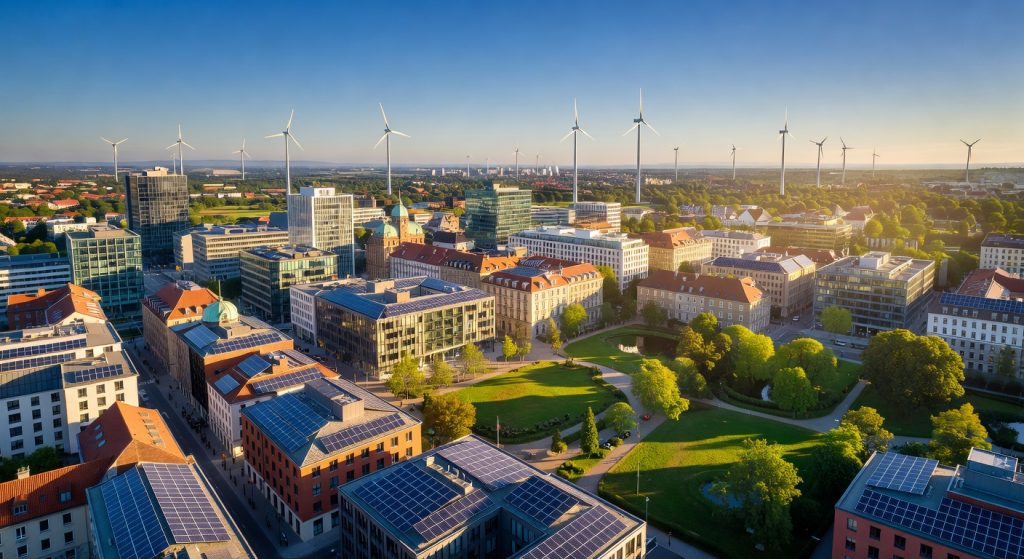
The era of grand climate declarations in Europe is giving way to something harder and more consequential: actual delivery. The EU Green Deal, the bloc’s flagship framework for reaching climate neutrality by 2050, has entered a decisive implementation phase. Targets are locked in law, carbon markets are expanding, and industrial policy is being reshaped around net-zero priorities. For businesses, households, and policymakers alike, the question is no longer what Europe wants to achieve — it’s how, and at what cost.
Climate Targets Are Set — Now Comes Enforcement
The foundation of Europe’s climate policy is the European Climate Law, which enshrines the 2050 climate-neutrality goal as a legally binding obligation. The 2030 interim target — a reduction of at least 55% in greenhouse gas emissions compared to 1990 levels — is already guiding legislation across energy, transport, industry, and land use. The European Commission has gone further still, proposing a -90% target for 2040, a benchmark that would place Europe on one of the most ambitious decarbonisation trajectories of any major economy.
This shift from target-setting to enforcement is significant. Member states and industries are now expected to demonstrate credible progress, and the Commission has tools to act when they don’t. Sustainability reporting requirements — including the Corporate Sustainability Reporting Directive (CSRD) — are tightening disclosure standards for thousands of European companies, making climate performance a matter of public record and investor scrutiny. The message to business is clear: alignment with EU climate goals is no longer optional or reputational. It is regulatory.
Carbon Markets and CBAM: Pricing Pollution Across Borders
At the heart of Europe’s decarbonisation strategy are carbon markets. The EU Emissions Trading System (EU ETS), the world’s largest carbon pricing mechanism, is expanding its reach. New sectors — including maritime shipping and, from 2027, road transport and buildings — are being brought under the ETS umbrella. Carbon revenues are being channelled into the Innovation Fund and the Social Climate Fund, designed to support green investment and protect vulnerable households from energy cost pressures.
Equally significant is the Carbon Border Adjustment Mechanism (CBAM), which is moving toward full operational use. CBAM effectively places a carbon price on imports of carbon-intensive goods — steel, cement, aluminium, fertilisers, and electricity — from countries without equivalent carbon pricing. This is both an environmental regulation tool and a trade policy instrument: it protects European industry from unfair competition while incentivising trading partners to raise their own climate ambitions. For global supply chains, CBAM represents a structural shift in how carbon costs are accounted for at the border.
Industrial Policy Meets Climate Ambition
Perhaps the most consequential evolution within the Green Deal framework is the deepening link between climate policy and industrial strategy. The Green Deal Industrial Plan, the Net-Zero Industry Act, and the Critical Raw Materials Act together form a policy architecture designed to ensure that Europe manufactures the technologies it needs for the energy transition — batteries, electrolysers, heat pumps, solar panels, wind turbines — rather than importing them.
This is a direct response to competitive pressures from the United States’ Inflation Reduction Act and China’s dominant position in clean-tech manufacturing. The Net-Zero Industry Act sets a target of producing at least 40% of the EU’s clean technology needs domestically by 2030, while the Critical Raw Materials Act aims to reduce dependence on single-source suppliers for strategic minerals. REPowerEU-style measures continue to accelerate renewables permitting and expand EV charging infrastructure, reinforcing the connection between energy security and decarbonisation.
What This Means for Citizens, Businesses, and Policymakers
For citizens, the Green Deal’s implementation translates into cleaner air, more energy-efficient homes and appliances, and — through social funds linked to carbon revenues — targeted support to manage the costs of the energy transition. For businesses, the implications are immediate: tighter emissions rules, rising carbon market costs, mandatory sustainability reporting, and new supply chain requirements demand strategic adaptation now, not later. For policymakers, the challenge is balancing environmental ambition with affordability and competitiveness — ensuring the transition is fast enough to meet climate targets without leaving communities or sectors behind.
Key takeaway: The EU Green Deal is no longer a roadmap — it is a regulatory reality. With legally binding targets, expanding carbon markets, border carbon adjustments, and an industrial policy built around net-zero technologies, Europe is constructing the world’s most comprehensive climate governance system. The window for preparation is narrowing. For anyone operating in or with Europe, understanding and adapting to this framework is now a strategic imperative.