Geothermal, Solid-State Batteries, and CO₂-to-Fuel: The Green Tech Breakthroughs Reshaping the Energy Transition
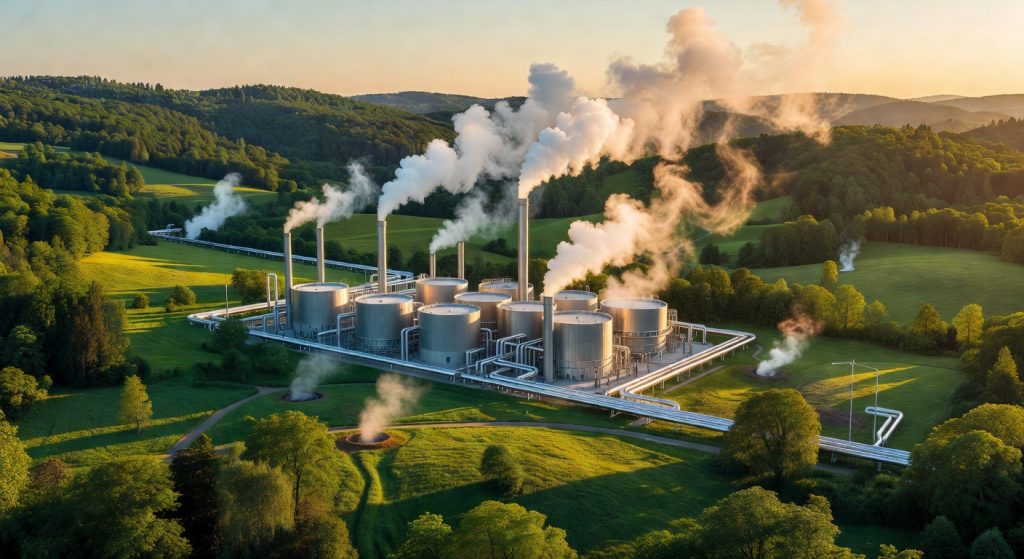
The energy transition has long leaned on two pillars: solar and wind. But a wave of emerging green technology breakthroughs is quietly expanding the toolkit available to policymakers, engineers, and cities worldwide. From the depths of the Earth to the architecture of next-generation batteries, this week’s most significant developments in cleantech signal a maturing innovation landscape — one with direct relevance for Europe’s industrial decarbonization agenda and beyond.
Geothermal Energy: The Sleeping Giant Wakes Up
A landmark report jointly released by Project InnerSpace and the Council on Energy, Environment and Water (CEEW) has put geothermal energy firmly back on the global map. The study estimates that India alone could unlock thousands of gigawatts of geothermal capacity for industrial heating, cooling, and electricity generation — a staggering figure that reframes geothermal not as a niche resource, but as a credible baseload clean-power option.
Unlike solar and wind, geothermal delivers firm, continuous power regardless of weather or time of day. This makes it particularly valuable for energy-intensive industries and district heating networks in urban areas — sectors that remain stubbornly difficult to decarbonize with intermittent renewables alone. The implications stretch well beyond South Asia. Europe, which already leads in geothermal adoption through countries like Iceland, Italy, and increasingly Germany, has strong reasons to accelerate investment in enhanced geothermal systems (EGS) as part of its energy transition strategy. With the EU’s industrial heat demand accounting for roughly 25% of total final energy consumption, geothermal’s reliability and cost stability could prove transformative for manufacturing clusters and smart city infrastructure alike.
Solid-State Batteries and CO₂-to-Fuel: Two Pivotal Cleantech Milestones
Two further developments are drawing attention from researchers and investors across the green innovation ecosystem.
First, advances in all-solid-state batteries (ASSBs) are gathering pace. New research into optimised ionic transport pathways suggests that ASSBs — which replace the liquid electrolyte in conventional lithium-ion cells with a solid material — could soon deliver safer, higher-density storage for both electric mobility and grid-scale applications. For Europe, where the race to build a competitive battery manufacturing sector is intensifying under the EU Battery Regulation and the Net-Zero Industry Act, breakthroughs in ASSB technology could be decisive. Safer batteries with greater energy density directly support the continent’s ambitions for electric vehicle adoption and renewable energy storage.
Second, a South Korean research team has achieved a notable milestone in carbon capture and utilisation: a pilot plant converting captured CO₂ directly into liquid hydrocarbons (gasoline) at a rate of 50 kilograms per day. While still at early pilot scale, this advance points toward a future where industrial carbon emissions become a feedstock rather than a waste product. E-fuels produced this way could serve hard-to-electrify sectors — aviation, shipping, heavy industry — providing a complementary pathway to full electrification in Europe’s decarbonization mix.
Smarter Cities Through Energy-Efficient Computing
Often overlooked in energy transition discussions, digital infrastructure carries a significant and growing carbon footprint. Data centres alone account for roughly 1–2% of global electricity consumption, a share set to rise sharply with the expansion of AI and IoT networks underpinning smart cities. New research on thermal memory devices — capable of operating with 66 times lower energy consumption than conventional alternatives — offers a glimpse of a more efficient digital backbone for urban environments. For European cities pursuing smart infrastructure goals under the EU’s Smart Cities and Communities initiative, such innovations could meaningfully reduce the energy burden of digital transformation without sacrificing capability.
What This Means for Europe and the Global Transition
Taken together, these developments reflect three converging trends shaping the future of green technology:
- Firm clean power — geothermal and advanced storage — is becoming as strategically important as generation capacity.
- Carbon utilisation is maturing from laboratory concept to pilot-scale reality, opening new industrial decarbonization routes.
- Energy-efficient computing is emerging as a critical, underappreciated lever for sustainable urban development.
Europe’s energy transition framework — built around the Green Deal, REPowerEU, and the Net-Zero Industry Act — is well-positioned to integrate these innovations, but policy ambition must be matched by investment in demonstration projects, regulatory clarity, and cross-border infrastructure planning.
Key takeaway: The clean energy transition is no longer a two-technology story. Geothermal, solid-state batteries, carbon utilisation, and low-energy computing are converging to build a more resilient, diverse, and genuinely sustainable energy system — one that Europe has both the incentive and the industrial capacity to help lead.