Solar and Wind Hit 814 GW in 2025: Why the Clean Energy Revolution Is Now Irreversible
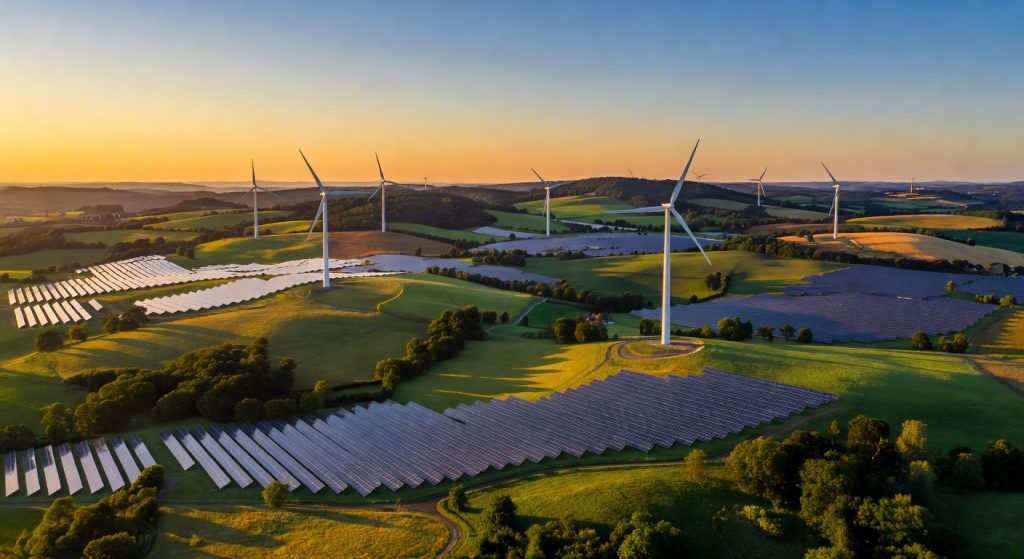
The numbers are in, and they are striking. According to data from Ember, the independent global energy think tank, the world added a record 814 gigawatts (GW) of solar and wind capacity in 2025 — a 17% increase over the 696 GW installed in 2024. At the same time, energy storage deployment exploded by more than 2,000% year-on-year, signalling that the clean energy transition has moved well beyond a policy experiment into a structural economic reality. For European citizens, professionals, and policymakers, this moment deserves careful attention.
A Market Transformation Driven by Economics, Not Just Policy
Perhaps the most telling signal in this year’s data is where growth is happening — and why. In the United States, renewable energy surged despite active federal policy headwinds, with green power accounting for 25% of electricity generation in June 2025 (up from 18% the previous year) and reaching a remarkable 33% in April. Grids across New York, New England, and the Mid-Atlantic set new records, driven not by government mandates but by rising electricity demand from electric vehicles, AI data centres, and extreme weather events.
The financial logic is now undeniable. According to Lazard’s latest Levelized Cost of Energy analysis, utility-scale solar and wind remain cheaper and faster to deploy than new coal or nuclear alternatives. US utilities are prioritising renewable energy simply because it delivers electrons to the grid more quickly and at lower cost as ageing fossil fuel plants are decommissioned. This is a market-driven boom, and it is reshaping power systems at a pace that few anticipated even five years ago.
In Europe, the picture is similarly dynamic. Germany continues to lead the continent in both solar and wind deployment, and the EU’s broader push for energy independence following the 2022 energy crisis has accelerated permitting reforms and investment across member states. The combination of falling battery prices, expanded grid infrastructure, and growing industrial demand for clean power is creating a self-reinforcing cycle of deployment.
Storage: The Missing Piece That Is Finally Arriving
For years, the central critique of renewable energy centred on intermittency — the sun does not always shine, the wind does not always blow. The 2025 data suggests this argument is rapidly losing its force. The 2,000%+ surge in energy storage deployment represents a qualitative shift in how power systems are managed.
The urgency is real. Curtailment — the practice of switching off renewable generation because the grid cannot absorb it — has been estimated to waste approximately $30 billion worth of clean electricity annually at a global level. Battery storage, increasingly paired with utility-scale solar and wind farms, is beginning to address this inefficiency directly. As battery prices continue to fall, storage is becoming a standard component of new renewable projects rather than an optional add-on.
This development also has implications beyond electricity. Cheap, abundant renewable power is a prerequisite for scaling green hydrogen production, which Europe is betting on heavily as a decarbonisation tool for hard-to-abate sectors such as steel, shipping, and heavy industry. Greater energy efficiency across the grid — enabled by smarter storage and demand management — reduces the overall resource footprint of the energy system, including demands on water resources used in cooling conventional power plants.
What This Means for Europe’s Energy Future
The implications for European decision-makers are significant. The clean energy transition is no longer a question of political will alone — it is being driven by capital markets, falling technology costs, and rising energy demand. Key takeaways for the continent include:
- Grid investment must accelerate: Record renewable additions are only valuable if transmission and distribution infrastructure can absorb and distribute the power efficiently.
- Storage policy needs urgency: Europe must fast-track regulatory frameworks for battery storage and demand-response systems to avoid the curtailment trap.
- Industrial competitiveness is at stake: Cheap renewable energy and green hydrogen will define which economies lead in clean manufacturing over the next decade.
- Resource management matters: Scaling renewables reduces dependence on water-intensive thermal generation, offering co-benefits for water security in drought-prone southern Europe.
The energy revolution, it turns out, does not wait for consensus. It follows cost curves and capital flows. Europe’s task now is to ensure its infrastructure, regulation, and industrial strategy are moving at the same speed as the technology.
Key takeaway: With 814 GW of new solar and wind capacity added globally in 2025 and storage deployment breaking all records, the clean energy transition has reached an inflection point. For Europe, the priority is no longer convincing markets to move — it is building the systems fast enough to keep up.