From Waste to Feed: How Tesco’s New Facility and Regenerative Pilots Are Reshaping Sustainable Food Systems
The food and agriculture sector is undergoing a quiet but consequential transformation. From supermarket loading docks to Irish barley fields, a new generation of initiatives is closing loops in supply chains, rebuilding degraded soils, and rethinking what a sustainable food system actually looks like in practice. This week’s developments — spanning the UK, Ireland, the US, and beyond — offer a revealing snapshot of where the industry is heading.
Tesco’s Food Waste Facility: Circular Economy in Action
UK retail giant Tesco has opened a new processing plant operated by RenEco at the Chelveston Renewable Energy Park, designed to convert unsold and surplus food into animal feed. The initiative is a textbook example of circular economy principles applied to supply chain sustainability: material that would otherwise end up in landfill or anaerobic digestion is instead redirected into the agricultural input chain, reducing both waste and the demand for virgin feed ingredients.
For European audiences, this matters beyond the headline. The EU’s Farm to Fork Strategy explicitly targets a 50% reduction in food waste by 2030, and retail-led interventions like Tesco’s are increasingly seen as essential complements to regulatory pressure. By embedding circularity directly into its logistics infrastructure, Tesco is demonstrating that supply chain sustainability can be operationalised at scale — not just pledged in annual reports.
What makes the Chelveston model particularly noteworthy is its integration within an existing renewable energy park, suggesting a broader systems approach: waste streams, energy generation, and agricultural inputs co-located and mutually reinforcing. This kind of infrastructure thinking will be critical as Europe accelerates its circular bioeconomy ambitions.
Regenerative Agriculture Gains Institutional Momentum
Circularity in food systems doesn’t stop at waste processing. Several major developments this week signal that regenerative agriculture — long championed by agroecology advocates — is moving from niche pilot to mainstream investment target.
- Guinness has announced one of Ireland’s largest regenerative agriculture pilots, focusing on soil health and ecosystem restoration across its barley supply chain. For a global brand with deep roots in Irish farming, this signals that business-led agroecology is no longer a fringe proposition.
- In the United States, Farmers Business Network (FBN) and the Walton family have launched a first-of-its-kind farmland loan programme that financially incentivises regenerative practices — a model that could eventually find European equivalents as impact finance matures.
- The USDA has unveiled a new conservation programme in Wisconsin, promoting no-till farming, soil health, and nutrient management for Midwest producers — underscoring that public policy and private capital are beginning to move in the same direction.
Taken together, these initiatives reflect a structural shift: sustainable agriculture is increasingly being financed, not just advocated. For European farmers navigating the post-CAP reform landscape, the emergence of blended finance models and brand-led supply chain programmes offers a potential template worth watching closely.
Agrivoltaics: When Solar Farms Grow Food Too
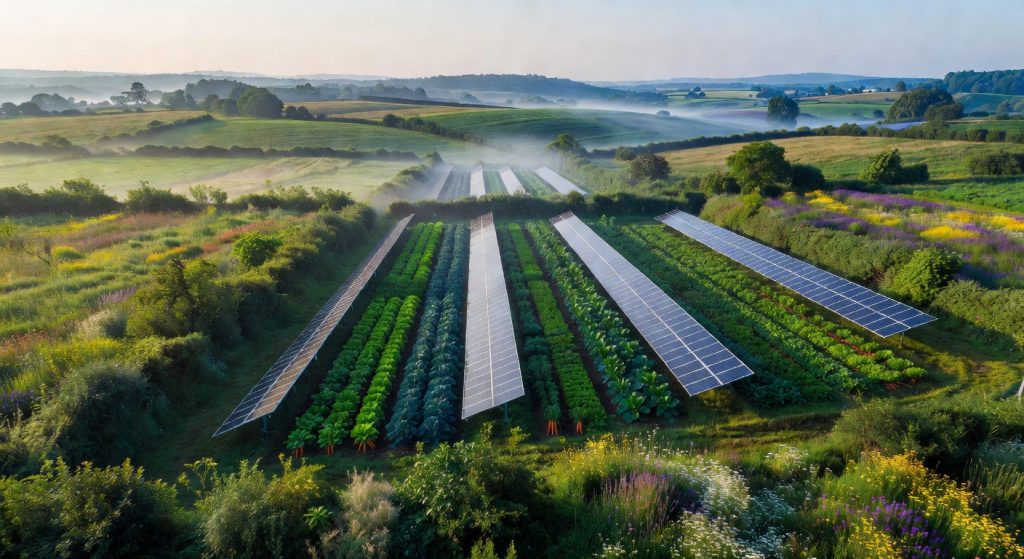
One of the more technically compelling findings this week comes from Iowa State University, whose researchers have confirmed the commercial viability of growing vegetables within utility-scale solar installations — a practice known as agrivoltaics. The dual-use model allows the same land to generate renewable electricity while producing food crops, addressing one of the central tensions in the green transition: competition between energy infrastructure and agricultural land.
Europe is already ahead on this front. Countries like France, Germany, and the Netherlands have active agrivoltaic research programmes and pilot installations, and the European Commission has flagged the approach as relevant to both its renewable energy and food security objectives. Iowa State’s findings add peer-reviewed weight to what European innovators are already deploying in the field.
What These Trends Mean for Europe’s Food Future
The convergence of circular food waste solutions, regenerative agriculture financing, and integrated land-use innovation points toward a food system that is simultaneously more resilient, more productive, and lower-impact. For European policymakers, the implications are clear:
- Retail-led circularity can accelerate Farm to Fork targets if supported by the right regulatory frameworks.
- Private capital flowing into regenerative practices needs public policy alignment to reach smallholder and family farms.
- Agrivoltaics deserve dedicated land-use planning support to unlock their dual potential at scale.
Key takeaway: Sustainable food systems are no longer a vision document — they are being built, financed, and tested right now. The challenge for Europe is to ensure that the pace of policy matches the pace of innovation, and that the benefits reach farmers and communities, not just corporate balance sheets.