ESG at a Crossroads: Corporate Sustainability Gains Ground While an Oil Slick Threatens the Persian Gulf
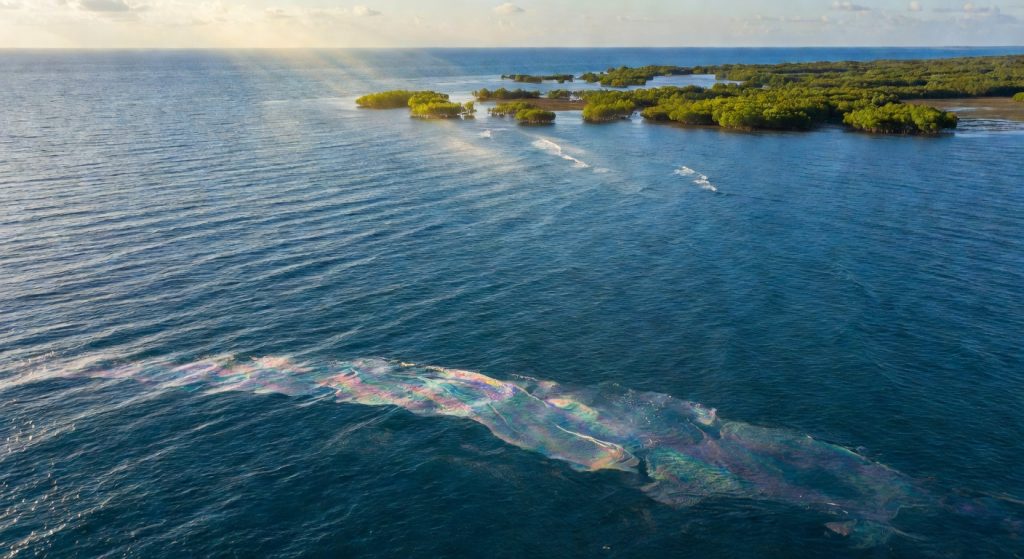
Sustainability rarely moves in a straight line. This week offered a sharp reminder of that reality: while major corporations announced meaningful advances in ESG, circular economy practices, and green business innovation, satellite images revealed a large oil slick spreading west of Iran’s Kharg Island — the country’s primary oil export hub in the Persian Gulf. The contrast could not be more stark, and it tells us something important about where the global sustainability agenda truly stands.
An Oil Slick That No One Is Claiming
Satellite imagery released last week by Reuters shows a dark, sprawling oil slick covering dozens of square kilometres in the Persian Gulf, west of Kharg Island. The cause and origin remain officially unknown. Iran’s Oil Terminals Company has denied any leak from its facilities, leaving regulators, environmental scientists, and shipping observers without a clear explanation.
The Persian Gulf is one of the world’s most ecologically sensitive and economically critical marine corridors. A significant spill in this area could devastate coral reefs, seagrass beds, and the fish populations that coastal communities across the region depend on. It would also disrupt one of the busiest shipping lanes for global energy trade — with direct consequences for European energy security and import flows.
What makes this situation particularly alarming from an ESG standpoint is the lack of transparency. Corporate responsibility frameworks and international environmental law both demand prompt disclosure and accountability when environmental incidents occur. The denial — in the absence of an alternative explanation — is itself a governance failure. European regulators and investors who apply sustainable finance criteria to energy sector assets should be watching closely.
Where Corporate ESG Is Moving Forward
Away from the Persian Gulf, the week brought more encouraging signals on the corporate responsibility front. Amazon announced it is leveraging artificial intelligence to optimise its logistics network with sustainability targets in mind, accelerating progress toward its net zero by 2040 goal. According to the company, AI-driven improvements in route efficiency, packaging reduction, and returns management could contribute to broader circular economy gains — with analysts estimating that circularity at scale could save European businesses as much as US$44.4 billion.
Meanwhile, beauty and fragrance group Coty received recognition from the CDP (formerly the Carbon Disclosure Project) for its supplier engagement on climate issues — one of the most difficult and impactful dimensions of ESG reporting. Scope 3 emissions, which include supply chain activity, typically account for the vast majority of a company’s carbon footprint. Coty’s recognition signals that green business leadership increasingly means looking beyond your own operations.
Mercedes-Benz, meanwhile, announced a partnership with SAP and Formula 1’s Head of ESG on sustainability initiatives — an unlikely but symbolically powerful alliance that underlines how mainstream ESG has become across sectors, from luxury automotive to elite sport.
The Troubling Trend of Ditching Sustainability Reports
Yet not all the corporate news was positive. A growing number of companies are quietly stepping back from formal sustainability reporting, citing regulatory uncertainty, reputational risk, and the rising costs of compliance. This trend — sometimes framed as a response to anti-ESG political pressure, particularly from the United States — poses a real challenge for sustainable finance in Europe.
The EU’s Corporate Sustainability Reporting Directive (CSRD) is designed precisely to prevent this kind of retreat, mandating detailed, auditable sustainability disclosures for thousands of companies operating in the European market. But enforcement remains uneven, and smaller firms are already seeking exemptions. If transparency becomes optional in practice, the credibility of the entire ESG ecosystem is at risk.
- Transparency gaps — as seen with the Kharg Island incident — can escalate into environmental disasters.
- Voluntary reporting rollbacks undermine investor confidence and sustainable finance flows.
- AI and circular economy tools offer scalable solutions, but only if governance keeps pace with technology.
What This Moment Tells Us
The juxtaposition of a potentially catastrophic, unacknowledged oil spill and a week of corporate ESG milestones is not a contradiction — it is a diagnosis. Progress in sustainability is real, but it remains uneven, fragile, and deeply dependent on accountability structures that are still being built. Europe has the regulatory architecture to lead. The question is whether the political will — and the corporate culture — will match the ambition.
Key takeaway: ESG is only as strong as its weakest link. Whether that link is an unexplained oil slick in the Persian Gulf or a company quietly dropping its sustainability report, the gaps matter — for ecosystems, for investors, and for the credibility of the green transition itself.