Regenerative Agriculture Gets a Financial Boost — But Can It Scale in Time?
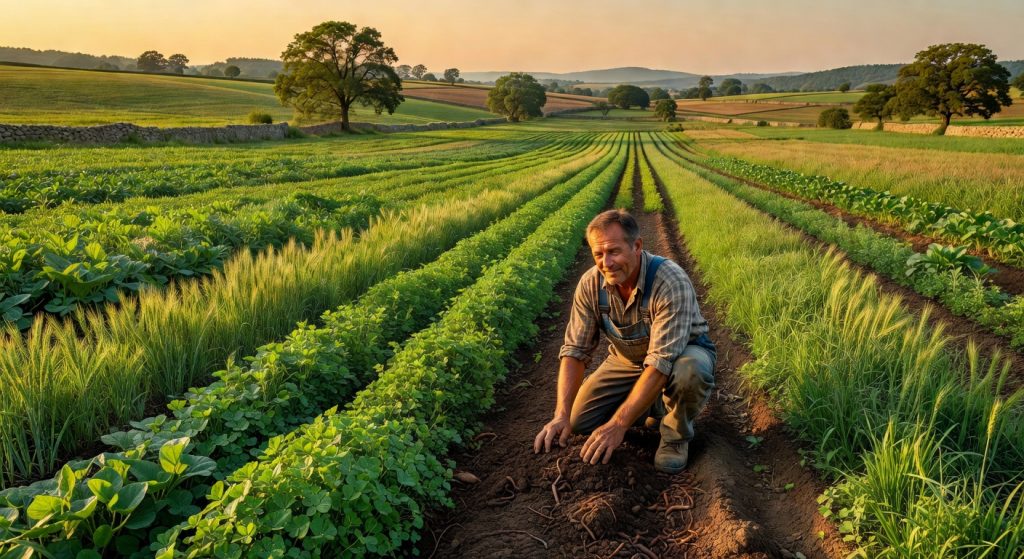
The global food system is under pressure from multiple directions: volatile farm incomes, retreating federal subsidies, and the mounting urgency to cut agricultural emissions. Against this backdrop, a wave of private investment is stepping in — backing regenerative agriculture, biological methane solutions, and agtech automation with a scale and ambition rarely seen before. The question is no longer whether sustainable agriculture can attract capital. It’s whether these initiatives can deliver systemic change before the window closes.
Money Moves: Financing the Regenerative Transition
The most significant signal this week came from the United States, where Farmers Business Network (FBN) and the Walton Family — heirs to the Walmart fortune and prominent environmental philanthropists — launched a first-of-its-kind pilot lending programme offering preferential loan terms to farmers who adopt regenerative and sustainable practices. The initiative arrives at a critical moment: the US farm economy is in a prolonged downturn, and federal funding for agricultural sustainability programmes faces growing political uncertainty.
The model is straightforward but potentially transformative. Farmers who commit to practices such as cover cropping, reduced tillage, and rotational grazing gain access to better financing conditions — creating a direct economic incentive where regulatory pressure alone has failed. This kind of blended finance approach, combining private capital with environmental conditionality, is increasingly being discussed in European policy circles as a complement to the EU’s Common Agricultural Policy (CAP) reform.
Across the Atlantic, Guinness has announced one of Ireland’s largest regenerative agriculture pilots, working with barley farmers to improve soil health, reduce synthetic inputs, and build supply chain sustainability into its brewing operations. For European food systems, where agroecology is gaining institutional momentum but farmer adoption remains slow, corporate-led programmes like this offer a practical, market-linked pathway — though critics rightly ask whether voluntary pilots can substitute for binding policy frameworks.
Methane in the Crosshairs: Biological Solutions Scale Up
Livestock farming accounts for roughly 14.5% of global greenhouse gas emissions, according to the FAO, with enteric methane from cattle representing the single largest share. Two developments this week suggest that biological innovation is finally reaching commercial viability as a tool to address this.
CH4 Global has begun large-scale production of its seaweed-based feed additive, which clinical trials suggest can reduce methane emissions from cattle by up to 80%. Meanwhile, Windfall Bio — backed by Amazon’s Climate Pledge Fund — has hit a commercial milestone with its methane-eating microbes, organisms engineered to consume methane directly in agricultural settings and convert it into microbial biomass usable as fertiliser.
These are not fringe experiments. They represent a convergence of microbial biotechnology and food systems thinking that European researchers and policymakers have been advocating for years under the agroecology banner. The EU’s Farm to Fork Strategy explicitly calls for reducing livestock emissions and cutting synthetic fertiliser use by 20% by 2030. Biological solutions of this kind could become key tools — provided regulatory pathways for novel feed additives and microbial products are streamlined across member states.
Automation and AI: Closing the Labour Gap Sustainably
No analysis of sustainable agriculture in 2024 is complete without addressing the labour crisis. Bonsai Robotics has secured $15 million in fresh funding to advance its AI-powered fruit harvesting systems, designed to work in orchards where manual labour is scarce, expensive, and increasingly unavailable. Automated harvesters reduce food waste by harvesting at optimal ripeness, cut fuel consumption compared to conventional machinery, and — critically — can be programmed to minimise soil compaction, a key concern in regenerative systems.
For European growers, particularly in labour-intensive sectors like viticulture and soft fruit production, agtech automation is moving from a curiosity to a competitive necessity. Supply chain sustainability increasingly depends not just on what is grown, but on how efficiently and responsibly it is harvested and transported.
Implications for Europe and the Road Ahead
Taken together, this week’s developments sketch a clearer picture of where sustainable food systems are heading:
- Private capital is filling the gap left by retreating public funding — but it brings its own conditionalities and priorities.
- Biological and microbial innovations are maturing rapidly and need supportive regulatory environments to scale across the EU.
- Agtech automation is becoming inseparable from supply chain sustainability, particularly as climate volatility disrupts harvest windows.
Key takeaway: The infrastructure for a genuinely sustainable agriculture system is being built — piece by piece, loan by loan, microbe by microbe. Europe has the policy ambition; what it increasingly needs is the speed and coordination to match the private sector’s momentum. The Guinness pilot and the Walton lending model are worth watching not as isolated stories, but as early blueprints for what farmer transition at scale might actually look like.