Solar, Wind, and Batteries Are Rewriting the Global Energy Map in 2025
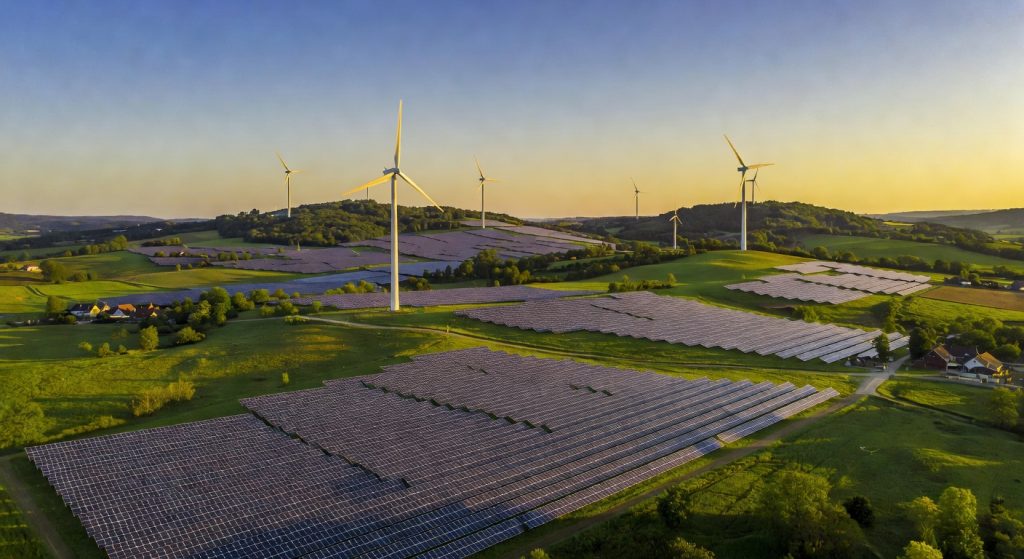
Something significant is happening in the global energy system — and the numbers are hard to ignore. According to the U.S. Energy Information Administration (EIA), renewables are projected to account for 100% of all new electricity capacity added in the United States in 2026. Solar leads the charge with 41 GW of planned additions, followed by battery storage at 22 GW and wind at 14 GW. Net growth in fossil fuel capacity? Zero. Meanwhile, on this side of the Atlantic, Europe is hitting its own milestones. The clean energy transition is no longer a distant promise — it is the present reality of how power systems are being built and run.
Europe’s Renewable Surge: Solar Overtakes Gas and Coal
June 2025 marked a historic moment for European electricity: solar energy generated 22% of all EU power, surpassing gas and coal combined for the first time in a single month. This is not a seasonal anomaly to be dismissed — it reflects years of sustained investment, policy support, and falling technology costs that have made solar the continent’s fastest-growing energy source.
Wind energy is keeping pace. According to WindEurope, the sector attracted €45 billion in new investment last year, financing 21 GW of future capacity. These are not speculative figures — they represent contracts signed, projects financed, and turbines being manufactured. Europe’s wind industry has become one of the most capital-intensive clean energy sectors on the planet, and it continues to scale.
Together, solar and wind are reshaping how Europeans think about energy security and resource management. With domestic renewable generation displacing imported fossil fuels, the strategic case for accelerating the transition has never been stronger — particularly in the context of volatile gas prices and geopolitical uncertainty.
Battery Storage and Hydrogen: Solving the Reliability Puzzle
One of the most persistent critiques of renewable energy is intermittency — the sun doesn’t always shine, the wind doesn’t always blow. But the 2025 data suggests the energy sector is finding its answers. Battery storage is now the second-largest category of new capacity being added in the U.S., and similar trends are visible across Europe, where grid-scale storage projects are being co-located with solar and wind farms.
In the United States, Xcel Energy has already activated new solar and battery storage installations in Texas and New Mexico, explicitly to manage energy costs and smooth grid reliability. This model — pairing generation with storage — is becoming the default architecture for new clean energy projects.
On the innovation frontier, hydrogen is attracting renewed attention. UK-based Element One is advancing a patent-pending technology for real-time, low-carbon natural hydrogen production derived directly from rock systems — a process that could unlock geologically sourced hydrogen at scale without electrolysis. While still early-stage, this kind of breakthrough could complement green hydrogen produced via renewable-powered electrolysis, offering a broader toolkit for decarbonising hard-to-electrify sectors like heavy industry and long-distance transport.
Implications: Policy, Pricing, and the Road Ahead
The energy transition is accelerating — but it is not without friction. In the United States, policy risks are mounting: state-level raids on clean energy funds and the cancellation of transmission loan programmes under the previous administration have created uncertainty for developers. Transmission infrastructure, in particular, remains a critical bottleneck. Without expanded grid capacity, even record-breaking renewable additions cannot fully deliver their potential.
In Europe, the challenge is different but equally pressing. The continent must:
- Accelerate permitting reform to match investment ambitions with actual build-out speed
- Invest in cross-border grid interconnection to balance supply across regions
- Scale energy efficiency programmes alongside generation — including water utility upgrades like the $355,000 incentive package recently awarded by Entergy Arkansas to improve efficiency in the water sector
- Develop clear hydrogen strategies that integrate both green and natural hydrogen pathways
Electricity pricing will also be a defining issue. As renewables with near-zero marginal costs dominate new capacity, wholesale prices are expected to fall during high-generation periods — a benefit for consumers and energy-intensive industries, including the rapidly growing data centre sector.
The key takeaway is straightforward: the energy transition has moved from ambition to arithmetic. Solar, wind, and battery storage are now the default choice for new power capacity — not because of ideology, but because of economics, performance, and supply chain maturity. For Europe, which has long positioned itself as a global leader in climate policy, the task now is to translate investment momentum into reliable, affordable, and fully decarbonised power systems. The infrastructure being built today will define energy security for the next fifty years.