Europe’s Organic Momentum: How CAP Reform, Regenerative Farming, and Digital Tools Are Reshaping Food Systems
Europe’s food system is at an inflection point. This week, the European Commission spotlighted its school scheme — which delivers fruit, vegetables, and dairy to millions of children — alongside the winners of the EU Organic Awards, projects recognized for building resilient food systems and sustaining rural jobs. Taken together, these signals point to a broader shift: sustainable agriculture is no longer a niche concern but a central pillar of European policy and business strategy.
Across the continent, from high-level negotiations in Brussels to insect traps in Spanish fields, a convergence is underway. Policymakers, farmers, and corporations are aligning around agroecology, regenerative practices, and digital innovation as the tools needed to make food production more resilient to climate shocks, biodiversity loss, and market volatility.
The Policy Battle: CAP Reform and the Future of Organic Farming
The European Organic Congress, held recently in Cork, framed the upcoming Common Agricultural Policy (CAP) reform and the next EU budget cycle as a make-or-break moment for organic and agroecology-based farming. Stakeholders — including farmers’ associations, agri-businesses, researchers, and civil society groups — are pressing Brussels to lock in stronger financial and regulatory support before the next funding period begins.
This matters because the EU’s organic sector, which already covers roughly 10% of the bloc’s farmland, has pledged to reach 25% by 2030 under the Farm to Fork strategy. Without dedicated CAP instruments — eco-schemes, organic conversion payments, and research funding — that target risks slipping out of reach. The Cork congress underscored a recurring tension in EU agricultural policy: ambitious sustainability goals often collide with budget negotiations dominated by competing priorities like defense spending and crisis response funds.
The EU Organic Awards, announced alongside the school scheme update, offer a counterpoint of optimism. Winning projects showcased how organic transitions can simultaneously protect soil health, create rural employment, and strengthen local food systems — proof points policymakers can cite as they defend organic budget lines in tougher negotiations ahead.
Innovation on the Ground: Digital Tools and Regenerative Scaling
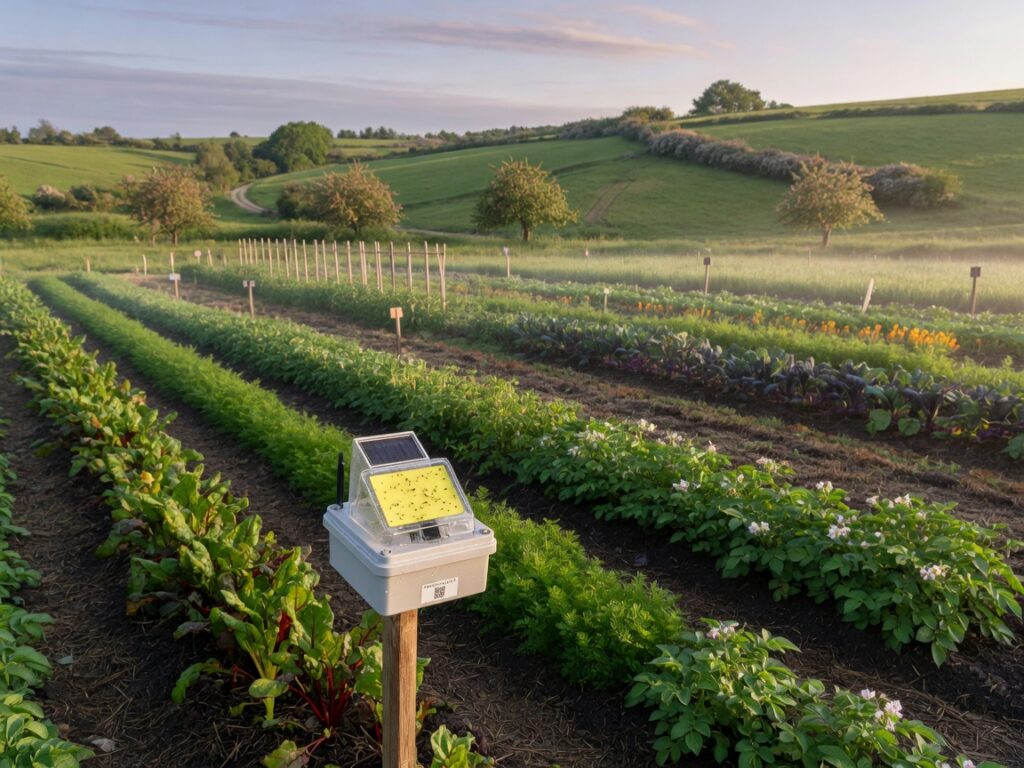
While policy debates unfold in Brussels and Cork, concrete innovation is advancing in the fields. In Murcia, Spain, producers have deployed a bio-network of AI-enabled insect traps across more than 4,000 acres. These smart traps improve pest forecasting, allowing farmers to apply phytosanitary products only when and where necessary — cutting chemical inputs while boosting on-farm biodiversity. It’s a clear example of how precision technology and ecological farming can reinforce rather than compete with one another.
Corporate supply chains are moving in parallel. Fyffes, the fruit and vegetable giant, announced a framework to expand regenerative agriculture practices across 13,000 hectares by 2030, with ambitions to extend the approach throughout its entire supply chain by 2035. Meanwhile, the One Planet Business for Biodiversity coalition (OP2B) reported more than 180 regeneration projects spanning Europe, supporting 21,000 farmers and covering 1.3 million hectares.
These figures illustrate a shift in supply chain sustainability thinking: regenerative agriculture is increasingly viewed not as a cost center but as a risk-management strategy, insulating companies from soil degradation, water stress, and input price volatility.
Cross-Border Collaboration: Lessons Beyond Europe’s Borders
Sustainability in European food systems doesn’t stop at the continent’s edge. A Dutch-Ethiopian partnership is promoting integrated pest management, circular agriculture, and biological crop protection as part of a broader sustainable trade agenda. This kind of collaboration reflects a growing recognition that European food security is intertwined with practices in exporting countries — and that technical knowledge-sharing can strengthen soil health and reduce chemical dependency on both ends of the supply chain.
It also hints at a market shift relevant to the rise of plant-based diets and ingredients: as demand grows for diverse, climate-resilient crops, partnerships that improve agronomic practices abroad directly support the diversification goals of European retailers and food manufacturers.
What This Means for Europe’s Food Future
The implications of these converging trends are significant:
- Policy uncertainty remains the biggest risk. Without firm CAP commitments, organic growth targets could stall despite strong grassroots momentum.
- Technology is de-risking ecological transitions. AI-driven pest monitoring and precision tools make low-input farming more economically viable at scale.
- Corporate commitments are becoming measurable. Hectare-based targets from Fyffes and OP2B signal a shift from vague pledges to trackable accountability.
Key takeaway: Europe’s path toward resilient, lower-impact food systems is advancing on multiple fronts simultaneously — policy, technology, and corporate supply chains. The real test will be whether CAP negotiators translate grassroots and business momentum into durable funding, ensuring that today’s pilot projects become tomorrow’s agricultural norm.