Why Regenerative Agriculture Is Becoming Europe’s Next Investable Asset Class
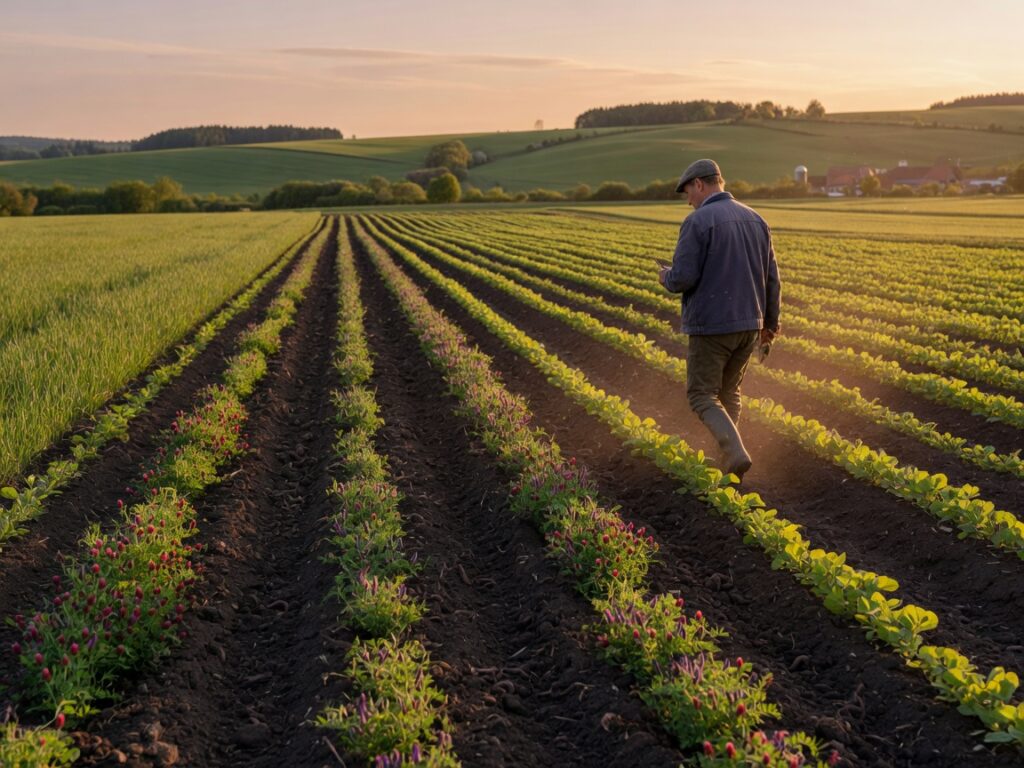
For decades, the transition to sustainable agriculture in Europe was largely funded through public subsidies, grants, and slow-moving corporate sustainability budgets. That picture is changing fast. A new €120 million private credit facility for InSoil, backed by Pollen Street Capital, is the clearest signal yet that regenerative farming is being treated not as a philanthropic cause but as a genuine investable asset class. For a sector chronically starved of capital, this matters enormously.
The European farm finance gap has long been one of the biggest obstacles to scaling agroecology and soil-health practices. Transitioning from conventional to regenerative methods — cover cropping, reduced tillage, diversified rotations — requires upfront investment and often several years before yields and soil productivity stabilize. Banks have historically been reluctant to underwrite that risk. Private credit funds, however, are starting to see a different calculus: resilient soils, diversified income streams, and long-term contracts with food companies desperate to decarbonize their supply chain sustainability footprint.
Private Capital Meets Farm-Level Reality
The InSoil facility is notable not just for its size but for what it represents structurally. Rather than a one-off grant or a pilot project, it’s a credit facility — a repeatable financial instrument that can be replicated across geographies and crop types. This is the kind of infrastructure that regenerative agriculture has lacked: scalable, bankable mechanisms that let farmers access capital without waiting on public subsidy cycles.
This shift aligns with broader pressure on food and beverage companies operating in Europe, many of which face upcoming reporting obligations under the EU’s Corporate Sustainability Reporting Directive and scope 3 emissions targets tied to agricultural sourcing. Retailers and manufacturers increasingly need verifiable, lower-impact ingredients — and that demand is pulling private capital toward the farms that can supply them.
Policy and Market Signals Are Converging Globally
Europe isn’t acting in isolation. In Japan, regulators have approved a new methodology under the J-Credit scheme allowing livestock producers to earn carbon credits by using methane-reducing feed additives — a policy innovation that creates a direct financial incentive for lower-emission meat and dairy production. It’s a template other governments, including those in the EU, are watching closely as they look to expand carbon markets into agriculture beyond forestry and soil carbon.
Meanwhile, market-level adoption is advancing in parallel with policy. In the UK, the first commercial batch of “low-carbon” potatoes has reached supermarket shelves, marking a shift from niche eco-labeling to mainstream retail integration. This matters because consumer-facing proof points — actual products on actual shelves — are what ultimately validate the economics behind sustainable food systems, whether the innovation is in reduced fertilizer use, precision irrigation, or emissions-optimized logistics.
Innovation is also accelerating on the technology side. An EU Innovation Council grant is supporting autonomous citrus-harvesting robots designed to reduce labor dependency and input waste, while low-emission rice programs across Asia are demonstrating that cutting methane and water use can go hand-in-hand with improved farmer profitability. Together, these developments show a food system increasingly organized around efficiency, traceability, and measurable emissions reduction — not just at the plant-based end of the spectrum, but across conventional livestock and staple crop production too.
What This Means for Farmers, Companies, and Policymakers
- Farmers gain new pathways to capital that don’t depend solely on subsidy timelines, though eligibility criteria and repayment terms will need scrutiny to avoid replicating debt burdens.
- Food companies get a more credible route to hit supply chain sustainability targets by financing change at the source rather than offsetting downstream.
- Policymakers face growing pressure to harmonize carbon credit methodologies — as Japan has done for livestock — to prevent fragmented, hard-to-verify markets across regions.
- Investors are testing whether regenerative agriculture can deliver both environmental outcomes and reliable returns at scale, a question the next few years of facility performance will help answer.
There are real risks worth watching: private credit isn’t grant funding, and farmers taking on debt to finance transition need robust safeguards, transparent terms, and realistic timelines for return on soil-health investments. Regulatory clarity around what counts as “regenerative” or “low-carbon” will also be essential to prevent greenwashing as capital inflows grow.
Key Takeaway
The convergence of private capital, carbon-credit policy innovation, and retail-level product adoption suggests Europe’s agricultural transition is entering a more mature, market-driven phase. If financing mechanisms like the InSoil facility prove durable, regenerative agriculture could shift from a subsidy-dependent niche to a core pillar of resilient, decarbonized food systems — with lessons and pressure points relevant well beyond Europe’s borders.