Climate Tech Investment Surges to $40.5 Billion: AI, Storage, and Clean Hydrogen Lead the Charge
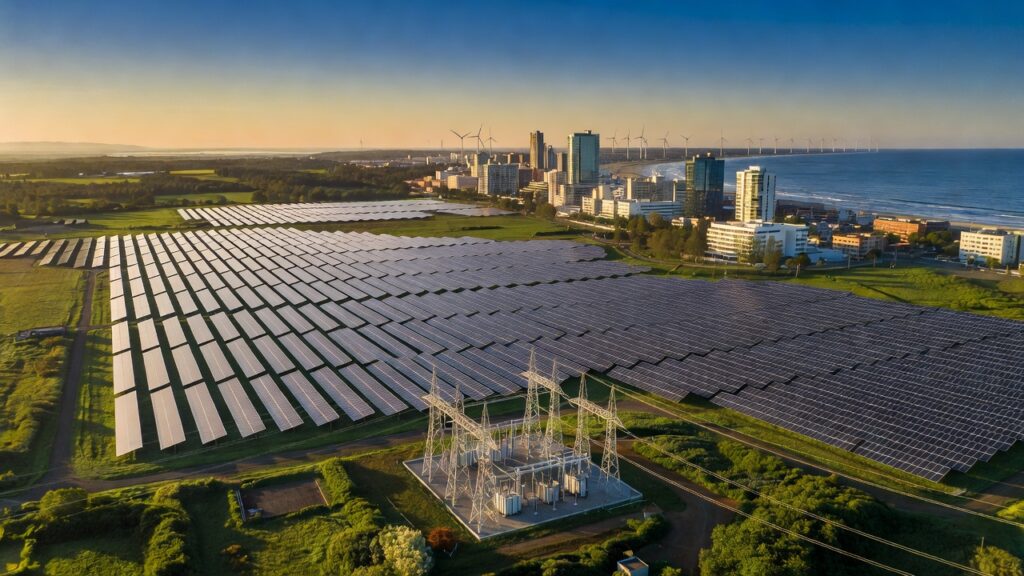
The numbers are in, and they tell an encouraging story: global climate tech investment reached $40.5 billion in 2025, an 8% increase on the previous year, according to the Climate Flash Report. A record 179 climate fund closes were recorded, and nearly $2 billion flowed specifically into AI-related clean solutions — from data-centre efficiency to smart grid management. After a period of uncertainty driven by rising interest rates and policy volatility, green innovation is back on an upward trajectory. For Europe, which has long positioned itself as the global standard-bearer for the energy transition, this momentum arrives at a critical moment.
AI Meets Clean Infrastructure: A New Engine for the Energy Transition
The most striking signal from this year’s investment data is the convergence of artificial intelligence and clean energy infrastructure. Investors are no longer treating these as separate verticals. AI-enabled climate tools — software that optimises grid dispatch, predicts renewable output, or manages demand response in smart cities — are attracting serious capital precisely because they multiply the value of physical assets already being built.
This matters for Europe in particular. The continent is simultaneously scaling offshore wind, expanding solar capacity, and integrating distributed energy resources across interconnected national grids. Managing that complexity without intelligent software is increasingly impractical. The EU’s Green Deal Industrial Plan and the accompanying Net-Zero Industry Act have created a policy environment that rewards exactly the kind of scalable, infrastructure-heavy solutions investors are now favouring.
For citizens and professionals alike, the practical implication is tangible: faster deployment of cleaner power, more resilient grids less prone to blackouts, and more efficient digital services that consume less energy per unit of output. The near-term gains, however, remain concentrated in commercial and utility-scale systems rather than consumer-facing products — a gap that European policymakers should keep in focus.
Grid-Scale Storage, Geothermal, and the Firm-Power Frontier
Intermittency has always been the Achilles heel of renewable energy. That challenge is now being addressed at unprecedented scale. Among the most significant developments is Form Energy’s 300 MW / 30 GWh iron-air battery deployment — a grid-scale storage project that could hold enough energy to power hundreds of thousands of homes through multi-day weather events when solar and wind output drops.
Alongside storage, geothermal energy is experiencing a quiet renaissance. Startup Quaise Energy is advancing millimeter-wave drilling technology that could unlock deep geothermal heat virtually anywhere on Earth, not just in volcanically active regions. Meanwhile, Twelve is progressing toward a commercial electrofuels production facility, converting CO₂ and renewable electricity into synthetic fuels — a pathway particularly relevant for hard-to-abate sectors like aviation and shipping, where electric mobility solutions remain limited.
These technologies collectively address a fundamental need in the clean energy system: firm, dispatchable power that complements variable renewables. Europe’s push toward climate neutrality by 2050 cannot succeed on solar and wind alone; storage and firm-clean-power technologies are the connective tissue of a truly resilient grid.
Hydrogen and Water: Two Resource Breakthroughs Worth Watching
Beyond storage and AI, two scientific developments deserve attention from anyone tracking green technology trends. Researchers at the University of Birmingham have demonstrated a perovskite-based catalyst capable of splitting water into hydrogen at lower temperatures than conventional electrolysers require. If this scales, it could meaningfully reduce the cost of green hydrogen — a fuel Europe is betting heavily on for industrial decarbonisation.
Separately, a newly reported solar desalination system can produce drinking water from seawater without generating the concentrated brine byproduct that typically harms marine ecosystems. For coastal cities in Southern Europe and water-stressed regions across the Mediterranean, this dual water-and-climate innovation could prove transformative as climate change intensifies drought and water scarcity pressures.
What This Means for Europe’s Green Innovation Agenda
The broader investment landscape is being shaped by policy as much as technology. In the United States, the passage of the ‘One Big Beautiful Bill Act’ has clarified the direction for investors, even if its provisions are more limited than previous climate legislation. Globally, capital is rotating toward domestic materials, resilience infrastructure, and AI-enabled climate tools — themes that align closely with Europe’s strategic autonomy agenda.
For European decision-makers, the message is clear: the window to attract and anchor climate tech investment is open, but competition is intensifying. Streamlining permitting, deepening capital markets for cleantech scale-ups, and ensuring that green innovation reaches communities — not just corporate balance sheets — will define whether Europe leads or follows in the next phase of the energy transition.
- $40.5 billion in global climate tech investment in 2025 (+8% year-on-year)
- 179 climate fund closes — a new record
- ~$2 billion directed toward AI-related clean solutions
- Form Energy: 300 MW / 30 GWh iron-air battery deployment underway
- University of Birmingham perovskite catalyst could lower green hydrogen production costs
Key takeaway: Climate tech investment is not just recovering — it is maturing. The shift toward AI-enabled infrastructure, firm-clean-power technologies, and resource-efficiency breakthroughs signals that the energy transition is entering a more sophisticated, systems-level phase. Europe has the policy framework and the industrial base to lead. The question is whether it moves fast enough to seize the moment.