Green Tech in 2025: How AI, Clean Energy, and Urban Innovation Are Reshaping the Sustainability Landscape
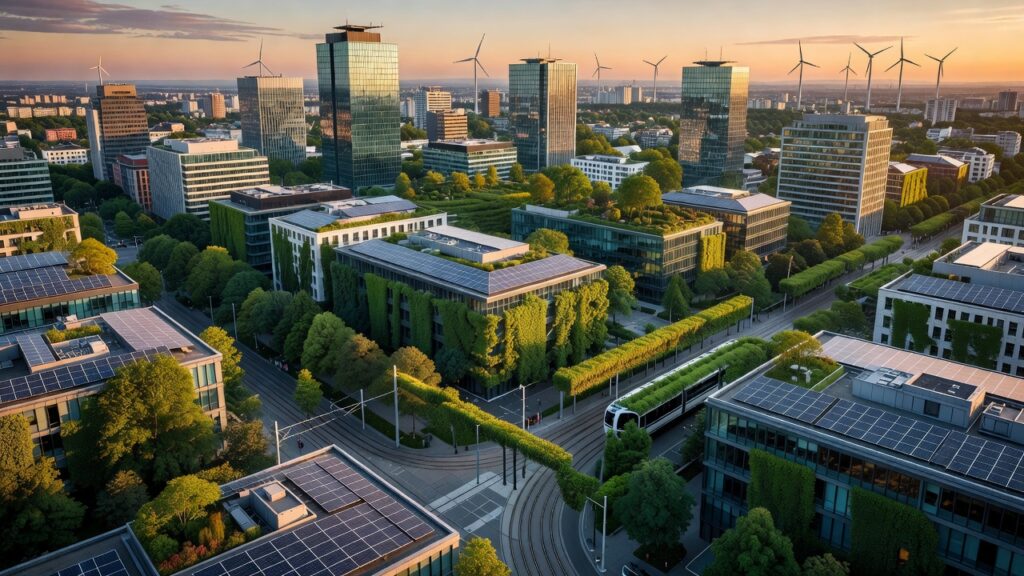
The pace of green innovation is quickening. Across Europe and globally, a new generation of cleantech solutions is moving from research labs and pilot programmes into mainstream business and urban infrastructure. Artificial intelligence, clean-energy co-location, low-carbon mobility, and resource-efficient city technologies are no longer distant promises — they are active, investable realities reshaping how companies operate and how cities are built. Here is what the current momentum tells us about where the energy transition is heading.
AI Becomes the Engine of Sustainability Compliance
One of the most significant shifts underway is the integration of artificial intelligence into sustainability management. According to analysts at MarketsandMarkets, AI-driven sustainability software is rapidly becoming central to how businesses handle carbon accounting, ESG reporting, and regulatory compliance. Natural-language processing tools now allow companies to analyse vast datasets — supplier chains, energy consumption records, emissions inventories — in a fraction of the time previously required.
This matters enormously in a European context. With the EU’s Corporate Sustainability Reporting Directive (CSRD) now extending obligations to tens of thousands of companies, the demand for automated, auditable ESG data pipelines is surging. Platforms that can ingest raw operational data and produce verified emissions reports are no longer a luxury; they are becoming a compliance necessity.
The broader implication is that green technology is no longer confined to hardware — solar panels, wind turbines, electric vehicles. Software and data intelligence are now equally critical infrastructure for the sustainability economy. For SMEs in particular, accessible AI tools could level the playing field, enabling smaller firms to meet the same reporting standards as large corporations without dedicated sustainability departments.
Clean Energy Meets Digital Infrastructure
A second major trend is the deliberate pairing of clean-energy infrastructure with digital expansion. The explosive growth of data centres — driven by cloud computing and AI workloads — has created a significant new source of energy demand. Forward-thinking developers are responding by co-locating data facilities directly alongside renewable energy generation, reducing grid pressure and accelerating project deployment timelines.
This model is gaining traction across Northern and Central Europe, where wind and solar capacity is expanding rapidly. By anchoring data centres to dedicated clean-energy sources, operators can offer guaranteed low-carbon computing while bypassing congested national grids. It is a practical convergence of two of the decade’s defining trends: the digital economy and the energy transition.
Meanwhile, partnerships such as the collaboration between Schneider Electric and Alstom signal growing momentum in electric mobility and low-carbon transport systems. Decarbonising rail and urban transit networks requires not just cleaner rolling stock but smarter energy management across entire infrastructure ecosystems — precisely the kind of integrated thinking that is beginning to define serious industrial decarbonisation strategies.
Urban Cleantech: From Desalination to Building-Integrated Solar
At the city scale, a wave of research-led cleantech breakthroughs is beginning to reach deployment readiness. Among the most promising developments highlighted by sustainability researchers at Impactful Ninja:
- Seawater desalination without toxic brine — new processes that eliminate the harmful saline byproduct that has long made large-scale desalination environmentally problematic, opening new possibilities for water-stressed Mediterranean and Southern European cities.
- Thin-film solar cells for buildings — lightweight, flexible photovoltaic materials that can be integrated directly into facades, windows, and rooftops, transforming urban surfaces into distributed energy generators and advancing the vision of true smart cities.
- Modular carbon-capture pilots — compact systems designed to be tested and scaled directly at industrial sites, removing a key barrier to adoption by making carbon capture accessible outside of large, purpose-built facilities.
For European cities pursuing climate neutrality targets under the EU Mission for 100 Climate-Neutral and Smart Cities, these technologies represent practical tools — not just aspirational concepts.
What This Means for Decision-Makers and Citizens
The convergence of AI, clean infrastructure, and urban innovation signals that the sustainability transition is entering a more complex, more integrated phase. Early wins came from deploying individual technologies — a wind farm here, an EV fleet there. The next phase demands systems thinking: connecting energy, data, mobility, and urban planning into coherent, low-carbon ecosystems.
For policymakers, this means procurement frameworks and regulatory incentives must evolve to reward integrated solutions, not just individual green products. For businesses, it means that sustainability is increasingly a technology and data challenge, not only an operational one. And for citizens, it means that the green innovation shaping daily life — from the buildings we work in to the transport we use — is accelerating faster than most public debate yet reflects.
Key takeaway: Green technology in 2025 is defined by convergence — AI meeting compliance, clean energy meeting digital demand, and urban research meeting real-world deployment. Europe, with its regulatory ambition and industrial base, is positioned to lead this integration. The question is no longer whether these technologies work, but how quickly institutions and markets can scale them.