Endangered Species Protections Gutted in the U.S. While the World Races to Phase Out Fossil Fuels
In a week that laid bare the widening fault lines in global environmental policy, the Trump administration moved to dismantle decades of biodiversity protections in the United States, while roughly 60 nations gathered for their first-ever international summit dedicated to the gradual elimination of fossil fuels. The contrast could hardly be sharper — and for citizens, businesses, and policymakers watching from Europe, the implications are both immediate and far-reaching.
A Blow to Biodiversity: Endangered Species Protections Overturned
The U.S. government’s decision to reverse key provisions of the Endangered Species Act — one of the most consequential pieces of conservation legislation ever enacted — opens sensitive natural habitats to industrial drilling and mining operations. The rollback, reported by CNN, marks one of the most significant retreats from biodiversity conservation in recent American history.
Scientists and environmental advocates warn that exposing these ecosystems to extractive industries risks accelerating species loss at a moment when biodiversity is already under severe pressure globally. According to the WWF, wildlife populations have declined by an average of 69% since 1970. Weakening the legal scaffolding that protects critical habitats does not just threaten local ecosystems — it undermines the broader web of natural systems that regulate climate, water, and food security worldwide.
From a European perspective, this shift sends a troubling signal. The EU has invested heavily in its Nature Restoration Law and the broader Biodiversity Strategy for 2030, which aims to protect at least 30% of land and sea areas. When a major global power dismantles environmental safeguards, it creates regulatory asymmetries that can distort markets, encourage a race to the bottom on environmental standards, and complicate international conservation agreements.
Sixty Nations, One Agenda: Phasing Out Fossil Fuels
Against this backdrop, approximately 60 countries — including Brazil, Germany, Canada, and Nigeria — convened their first formal international meeting this week to deliberate on a structured phase-out of fossil fuels. The gathering takes on added urgency given ongoing disruptions to global oil and gas markets linked to the conflict in Iran, which has exposed just how fragile energy security built on fossil fuel dependency remains.
The European Union is playing an active role in shaping the global agenda. EU member states have agreed to push for a global price on CO₂ emissions from shipping at upcoming United Nations negotiations — a proposal that is expected to face direct opposition from the United States. Shipping accounts for roughly 3% of global greenhouse gas emissions, and pricing that pollution is seen by many climate economists as a necessary step toward decarbonising international trade.
Meanwhile, Canada and the province of Alberta are reportedly close to finalising a deal that would raise carbon pricing for industrial polluters — a sign that, even in fossil-fuel-producing regions, stricter climate policy for businesses is gaining ground. These developments reinforce a broader trend: the economic logic of the energy transition is becoming harder to ignore, even where political resistance remains strong.
Nature as a Climate Solution: The Hidden Power of Saltmarshes
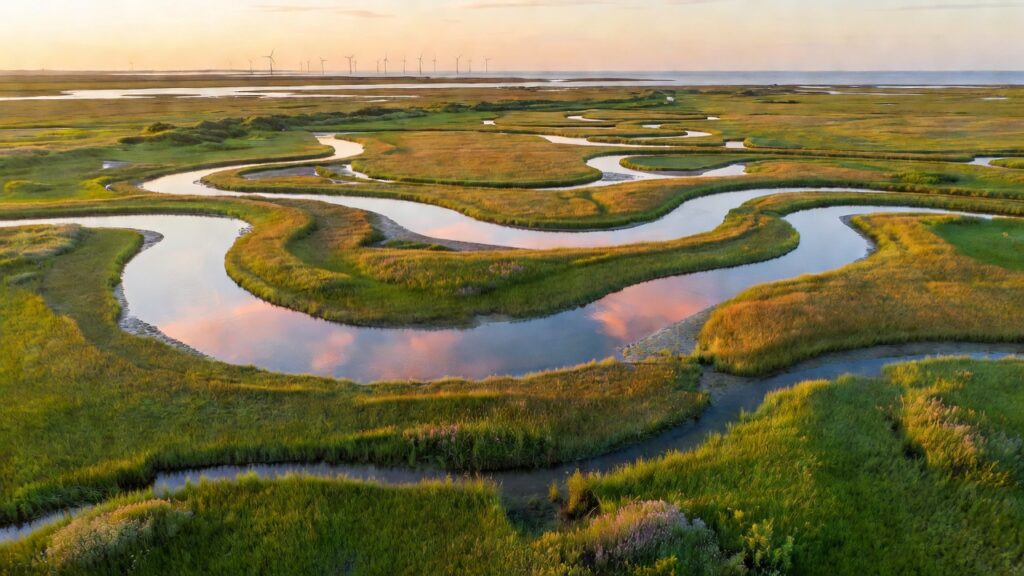
Amid the geopolitical noise, a quieter but important finding emerged from a new WWF report highlighting the remarkable carbon-sequestering capacity of UK saltmarshes. These coastal wetlands lock away climate-warming greenhouse gases in deep layers of mud — acting as highly efficient natural carbon sinks that also support rich biodiversity and protect coastlines from erosion.
The report is a timely reminder that effective climate mitigation does not rely solely on renewable energy infrastructure or carbon markets. Protecting and restoring natural ecosystems — from saltmarshes and peatlands to forests and seagrass meadows — is among the most cost-effective tools available. Europe’s coastal nations, in particular, have significant opportunities to invest in these nature-based solutions as part of integrated environmental policy.
What This Means Going Forward
The events of this week illustrate a world pulling in two directions at once. On one side, a growing coalition of nations is building the architecture for a post-fossil-fuel economy, pricing pollution, and recognising the climate value of natural ecosystems. On the other, powerful political forces are dismantling the environmental protections that underpin both biodiversity and long-term economic resilience.
- For businesses: Regulatory divergence between the U.S. and EU will create new compliance complexities, particularly in energy, shipping, and extractive industries.
- For policymakers: Maintaining ambitious environmental policy in the face of international rollbacks requires stronger multilateral coalitions and credible enforcement mechanisms.
- For citizens: Nature-based solutions and the phase-out of fossil fuels are not abstract goals — they directly affect air quality, food security, and climate stability.
The key takeaway: Biodiversity and climate change are inseparable challenges. Weakening protections for one inevitably accelerates damage to the other. As the global community edges toward a fossil fuel phase-out, the integrity of natural ecosystems must be treated not as an obstacle to development, but as the foundation of it.