2024: Record Heat, Record CO2, and the Race for Climate Solutions
The numbers are in, and they are stark. According to a new report from the United Nations, 2024 was confirmed as the hottest year ever recorded in the Arab region, where temperatures rose at twice the global average. At the same time, atmospheric CO2 levels reached unprecedented highs worldwide — driven by human emissions, an intensification of wildfires, and a worrying decline in the capacity of land and ocean sinks to absorb carbon. These are not isolated data points. Together, they paint a picture of a climate system under mounting stress, with consequences felt from the Middle East to South America and well beyond Europe’s borders.
A Climate in Crisis: What the Data Tells Us
The Arab region’s experience in 2024 serves as a sharp warning for the rest of the world. When a major geographic area warms at double the global rate, it signals accelerating feedback loops that environmental policy has so far failed to contain. Extreme heat drives water scarcity, threatens food systems, and forces mass displacement — challenges that inevitably ripple into European migration and geopolitical dynamics.
The surge in atmospheric CO2 is equally alarming. Scientists have long relied on natural carbon sinks — forests, soils, and oceans — to absorb roughly half of human-caused emissions each year. But reduced absorption by these sinks, compounded by emissions from record-breaking wildfires, pushed 2024’s CO2 concentrations to levels with no historical precedent in modern climate records. This is not merely an environmental statistic; it is a direct indicator of how far current climate change trajectories deviate from the targets set by the Paris Agreement.
Meanwhile, extreme weather events continued to exact a human toll. In Chile, heavy rains across central and southern regions caused three deaths, widespread power cuts, flooding, and road closures — a reminder that the climate emergency is not a future abstraction but a present-day humanitarian reality.
Nature as an Ally: The Hidden Power of Saltmarshes
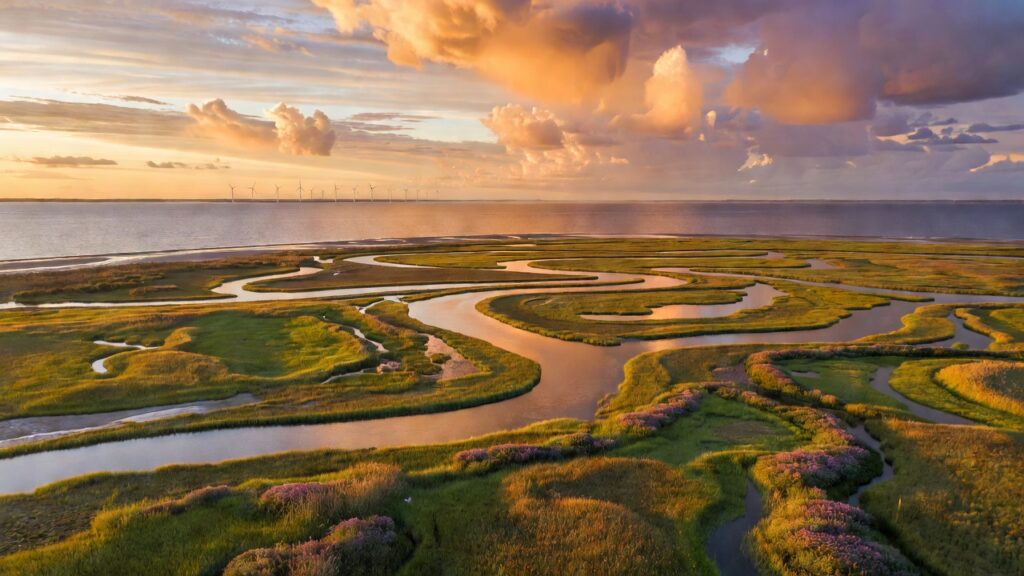
Amid the troubling headlines, a new WWF report has drawn attention to one of the most undervalued tools in the climate toolkit: saltmarshes. These coastal ecosystems, found extensively along UK and European shorelines, lock away climate-warming greenhouse gases in dense layers of mud — a process known as blue carbon sequestration. Unlike forests, saltmarshes store carbon in waterlogged sediments where it can remain stable for centuries.
The findings reinforce a growing scientific consensus: biodiversity and conservation are not peripheral concerns in the climate debate — they are central to it. Protecting and restoring natural ecosystems such as saltmarshes, peatlands, and seagrass meadows offers a cost-effective, nature-based complement to emissions reduction. For European policymakers working to meet EU Nature Restoration Law targets, this evidence provides both scientific backing and political momentum.
Renewable Energy Innovation: Sodium-Ion Batteries Enter the Race
On the technology front, there is genuine cause for optimism. The UK is currently leading the global push to bring sodium-ion batteries to mass market — a development with significant implications for renewable energy storage. Unlike lithium-ion batteries, sodium-ion technology uses abundant, widely available materials, reducing dependence on lithium and cobalt supply chains that carry their own environmental and geopolitical risks.
Affordable, scalable energy storage is widely recognised as one of the critical missing links in the clean energy transition. It would allow excess solar and wind power to be stored and distributed efficiently, reducing reliance on fossil fuel backup systems. Combined with the fact that Wales recorded its sunniest spring on record in 2024 — with 648 hours of sunshine in May alone — the potential for expanded solar energy generation across the British Isles and Northern Europe is clear, even as shifting climate patterns bring their own uncertainties.
Implications for Policy and Citizens
The convergence of these developments — record heat, rising CO2, natural climate solutions, and clean energy breakthroughs — underlines the urgency and complexity of the challenge ahead. For European decision-makers, the priorities are clear:
- Accelerate emissions reduction in line with science-based targets, closing the gap between pledges and action.
- Invest in nature-based solutions such as saltmarsh and wetland restoration as part of integrated climate and biodiversity strategies.
- Support innovation in renewable energy storage, including sodium-ion technology, to unlock the full potential of the clean energy transition.
- Strengthen international cooperation on climate adaptation, particularly with regions like the Arab world that are bearing a disproportionate share of climate impacts.
For citizens, the message is equally direct: the data from 2024 confirms that climate change is accelerating, but so too are the solutions. Engaging with environmental policy, supporting conservation efforts, and backing the clean energy transition at every level — from local government to the European Parliament — has never been more consequential.
The key takeaway: 2024’s record-breaking heat and CO2 levels are a call to action, not a cause for despair. The science, the technology, and the natural solutions all exist. What remains is the political and collective will to deploy them — fast enough, and at scale.