From CO₂ to Concrete: How the World’s First Carbon Refinery Is Rewriting the Rules of Green Innovation
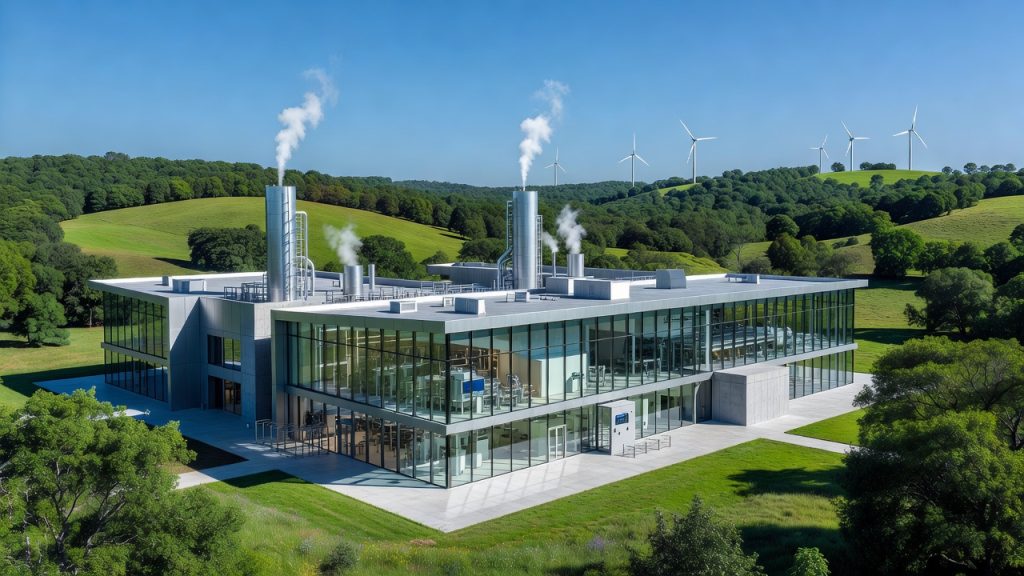
A new chapter in green technology has quietly opened in Australia — and its implications stretch far beyond the Southern Hemisphere. The world’s first fully integrated carbon refinery is now operational, capturing industrial CO₂ and waste materials and converting them directly into construction products. The result: net emissions reductions of up to 90% for some of the hardest-to-decarbonise sectors on the planet. This is not a pilot project or a laboratory concept. It is working infrastructure, and it signals a fundamental shift in how we think about carbon — not as a problem to be buried, but as a resource to be refined.
Carbon Capture Grows Up: From Storage to Utilisation
For years, carbon capture and storage (CCS) has been the subject of intense debate in European climate policy circles. Critics argued it was expensive, unproven at scale, and potentially a lifeline for fossil fuel industries reluctant to change. The Australian carbon refinery reframes that conversation entirely. Rather than sequestering CO₂ underground and hoping it stays there, this facility transforms it — alongside industrial waste streams — into usable building materials.
This approach, known as carbon capture and utilisation (CCU), closes the loop in a way that pure storage never could. The construction sector, responsible for roughly 11% of global greenhouse gas emissions according to the UN Environment Programme, suddenly gains access to a supply chain that is both lower-carbon and economically viable. For European heavy industry — steel, cement, chemicals — facing mounting pressure under the EU Emissions Trading System and the Carbon Border Adjustment Mechanism, this model deserves urgent attention.
A Wave of Green Innovation Reshaping Infrastructure
The Australian refinery does not stand alone. A cluster of breakthroughs announced in recent weeks points to a broader acceleration in green innovation that is quietly transforming the physical infrastructure of our economies:
- Undersea data centres: Off the coast of Shanghai, a submerged data centre now runs on seawater cooling and offshore wind power. As artificial intelligence drives electricity demand to record levels, this land-efficient, low-carbon model offers a compelling alternative to energy-hungry terrestrial server farms — a challenge equally pressing for data centre-dense regions like Ireland, the Netherlands, and Sweden.
- Deep geothermal and lithium co-production: In Cornwall, England, a geothermal plant drilling more than three miles underground is generating electricity and extracting battery-grade lithium simultaneously. For a Europe anxious about critical mineral dependency, this dual-output model is strategically significant — clean energy and domestic raw materials from a single site.
- 10-nanometre solar glass: Solar cells just 10 nanometres thin can now be embedded directly into glass, allowing skyscrapers to generate electricity without any visible alteration to their facades. For smart cities pursuing building-integrated photovoltaics, this technology removes one of the last aesthetic and structural barriers to urban solar adoption.
What This Means for Europe’s Energy Transition
Europe has positioned itself as the global standard-setter for climate regulation, but the continent’s cleantech manufacturing base has struggled to keep pace with investment flows heading to the United States and China. The technologies described above — CCU refineries, geothermal-lithium hybrids, transparent solar glass — represent exactly the kind of high-value, scalable green innovation that the European Green Deal and the Net-Zero Industry Act are designed to nurture.
The Cornwall geothermal project is a direct proof of concept for regions across central and southern Europe sitting above underexplored geothermal resources. The ultra-thin solar glass aligns perfectly with Europe’s ambitious renovation wave targets for existing building stock. And the carbon refinery model could offer a credible compliance pathway for European cement and steel producers facing the steepest phase of ETS carbon pricing between now and 2030.
Electric mobility, smart city planning, and industrial decarbonisation are no longer separate tracks — they are converging into an integrated infrastructure challenge that demands exactly this kind of systemic thinking.
Key Takeaway
The opening of the world’s first carbon refinery is more than a single news story. It is evidence that the energy transition is entering a more sophisticated phase — one where waste becomes feedstock, emissions become materials, and the boundaries between energy, construction, and digital infrastructure dissolve. For European policymakers, investors, and industry leaders, the question is no longer whether these technologies work. It is how quickly they can be scaled, financed, and integrated into a coherent industrial strategy. The race is on, and the starting gun has already fired.