EU Sets 42.5% Renewable Energy Target for 2030 — But Grid Saturation Threatens to Undermine the Transition
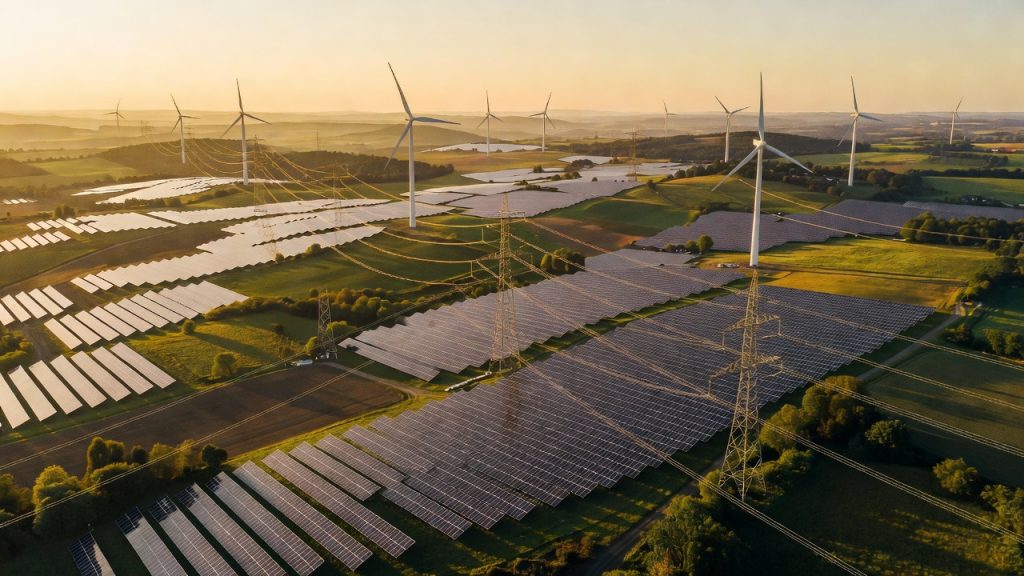
Europe has taken a significant step forward in its green transition. Negotiators from the European Council and Parliament have reached a provisional political agreement on the revised Renewable Energy Directive (RED), raising the EU’s binding renewable energy target from 32% to 42.5% of total energy consumption by 2030, with an additional indicative goal of 2.5% that could push the share to 45%. The deal signals a clear political commitment to accelerating the shift away from fossil fuels — but a growing infrastructure crisis is already undermining the clean energy boom happening right now.
A Landmark Agreement With Real Ambition
The revised RED is one of the most consequential pieces of energy legislation in the EU’s history. By locking in a higher renewable energy target, the directive sends a powerful signal to investors, industries, and member states: the green transition is not slowing down. For businesses, the agreement introduces new investment mandates and clearer frameworks for industrial electrification, renewable hydrogen, and energy efficiency improvements across sectors.
The directive also sets specific sub-targets for renewable energy in heating and cooling, transport, and industry — areas that have historically lagged behind the electricity sector. Hydrogen, both green and low-carbon, features prominently as a tool for decarbonising hard-to-abate industries. For citizens, the practical implications range from changes in energy infrastructure and costs to faster deployment of solar panels, wind farms, and district heating networks across the continent.
The agreement aligns with the EU’s broader REPowerEU plan, designed to reduce dependence on Russian fossil fuels and strengthen long-term energy security — a priority that has only grown more urgent since 2022.
The Grid Saturation Problem: Clean Energy Going to Waste
Yet even as Europe sets more ambitious targets, a structural bottleneck is limiting the real-world impact of renewables already installed. Spain and several other European countries are losing more than 50% of their potential renewable energy output due to grid saturation and insufficient storage capacity. This represents a massive waste of clean energy — electricity generated by solar and wind farms that cannot be absorbed by the grid and is simply curtailed.
The problem is not unique to Europe. Acciona Energía recently announced a new 1 GWh battery energy storage system (BESS) in Chile’s Atacama Desert, doubling its storage capacity there and integrating with the El Romero solar plant to improve grid flexibility. It is a model that European grids urgently need to replicate at scale. Without significant investment in storage, smart grids, and interconnection infrastructure, raising renewable targets risks becoming a paper exercise.
Effective resource management — including water resources used in energy production and cooling — must also be factored into grid expansion planning, particularly in drought-prone southern European regions where solar capacity is highest.
Industrial Electrification and Innovation on the Horizon
On the industrial side, momentum is building. Iberdrola has been selected for eight EU Commission projects totalling 150 MW of industrial electrification capacity, receiving €50 million in subsidies to support the decarbonisation of energy-intensive industries across Europe. These projects represent the kind of targeted, large-scale intervention the revised RED is designed to catalyse.
Meanwhile, innovation is pushing boundaries globally. China has deployed an underwater data centre off the coast of Shanghai, powered by offshore wind energy, to reduce the enormous energy consumption of AI infrastructure. While the project is Chinese, it illustrates a direction of travel relevant to Europe’s own offshore wind ambitions — using abundant marine renewable energy not just for the grid, but for co-located, energy-hungry digital infrastructure.
What This Means for Europe’s Energy Future
The revised Renewable Energy Directive is a necessary and welcome step. But targets alone do not build transmission lines, install batteries, or retrofit industrial facilities. The real test of Europe’s green ambition lies in execution. Policymakers must now prioritise:
- Grid modernisation and expansion to eliminate renewable energy curtailment
- Large-scale energy storage deployment, from batteries to green hydrogen
- Industrial electrification subsidies that reach beyond flagship projects
- Cross-border interconnection to balance supply and demand across member states
The green transition is generating clean energy at an unprecedented rate. The challenge now is making sure none of it goes to waste.
Key takeaway: The EU’s new 42.5% renewable energy target by 2030 is a bold and necessary commitment — but closing the gap between political ambition and physical infrastructure is the defining challenge of Europe’s energy transition.