Carbon Capture, Geothermal Lithium, and AI Wind Models: The Green Tech Breakthroughs Reshaping Europe’s Energy Future
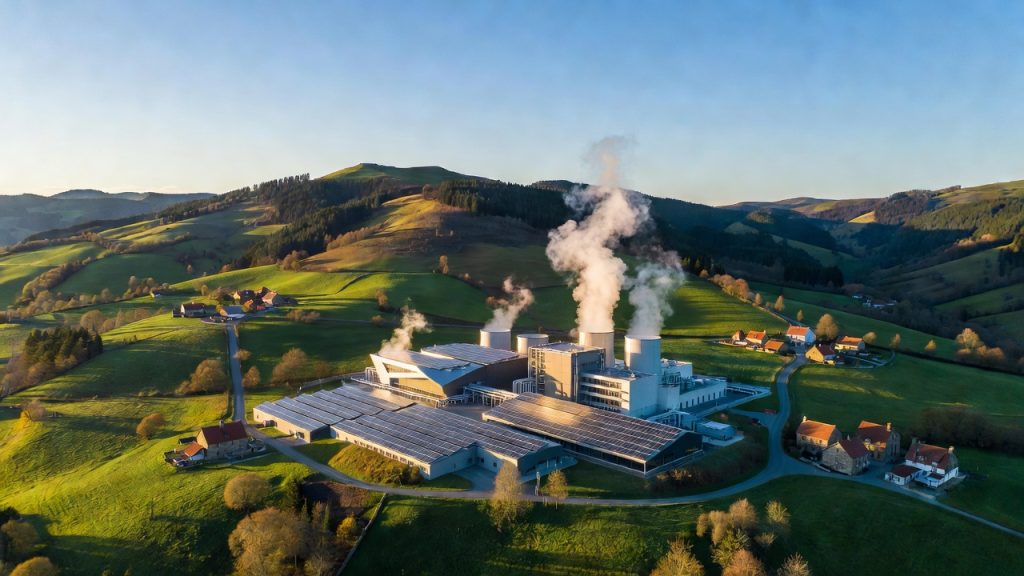
The pace of green technology innovation has rarely felt this urgent — or this promising. In the span of just a few weeks, a carbon refinery opened in Australia, a mobile CO₂ capture unit was deployed in Milan, geothermal energy began powering homes in Cornwall while producing battery-grade lithium, and an AI system learned to predict mountain wind patterns in seconds. Taken together, these developments signal a decisive shift: the energy transition is no longer a distant ambition. It is being engineered, tested, and deployed right now.
Carbon Capture Goes Industrial — and Circular
One of the most significant breakthroughs comes from Australia, where the world’s first fully integrated carbon refinery has begun operations, converting industrial CO₂ and waste streams directly into construction materials. The facility claims a 90% reduction in net emissions for heavy industry processes — a figure that, if replicated at scale, could fundamentally alter the economics of decarbonising cement, steel, and manufacturing sectors.
Closer to home, Italy’s Politecnico di Milano has deployed POLICAP, a mobile carbon capture pilot designed for on-site use at industrial facilities. Unlike fixed infrastructure, POLICAP can be transported directly to emission sources, converting captured CO₂ into synthetic fuels and building materials. This portability makes it especially relevant for Europe’s fragmented industrial landscape, where thousands of mid-sized manufacturers have struggled to justify large-scale carbon capture investments.
Both projects reflect a maturing understanding of Carbon Capture and Utilization (CCU) as a circular economy driver rather than a mere emissions offset tool. Instead of burying CO₂ underground and walking away, these approaches transform it into economically valuable products — closing the loop between industrial waste and material supply chains. For European policymakers navigating the EU’s Carbon Border Adjustment Mechanism (CBAM), this distinction matters enormously.
Cornwall’s Geothermal Site: Energy Independence Meets Critical Minerals
In southwest England, a deep geothermal project has quietly achieved something remarkable. Drilling more than three miles underground, the Cornwall site is now generating electricity from the Earth’s natural heat — while simultaneously co-producing battery-grade lithium from the geothermal brine brought to the surface.
This dual output addresses two of Europe’s most pressing energy transition challenges at once: the need for reliable, weather-independent clean electricity, and the urgent demand for domestically sourced critical minerals. Lithium is essential for electric vehicle batteries and grid-scale storage, yet Europe currently depends heavily on imports from Chile, Australia, and increasingly China. A home-grown supply chain, even a partial one, carries significant strategic value.
The Cornwall model is already attracting attention from developers in Germany, France, and the Nordic countries, where similar geological conditions exist. If geothermal energy can be paired consistently with lithium recovery, it could become a cornerstone of Europe’s push for energy independence and green innovation in critical mineral supply.
AI Unlocks Wind Energy in Difficult Terrain
Wind energy has long faced a stubborn bottleneck: the most resource-rich sites — mountain ridges, complex coastal topographies — are also the hardest to model accurately. A new AI-driven framework is changing that equation dramatically, predicting complex mountain wind patterns in seconds rather than the hours or days required by traditional computational fluid dynamics models.
The implications for cleantech project development are substantial. According to early assessments, the tool can reduce wind farm project timelines by up to 60%, cutting costs and accelerating permitting processes. For European countries like Austria, Switzerland, and Spain — where mountainous terrain has historically limited onshore wind expansion — this could open vast new areas to viable development.
AI-driven climate prediction is also feeding into broader smart cities and grid management systems, helping urban planners and energy operators anticipate demand fluctuations and integrate variable renewables more reliably.
What These Innovations Mean for Europe
Individually, each of these breakthroughs is significant. Together, they sketch the outline of a genuinely integrated energy transition — one that links industrial decarbonisation, domestic mineral supply, and intelligent grid management into a coherent system. European businesses and decision-makers should note several emerging priorities:
- CCU technologies are moving from pilot to commercial scale faster than expected, with direct relevance to CBAM compliance strategies.
- Geothermal co-production offers a rare opportunity to address both energy and critical mineral dependencies simultaneously.
- AI tools are compressing the timelines for renewable energy deployment in ways that traditional planning frameworks have not yet accounted for.
Key takeaway: The green tech landscape in 2025 is defined not by single solutions, but by convergence — where carbon capture, geothermal energy, critical minerals, and artificial intelligence are beginning to reinforce one another. Europe, with its regulatory ambition and industrial base, is well-positioned to lead — but only if policy frameworks evolve as quickly as the technology itself.