Gene-Edited Rice, Algae Fertilisers, and Local Food Hubs: How Science Is Reshaping Sustainable Agriculture
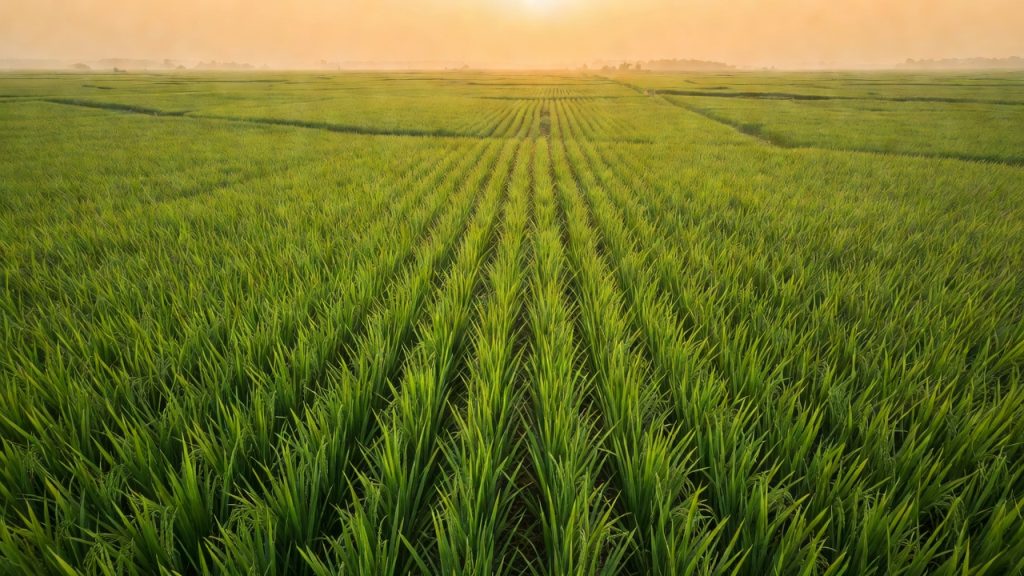
The pressure on global food systems has never been greater. With temperatures rising, soil health declining, and supply chains under geopolitical strain, the agriculture sector is being forced to reinvent itself — fast. This week’s developments paint a picture of an industry at a crossroads: embracing precision science, rethinking inputs, and rediscovering the value of local, regenerative models. Here is what the latest news means for sustainable agriculture in Europe and beyond.
Precision Breeding Breaks New Ground for Climate-Resilient Crops
The most striking headline this week comes from UK-based ocean agriculture company Alora, whose gene-edited rice variants delivered results that are difficult to ignore. In glasshouse trials, two heat-tolerant rice lines outperformed control plants by 53% and 43% under normal temperatures — and by a remarkable 273% and 103% under conditions exceeding 40°C. These are not marginal gains; they represent a potential step-change for food security in climate-vulnerable regions across South and Southeast Asia, Sub-Saharan Africa, and Latin America, where rice is a dietary staple for billions.
Precision breeding — distinct from traditional GMO techniques in that it edits a plant’s existing genome rather than introducing foreign DNA — is gaining regulatory traction in Europe. The EU’s proposed New Genomic Techniques (NGT) regulation is still navigating political debate, but momentum is building. If heat-tolerant varieties like these can be brought to field scale, they could become a cornerstone of climate-resilient food systems that reduce dependence on irrigation, synthetic inputs, and geographically narrow crop varieties.
Meanwhile, Argentina is set to approve a record 11 new GM crops in 2025, including insect-resistant corn and soybean developed by Chinese-owned companies. This signals a significant shift in global seed and biotech supply chains — one that raises legitimate questions about farmer autonomy, trade alignment, and whether European supply chain sustainability standards can remain coherent in a world where biotech leadership is diversifying rapidly.
Nature-Based Inputs and the Circular Farming Revolution
Not all innovation requires editing genomes. Field trials of an algae-based fertiliser have shown a 21% increase in crop yield, offering a compelling, low-input alternative to synthetic nitrogen — one of the most environmentally damaging inputs in conventional agriculture. Synthetic nitrogen production accounts for roughly 1–2% of global energy consumption and contributes significantly to nitrous oxide emissions, a greenhouse gas nearly 300 times more potent than CO₂.
Algae-derived fertilisers align well with the principles of agroecology and circular farming: they can be produced using wastewater or coastal resources, they improve soil biology rather than degrading it, and they reduce farmers’ exposure to volatile fossil-fuel-linked input costs. For European farmers navigating the Farm to Fork Strategy’s targets — including a 20% reduction in fertiliser use by 2030 — scalable, nature-based alternatives like this are not just environmentally desirable; they are economically strategic.
Local Food Systems and the Skills Pipeline
Technology alone cannot transform food systems. The third thread running through this week’s developments is the growing investment in localised, regenerative food models and the human capital to sustain them. Cornwall’s ambitious 10-year food and farming plan aims to position the region as the UK’s leading hub for sustainable food and drink, weaving together regenerative practices, short supply chains, and rural skills development. It is a model with clear relevance for European rural policy, particularly as the EU’s Common Agricultural Policy continues its slow pivot toward sustainability outcomes.
Complementing this, new university-linked programmes — including dedicated ‘smart farming’ master’s degrees and campus-scale local food initiatives — are expanding access to sustainable agriculture knowledge. Training the next generation of farmers, agronomists, and food entrepreneurs in both the science and the systems thinking behind plant-based and regenerative food systems is essential if policy ambitions are to translate into real-world change.
What This Means for Europe’s Food Future
Taken together, this week’s developments point toward a food system in transition — one where:
- Precision science (gene editing, algae inputs) is expanding what is agronomically possible under climate stress
- Geopolitical shifts in biotech supply chains demand clearer European regulatory and trade frameworks
- Local and regenerative models are gaining institutional support, from regional food plans to university curricula
The challenge for policymakers, investors, and citizens alike is to ensure these threads are woven together — not pursued in isolation. A heat-tolerant rice variety is only as useful as the supply chain sustainability and farmer support systems that can bring it to scale. An algae fertiliser only transforms farming if it reaches smallholders and cooperative networks, not just large agribusinesses.
Key takeaway: Sustainable agriculture is no longer a niche aspiration — it is becoming a technical, economic, and political imperative. Europe has both the regulatory architecture and the scientific capacity to lead this transition, but it will require coherent policy, open knowledge-sharing, and a willingness to embrace innovation at every level of the food system.