EU’s 90% Emissions Cut Target Is Reshaping the Cleantech Investment Landscape
The European Union has taken one of its most consequential climate steps in years. With member states giving final approval to a 2040 climate target requiring a 90% reduction in greenhouse gas emissions, the bloc has sent an unambiguous signal to investors, innovators, and policymakers alike: the energy transition is not slowing down. For the green technology sector, this moment represents both a mandate and an opportunity.
Why Regulatory Certainty Is the Cleantech Sector’s Most Valuable Asset
Green technology thrives on long-term visibility. Solar farms, battery gigafactories, hydrogen infrastructure, and smart grid systems all require capital commitments that stretch across decades. The EU’s 2040 target — building on the existing 2030 goal of a 55% emissions reduction under the European Green Deal — now provides that horizon with greater legal and political weight.
For clean-tech companies and their investors, this translates directly into reduced risk. When a regulatory framework is clear and durable, the cost of capital for green innovation projects falls, project financing becomes more accessible, and corporate R&D budgets can be allocated with confidence. The approved target strengthens the business case for everything from electric mobility infrastructure to industrial decarbonisation technologies and energy-efficient building retrofits.
At the same time, the EU’s decision to scale back parts of its corporate supply-chain due diligence rules — easing environmental and human-rights compliance pressure on companies after sustained lobbying — introduces a note of complexity. While this may reduce near-term reporting burdens for European firms operating in global supply chains, it also raises legitimate questions about whether sustainability enforcement will keep pace with the ambition of the 2040 target. Regulatory certainty at the macro level does not automatically guarantee rigour at the supply chain level.
Global Capital Is Flowing Into Green Innovation — And Europe Must Compete
The EU’s domestic commitment arrives in a global context where cleantech financing is accelerating rapidly. HSBC’s announcement of a $4 billion credit facility for Chinese enterprises focused on sustainable and transition technologies is a striking data point. It signals that major international financial institutions see clean industry — spanning low-carbon manufacturing, energy systems, and electric mobility — as a core growth sector, not a niche bet.
This matters for Europe’s green tech ecosystem. Chinese manufacturers already dominate global solar panel and battery production. If large-scale capital continues to flow into scaling those supply chains, European cleantech companies will need to compete not just on innovation but on speed and cost. The EU’s Net-Zero Industry Act and its strategic focus on building domestic manufacturing capacity for technologies like wind turbines, heat pumps, and electrolysers are partly a response to this competitive pressure.
Meanwhile, policy developments in other major markets — such as India’s tightening of procurement requirements for renewable energy projects and its extended deadline for energy-efficiency rules on electric cooking appliances — illustrate how green technology adoption is being shaped by very different regulatory levers across the world. For European firms with global ambitions, understanding these varied policy environments is increasingly essential.
What the 2040 Target Means for Smart Cities and Everyday Innovation
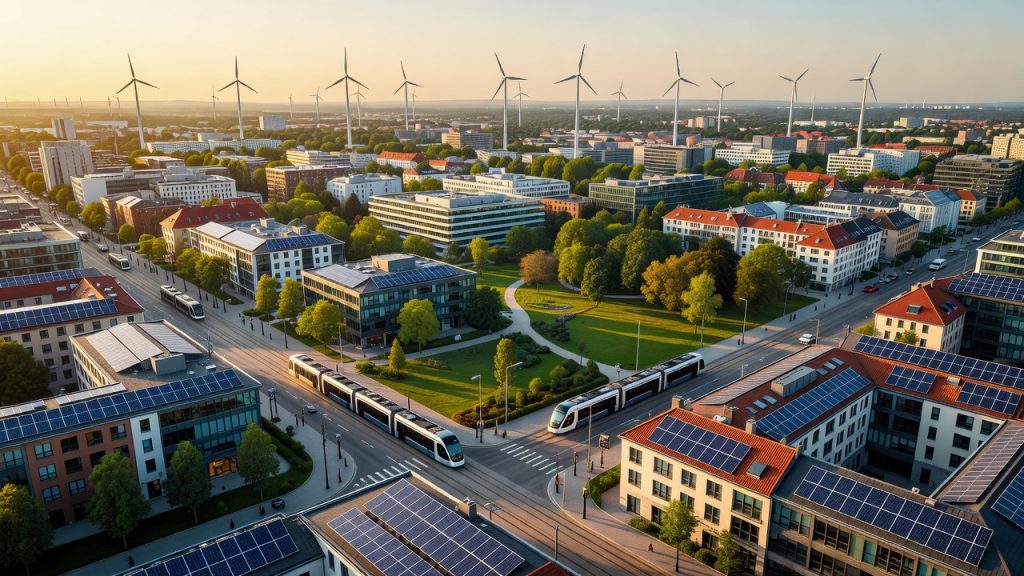
Beyond industrial policy, the 90% emissions target will accelerate transformation in areas that touch daily life. Smart cities, electrified public transport, energy-efficient buildings, and clean heating systems are all likely to see intensified policy support and investment in the years ahead. EU funding mechanisms — including the Innovation Fund and cohesion funds — are expected to align more tightly with the 2040 trajectory.
For citizens, this means faster rollout of technologies that are already proven: heat pumps replacing gas boilers, EV charging networks expanding across urban and rural areas, and smart energy management systems becoming standard in new construction. For startups and scale-ups in the green innovation space, it means a growing domestic market backed by regulatory momentum.
Key Takeaway
The EU’s approved 2040 climate target is more than a political statement — it is a structural signal that will shape investment decisions, technology roadmaps, and industrial strategies for the next two decades. For the cleantech and green technology sector, regulatory certainty is now the foundation on which the next wave of innovation will be built. The challenge ahead is ensuring that ambition at the top translates into consistent, enforceable action across supply chains, cities, and communities throughout Europe and beyond.