From Seaweed to Robots: The Agri-Tech Wave Reshaping Sustainable Agriculture in Europe and Beyond
A quiet but significant transformation is underway in global food and agriculture. Across Europe and key emerging markets, a new generation of agri-tech solutions is moving from pilot projects to commercial scale — tackling livestock emissions, chemical overuse, and agricultural waste in one sweeping moment of innovation. For anyone invested in supply chain sustainability, food systems resilience, or the future of farming, these developments deserve close attention.
Cutting Livestock Methane: A Seaweed Solution Goes Global
Livestock farming accounts for roughly 14.5% of global greenhouse gas emissions, according to the FAO, with enteric fermentation — the methane produced in cattle digestive systems — representing the single largest share. A new commercial partnership is now targeting this problem at scale.
Agri-input company UPL has partnered with CH4 Global to distribute Methane Tamer, a seaweed-derived feed supplement reported to reduce livestock methane emissions by up to 90%. Initial rollout is planned across India, Brazil, and Argentina — three of the world’s largest beef and dairy producers. While the product is not yet widely available in European markets, the implications for sustainable agriculture are global: if adopted broadly, it could become a critical tool for livestock businesses trying to meet net-zero commitments and for retailers seeking to offer genuinely lower-carbon animal products to consumers.
From a European perspective, this aligns with the ambitions of the EU’s Farm to Fork Strategy, which calls for significant reductions in agricultural emissions. Feed additives like Methane Tamer could complement regulatory pressure and carbon farming schemes already gaining traction across the bloc.
Autonomous Weeding and the Precision Agriculture Revolution
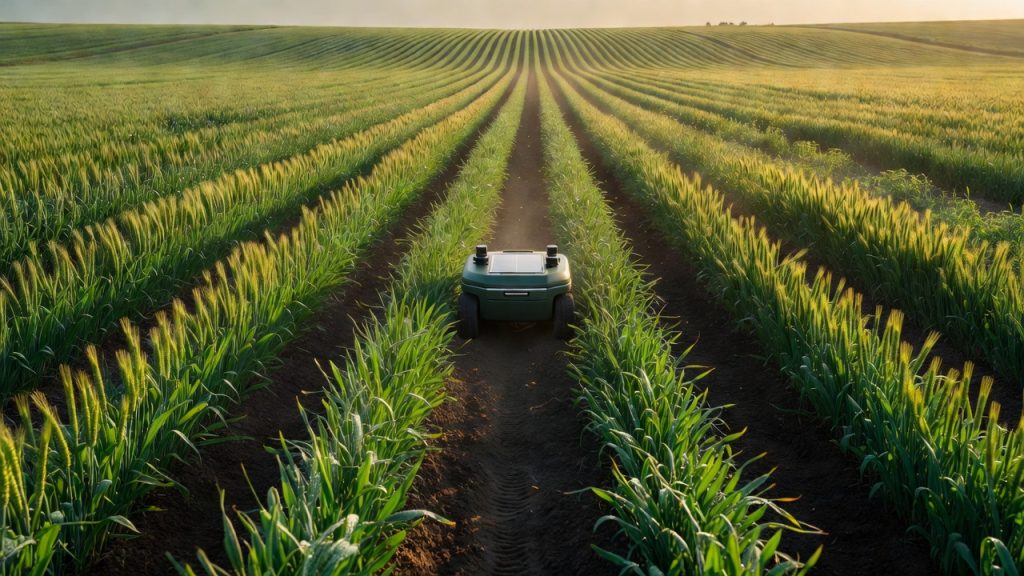
Reducing chemical inputs is one of the central challenges of agroecology — the discipline that seeks to redesign food systems around ecological principles rather than industrial inputs. Norwegian agtech company Kilter is addressing this directly with its AX-1 autonomous weeding robot, which uses computer vision and mechanical action to remove weeds without herbicides.
The company recently closed an $8.6 million Series A funding round, signalling sustained investor confidence in precision agriculture tools. Kilter reports that the AX-1 can reduce herbicide use by up to 95% — a figure that, if verified at scale, would represent a dramatic shift in how arable farmers manage weed pressure. For European growers facing tightening restrictions on glyphosate and other synthetic herbicides under EU pesticide reduction targets, robots like the AX-1 offer a practical, commercially viable alternative.
This is also a labour story. As rural depopulation and seasonal worker shortages continue to strain European farms, automation is increasingly seen not as a threat to agricultural employment but as a necessary adaptation. Precision tools that reduce both chemical dependency and manual labour costs could help smaller farms remain economically viable within a more sustainable food system.
Biogas, Circular Bioeconomy, and the Policy Momentum Building Globally
A third current running through recent agri-tech developments is the push toward circular bioeconomy solutions — particularly the conversion of agricultural waste into energy. India’s compressed biogas (CBG) sector is scaling rapidly, backed by new infrastructure investment and government policy support including higher purchase prices and direct subsidies for biogas producers.
While India’s context differs from Europe’s, the model is directly relevant. The EU’s bioeconomy strategy already identifies agricultural and food waste valorisation as a priority, and biogas infrastructure across Germany, Italy, and Denmark has demonstrated that farm-scale anaerobic digestion can generate both energy and digestate fertiliser — closing nutrient loops and reducing fossil fuel dependence simultaneously.
Agri-tech stakeholders are also calling for renewed government strategies focused on climate-smart agriculture, biodiversity, and the bioeconomy — a signal that policy momentum is shifting away from purely yield-maximising farm support toward technology-enabled resilience.
What This Means for Europe’s Food Future
Taken together, these developments sketch a coherent direction of travel for sustainable food systems: fewer emissions, fewer synthetic inputs, less waste, and smarter use of biological resources. The challenge for European policymakers, farmers, and supply chain actors is to accelerate adoption without leaving smaller producers behind.
- Retailers and food brands sourcing from livestock supply chains should monitor methane-reduction technologies as they approach European markets.
- Farmers and cooperatives facing herbicide restrictions should evaluate autonomous weeding solutions now entering commercial availability.
- Policymakers designing post-CAP support frameworks have an opportunity to tie agri-tech adoption incentives to measurable environmental outcomes.
Key takeaway: The agri-tech innovations gaining momentum right now — from seaweed-based feed supplements to weeding robots and biogas infrastructure — are not isolated novelties. They represent a systemic shift in how food production can be made compatible with climate and biodiversity goals. Europe, with its regulatory ambition and agricultural diversity, is well-positioned to lead — but only if policy and investment move at the speed the science demands.