Renewables Set to Overtake Coal in 2025: What the Latest Energy Shifts Mean for Europe and Beyond
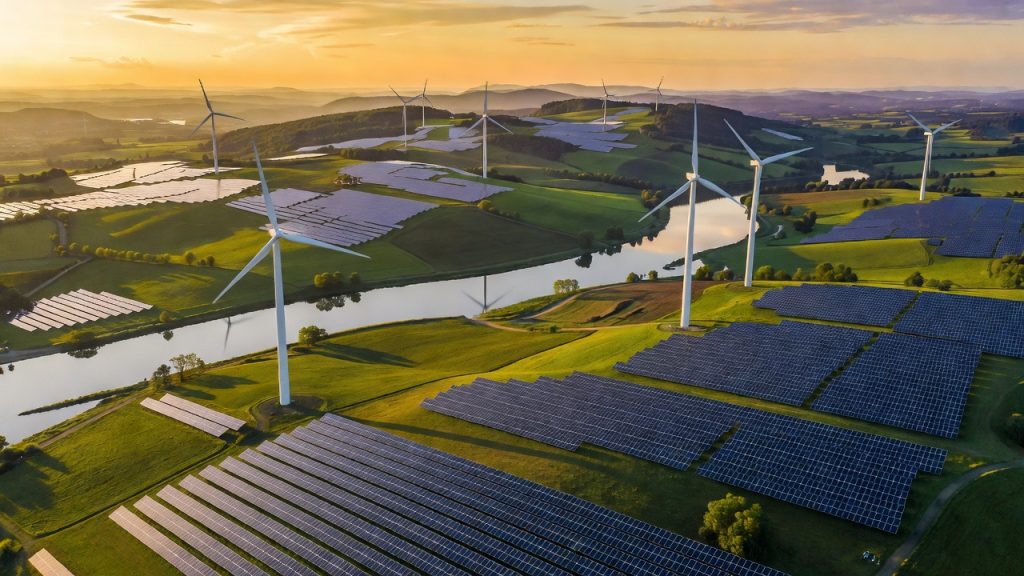
The global energy transition is no longer a distant ambition — it is happening in real time, measured in gigawatts, investment decisions, and policy deadlines. A cluster of developments this week, spanning India, Europe, and North America, paints a picture of a clean-energy system that is scaling fast but still wrestling with the hard questions of supply chains, grid flexibility, and regulatory design.
Renewables Reach a Historic Tipping Point
The headline figure comes from the International Energy Agency (IEA), which reports that renewable energy is on track to overtake coal in global electricity generation in 2025 — a milestone that would have seemed optimistic just a decade ago. Even more striking: both wind and solar are individually expected to surpass nuclear output by 2026, underscoring how dramatically the generation mix is shifting.
This momentum is visible in the numbers on the ground. In the United States alone, 55.9 GW of solar, batteries, and wind capacity were added in 2025, according to data cited by the World Resources Institute. Battery storage is emerging not just as a complement to renewables but as a critical flexibility tool for grids that must balance increasing shares of variable generation. The message for European grid operators and policymakers is clear: storage is no longer optional infrastructure — it is foundational.
Europe Doubles Down on Domestic Clean-Tech Manufacturing
Europe is responding to the global scale-up with a deliberate industrial strategy. A Bulgaria-based company, IPS, has received official strategic project status under the EU Net-Zero Industry Act for its integrated battery energy storage system — a signal that Brussels is actively backing domestic production of clean technologies to reduce dependence on non-European supply chains.
On the hydrogen front, Air Liquide has taken a final investment decision on a 200-MW electrolyser project in Rotterdam, with TotalEnergies already secured as a major offtaker. This is significant: large-scale hydrogen hubs are moving from planning documents to concrete execution, and Rotterdam’s position as a European energy hub makes this a bellwether project for the continent’s green hydrogen ambitions. The combination of committed industrial buyers and final investment decisions suggests the hydrogen economy is entering a more mature, commercially grounded phase.
Meanwhile, the UK is quietly removing friction from home electrification. The elimination of the 1-metre planning-permission rule for heat pump installations near a neighbour’s property may sound like a technicality, but regulatory barriers like this have historically slowed adoption. Reducing them is a practical step toward accelerating energy efficiency upgrades at the household level — exactly where much of Europe’s decarbonisation work still needs to happen.
India’s Solar Supply-Chain Deadline and the Global Manufacturing Race
One of the most consequential policy moves this week comes from outside Europe. India’s Ministry of New and Renewable Energy has confirmed it will not extend the ALMM List-II deadline beyond June 1, 2026. Projects commissioned after that date must source modules from an approved domestic or compliant manufacturer list. For developers and investors operating in one of the world’s largest and fastest-growing solar markets, this is a hard constraint that will shape sourcing strategies, project timelines, and near-term costs.
The broader significance is geopolitical as much as commercial. India’s move mirrors the logic behind the EU Net-Zero Industry Act: governments across the political spectrum are using clean-energy deployment as leverage to build domestic manufacturing capacity. The race to control solar supply chains is intensifying, and European developers with exposure to Asian markets — or European manufacturers eyeing export opportunities — need to factor these shifting rules into their strategies.
Implications for Decision-Makers
- Grid planners and utilities should treat battery storage as core infrastructure, not an add-on, given its growing role in managing renewable variability.
- Industrial and energy companies in Europe should monitor the Rotterdam hydrogen project closely — its commercial structure could become a template for future offtake agreements across the continent.
- Policymakers looking to accelerate home electrification can draw lessons from the UK’s planning rule change: sometimes the biggest gains come from removing small but persistent barriers.
- Investors and developers active in India must treat the June 2026 ALMM deadline as a firm planning constraint and review module sourcing now.
Key takeaway: The clean energy transition is accelerating across every major metric — generation capacity, storage deployment, and hydrogen infrastructure. But the competitive dynamics of supply chains and industrial policy are reshaping where and how that transition happens. For Europe, the challenge is not just deploying renewable energy faster, but ensuring it does so on terms that build long-term economic and strategic resilience.