From Seaweed to Robots: The Quiet Revolution Reshaping Sustainable Agriculture
Sustainable agriculture is no longer a niche aspiration debated in policy white papers. It is increasingly a commercial reality, shaped by a wave of targeted investments, regulatory pressure, and scientific innovation arriving from multiple directions at once. Recent developments — spanning livestock emissions in South America, autonomous weeding in European fields, and pesticide oversight in the United States — paint a picture of a food system under genuine, if uneven, transformation.
Cutting Methane and Chemicals: The Input Revolution Gains Momentum
One of the most striking recent signals comes from the livestock sector, historically one of the hardest to decarbonise within food systems. A reported partnership between UPL Global and CH4 Global aims to distribute a seaweed-based feed supplement across India, Brazil, and Argentina — three of the world’s largest livestock markets. The supplement, derived from the red algae Asparagopsis, has shown potential to reduce enteric methane emissions by up to 90% in controlled trials, though real-world, at-scale results will be the true test.
From a European perspective, this matters enormously. The EU’s Farm to Fork Strategy explicitly targets a reduction in agricultural greenhouse gas emissions, and methane from ruminants represents a significant share of that burden. If scalable, seaweed-based solutions could become a critical tool in the supply chain sustainability toolkit — not just for exporters to EU markets, but for European livestock producers themselves, who face tightening environmental benchmarks under the Common Agricultural Policy.
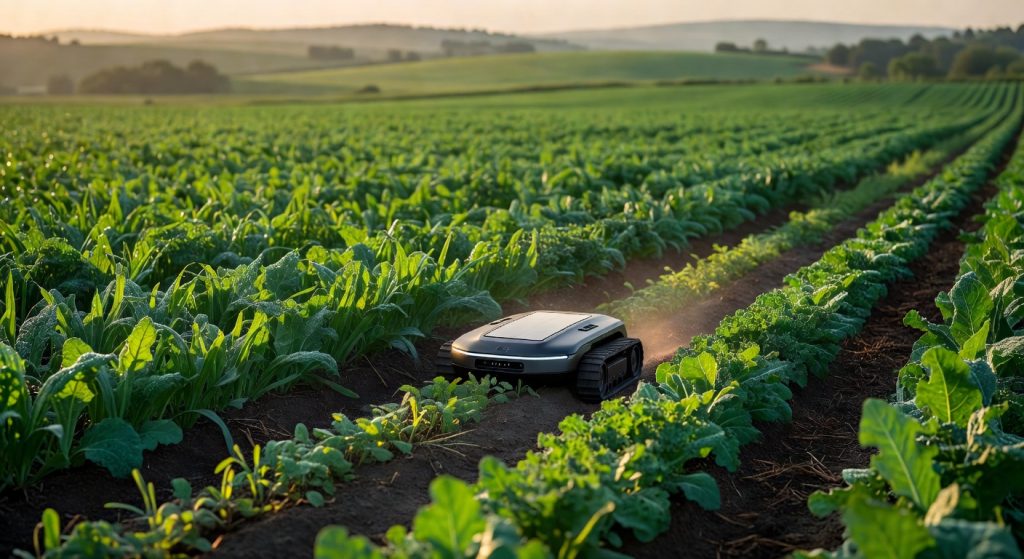
On the crop side, Norwegian agtech firm Kilter has raised $8.6 million to commercialise an autonomous weeding robot that reportedly reduces herbicide use by 95%. This is the kind of precision agriculture breakthrough that agroecology advocates have long called for: technology that works with natural systems rather than overwhelming them with chemistry. Reduced herbicide dependency also directly addresses growing concerns about soil microbiome health — a foundational element of long-term food system resilience.
Investment and Policy: Two Engines Driving the Shift
Capital is following conviction. Hort Innovation, Australia’s horticulture research body, has launched a $60 million venture fund in partnership with Artesian, targeting innovation across productivity, sustainability, consumption, and workforce development. While geographically distant, the fund’s focus areas reflect a global consensus: sustainable growing systems must also be economically viable and socially inclusive to achieve lasting adoption.
Meanwhile, regulatory signals from the United States add another layer of context. The EPA has announced stronger protections governing over-the-top dicamba use on cotton and soybeans, alongside renewed state partnership agreements designed to incentivise environmentally beneficial agricultural practices. Dicamba, a controversial herbicide linked to widespread crop damage and biodiversity concerns, has been a flashpoint in debates about plant-based and conventional farming alike. Tighter controls signal that regulatory pressure on farm inputs is intensifying — a trend mirrored in Europe through the Sustainable Use of Pesticides Regulation (SUR), currently being revised after significant political turbulence.
Together, these policy and investment currents suggest that the transition toward more sustainable agriculture is no longer purely voluntary. Compliance, market access, and investor expectations are converging to make it structural.
Implications for European Food Systems and Consumers
For Europe, these global developments carry direct implications across the food chain:
- Importers and retailers sourcing from Brazil or Argentina will increasingly need to account for methane footprint alongside carbon in their supply chain sustainability reporting, especially as the EU’s Corporate Sustainability Reporting Directive (CSRD) raises disclosure expectations.
- Farmers and cooperatives exploring agroecology or reduced-input models now have clearer evidence that precision tools — from autonomous robots to biological feed additives — are commercially available, not just experimental.
- Consumers choosing plant-based or sustainably certified products are part of a demand signal that is actively shaping where investment flows and which technologies get scaled.
The challenge remains one of speed and equity. Small and medium-sized farms — the backbone of European agriculture — must not be left behind as capital concentrates around high-tech solutions accessible only to large operators.
Key takeaway: Sustainable agriculture is entering a phase where technology, regulation, and finance are aligning more coherently than at any previous moment. The coming months will reveal whether these signals translate into systemic change — or remain promising pilots in a system still largely built around the status quo.