EU Locks In 90% Emissions Cut by 2040 — But Rolls Back Supply-Chain Rules at the Same Time
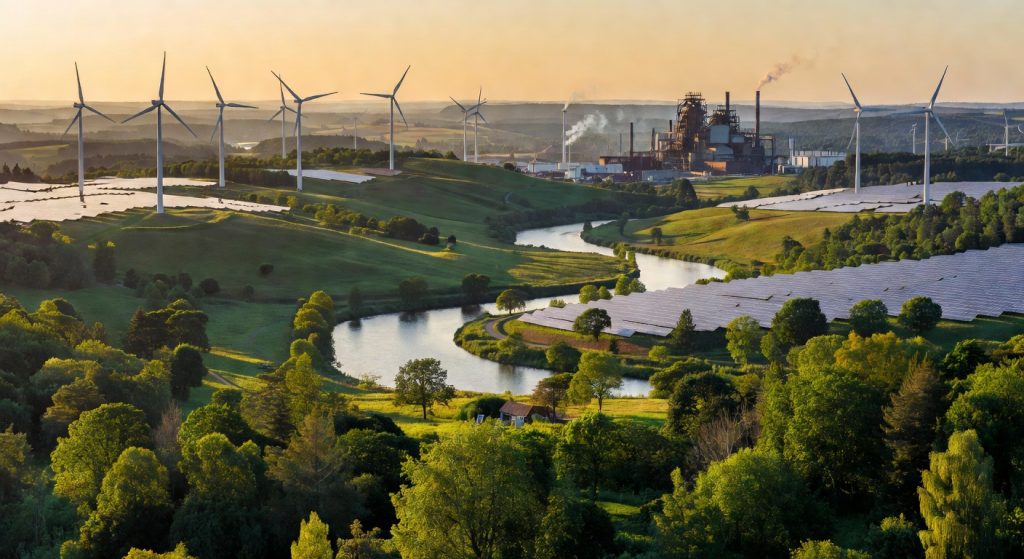
The European Union has taken a significant — and deliberately mixed — step forward on climate policy this week. EU member states gave final approval to a new climate target requiring a 90% reduction in greenhouse gas emissions by 2040 compared to 1990 levels, cementing one of the most ambitious decarbonization roadmaps in the world. Yet in the same legislative sweep, Brussels also scaled back corporate supply-chain due diligence requirements and quietly dropped a planned emissions label for steel. The result is a policy landscape that is simultaneously tightening on long-term climate ambition and loosening on short-term corporate accountability — a tension that will define the ESG debate in Europe for years to come.
A 90% Target: What It Actually Means for Industry and Finance
The 2040 climate target is not symbolic. It sets a binding trajectory that will cascade through every major sector of the European economy — power generation, transport, heavy industry, agriculture, and sustainable finance. The 90% figure sits between the EU’s existing 55% target for 2030 and the net-zero goal for 2050, and it is designed to close the gap that many climate scientists and economists warned was growing dangerously wide.
For businesses and investors, the implications are concrete. Capital allocation decisions made today — in infrastructure, manufacturing, and real estate — will need to be stress-tested against a regulatory environment that assumes deep decarbonization by 2040. ESG frameworks, corporate climate disclosures, and transition plans will increasingly be benchmarked against this trajectory. Financial institutions operating under the EU’s Sustainable Finance Disclosure Regulation (SFDR) and the Corporate Sustainability Reporting Directive (CSRD) will face growing pressure to align portfolios with the new target.
The target also sends a clear signal to global trading partners. European supply chains, procurement standards, and carbon border adjustment mechanisms will all be shaped by this long-term commitment, making the EU’s climate policy a de facto global standard for any company doing business with Europe.
The Supply-Chain Rollback: A Step Back on Corporate Responsibility?
The same week that delivered the 90% target also brought a significant retreat on corporate responsibility in supply chains. EU countries approved a scaled-back version of the Corporate Sustainability Due Diligence Directive (CS3D), easing the compliance burden on companies required to identify and address environmental and human-rights risks across their value chains. The scope of companies covered has been narrowed, and enforcement timelines have been extended.
Critics argue this undermines the coherence of Europe’s sustainability agenda. A green business strategy built on ambitious emissions targets loses credibility if the rules governing how companies source materials, manage suppliers, and report on social impacts are simultaneously weakened. For consumers and institutional investors who rely on supply-chain transparency to make informed decisions, the rollback introduces new uncertainty.
Separately, the European Commission’s emerging industrial plan reportedly drops a planned emissions label for steel — a tool that would have allowed buyers to distinguish between carbon-intensive and low-carbon steel, accelerating demand for green steel and supporting the circular economy transition in manufacturing. Without such a label, market signals for decarbonizing one of Europe’s most emissions-intensive sectors become weaker.
Africa’s Forests: A Warning Signal the EU Cannot Ignore
Beyond European borders, new research published this week adds urgency to the broader climate picture. According to findings highlighted by ScienceDaily, Africa’s forests have shifted from being net carbon absorbers to net carbon emitters since 2010 — a dramatic reversal driven by deforestation, land-use change, and climate stress. This is not a distant problem. Natural carbon sinks are a foundational assumption in virtually every net-zero scenario, including the EU’s own climate modelling.
For European policymakers and investors focused on nature-based solutions and biodiversity finance, this finding reinforces the need to dramatically scale up forest protection, restoration funding, and climate adaptation investment in tropical regions. It also raises questions about the reliability of carbon offset markets that depend on forest carbon sequestration.
Implications: Navigating Ambition and Contradiction
For sustainability professionals, ESG analysts, and decision-makers, this week’s developments highlight a core tension in European climate governance:
- Long-term ambition is hardening — the 2040 target will reshape investment horizons, regulatory risk, and transition planning across all sectors.
- Short-term accountability is softening — the CS3D rollback and the dropped steel label reduce immediate compliance pressure but risk slowing the structural changes needed to meet that same 2040 target.
- Global risks are accelerating — the loss of African forest carbon sinks is a reminder that Europe’s domestic policy, however ambitious, operates within a planetary system under increasing stress.
The EU’s credibility as a global leader on sustainability ultimately depends on whether its long-term targets are matched by consistent, enforceable rules for business behaviour today.
Key takeaway: The EU’s 90% emissions target for 2040 is a landmark commitment that will reshape European industry, finance, and trade for decades. But the simultaneous rollback of supply-chain due diligence rules and the removal of a steel emissions label reveal a political compromise that risks undermining the very mechanisms needed to get there. Businesses and investors should plan for a stricter long-term climate trajectory — while pushing back against the erosion of the accountability tools that make credible transitions possible.