Renewables Hit 32% of Global Electricity in 2024 — But the Energy Transition Is Getting More Complex
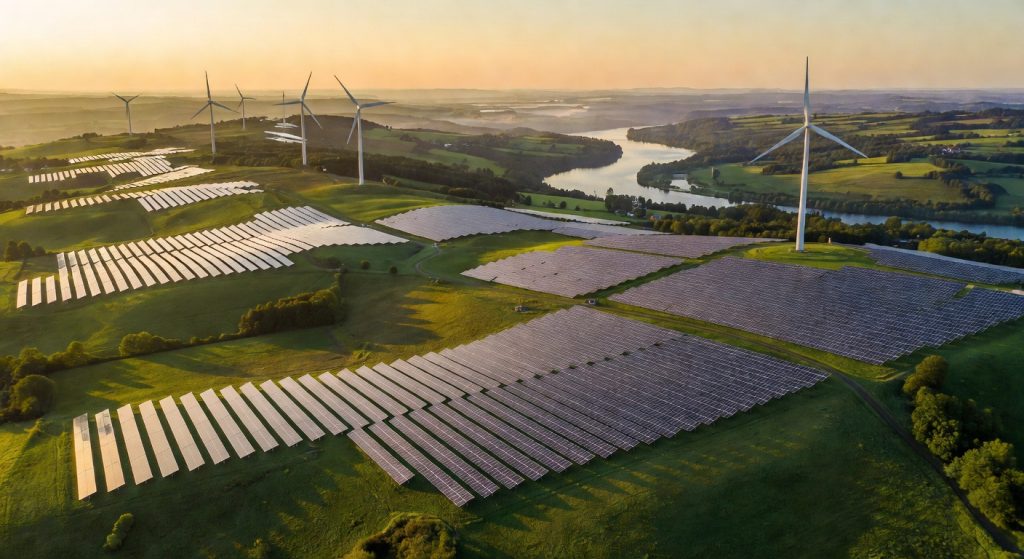
The headline numbers from 2024 are genuinely impressive: renewables supplied 32% of global electricity, a record 741 GW of new renewable capacity was added worldwide, and solar PV alone contributed around 602 GW — pushing total installed solar capacity past the symbolic threshold of 2 terawatts. Wind power added a record 117 GW in a single year. By almost any measure, the clean energy transition is accelerating.
But look closer at the data, the financing decisions, and the policy signals emerging from Europe and beyond, and a more nuanced picture comes into focus. The transition is not stalling — it is maturing. And maturity, in energy systems as in most things, comes with its own set of complications.
Solar Dominates, but Oversupply Creates New Tensions
Solar photovoltaic technology is now the undisputed engine of the global energy transition. Costs have collapsed over the past decade: the IRENA-reported cost of concentrated solar power (CSP) fell from $0.39/kWh in 2010 to under $0.12/kWh in 2023, while standard PV module prices in markets like the United States have dropped to around $0.10 per watt — driven largely by massive Chinese manufacturing overcapacity.
That oversupply is a double-edged sword. On one hand, cheap modules accelerate deployment and make solar accessible to more markets. On the other, they squeeze margins for manufacturers outside China, threatening the industrial base that Europe and the United States are trying to build domestically. The US Inflation Reduction Act (IRA) has triggered a wave of new manufacturing investment, and the EU is pursuing a parallel strategy through its Net-Zero Industry Act (NZIA) — but competing with rock-bottom Asian prices remains a structural challenge for Western producers.
For European citizens and energy planners, the practical implication is clear: solar energy is cheap and getting cheaper, but ensuring a resilient, diversified supply chain for panels, inverters, and battery storage requires deliberate industrial policy — not just market forces.
Europe Bets on Domestic Manufacturing and Storage
One of the most telling recent signals from European policy is the strategic project status granted under the NZIA to a fully integrated battery energy storage system (BESS) project based in Bulgaria. It is a small but significant move: the EU is explicitly using industrial policy to anchor clean-tech manufacturing on European soil, reducing dependence on imports for critical components like grid-scale storage.
This matters enormously for resource management and energy security. As variable renewable energy — solar and wind — makes up a growing share of the electricity mix, storage becomes the indispensable complement. Without adequate battery capacity, grids become harder to balance, and the value of all that new renewable generation is partially lost. Europe’s push to localise BESS production is therefore not just about jobs or trade policy; it is about making the energy transition physically work at scale.
Wind energy, meanwhile, faces its own growing pains. Offshore wind developers across Europe have navigated a difficult period of cost inflation, permitting delays, and supply chain bottlenecks. The sector is now shifting — slowly — from ambitious expansion announcements toward the harder work of project execution, financing, and even early-stage turbine recycling challenges.
Hydrogen: Promise Meets the Reality of Project Finance
Green hydrogen remains one of the most watched — and most debated — components of the clean energy future. The recent final investment decision by Air Liquide on a 200-MW electrolyser project in Rotterdam, with TotalEnergies as offtaker, is a genuine milestone for European industrial decarbonisation. Rotterdam, Europe’s largest port, is a logical hub for hydrogen in heavy industry and shipping.
Yet the broader hydrogen landscape is still sorting itself out. Alongside project announcements, the sector has seen bankruptcies, capital-raising struggles, and factory openings among electrolyser manufacturers — a classic pattern of a technology market in early consolidation. Costs remain high, demand signals are uncertain, and the infrastructure for hydrogen transport and storage is largely still to be built.
What This Means for Europe’s Energy Future
The energy transition in 2024 and beyond is characterised by three converging realities:
- Renewable deployment is accelerating — solar and wind growth is structural, not cyclical, and costs continue to fall.
- Industrial and supply chain policy is now as important as climate targets — the EU’s NZIA, like the US IRA, reflects a recognition that deployment alone is not enough without domestic manufacturing resilience.
- Key technologies like hydrogen and offshore wind are entering a more demanding execution phase — moving from narrative to delivery, with all the financing, logistics, and resource management challenges that entails.
The key takeaway: the energy transition is not slowing down, but it is growing up. For European decision-makers, businesses, and citizens, the task ahead is less about believing in renewables — the data makes that case conclusively — and more about building the industrial, financial, and policy infrastructure to make the transition durable, equitable, and genuinely independent.