Regenerative Agriculture Goes Mainstream: Corporate Targets and Public Funding Are Reshaping European Food Systems
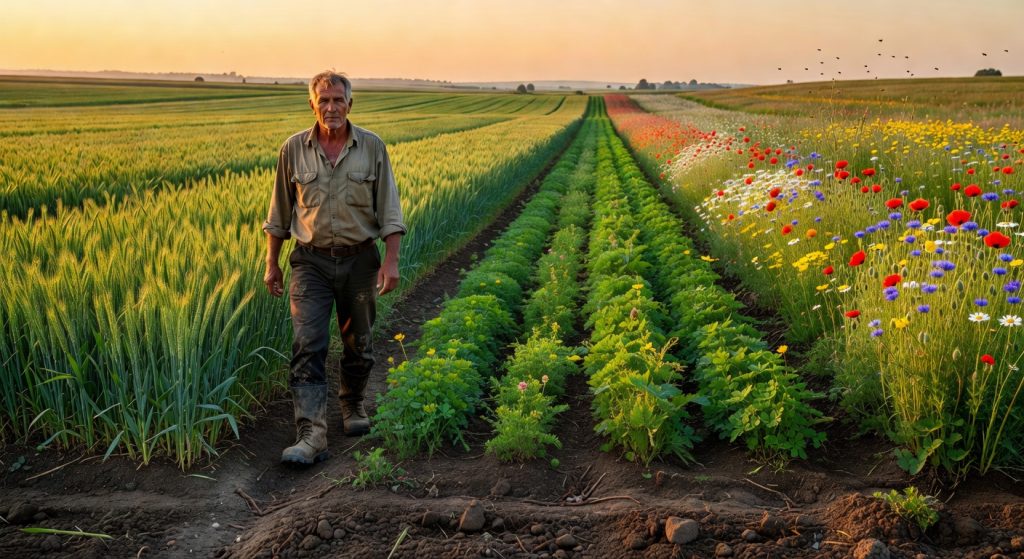
For years, regenerative agriculture occupied a promising but peripheral corner of the sustainability conversation — admired by agroecology advocates, piloted by a handful of forward-thinking farmers, but rarely embedded in the procurement strategies of major food corporations or the budget lines of public institutions. That is changing fast. A wave of concrete commitments, measurable targets, and public funding programmes signals that sustainable agriculture is entering a new, more accountable phase — one where soil health and emissions reductions are no longer aspirational footnotes but contractual obligations.
From Pilot to Scale: Corporate Sourcing Targets Are Getting Real
One of the clearest signs of this shift comes from Purina Europe, which recently announced it has already reached 29% of its regenerative sourcing milestone, engaging more than 630 farmers across 37,000 hectares of European farmland. The programme focuses on cereals and vegetable proteins — core ingredients in pet food supply chains — and demonstrates that supply chain sustainability is no longer limited to human food systems. When a major pet food manufacturer embeds regenerative criteria into its sourcing at this scale, it reflects a broader normalisation of agroecological principles across the entire agri-food sector.
Across the Atlantic, the Louis Dreyfus Company and PepsiCo have jointly launched a regenerative agriculture programme in Saskatchewan, Canada, targeting 45,000 acres by 2026. The initiative focuses on soil health and greenhouse gas emissions within commodity supply chains — a segment historically resistant to environmental transformation due to tight margins and high volume. The fact that two of the world’s largest agri-food players are now co-investing in verified regenerative practices in a major grain-producing region suggests the model is becoming commercially viable at commodity scale.
Public Incentives Are Catching Up — and Demanding Proof
Corporate momentum alone is insufficient without policy frameworks that support farmers in making the transition. Here, too, there are encouraging developments. The US state of Minnesota has opened applications for its Climate-Friendly Agricultural Practices programme, offering flat-rate payments of up to $10,000 per producer for adopting verified low-emissions practices including conservation cover, diversified crop rotation, and tree and shrub establishment. The programme’s emphasis on verifiable outcomes is significant: it reflects a maturing policy approach that prioritises measurable climate and soil results over vague sustainability commitments.
While this example comes from North America, it mirrors the direction of European agricultural policy under the Common Agricultural Policy (CAP) reforms, which are increasingly tying eco-scheme payments to demonstrated environmental outcomes. For European farmers navigating the transition to more sustainable agriculture, the convergence of corporate procurement standards and public payment schemes around shared metrics — soil organic matter, emissions intensity, biodiversity indicators — could reduce the financial risk of adoption and accelerate uptake across the continent.
Biochar and Circular Innovation: Closing the Loop on Agricultural Waste
Beyond sourcing and policy, innovation at the farm-input level is also advancing. Researchers at Prairie View A&M University in Texas have developed an automated processing unit that converts agricultural waste into biochar — a carbon-rich material that improves soil structure, enhances nutrient retention, and reduces dependence on synthetic fertilisers. This circular-economy approach addresses two problems simultaneously: the disposal of crop residues and the need for sustainable soil amendments in regenerative systems.
Biochar is gaining attention across Europe as well, particularly in the context of carbon farming initiatives and the EU Soil Strategy for 2030. Its potential to sequester carbon while improving agronomic performance makes it a compelling tool for farmers seeking to align with both plant-based supply chain sustainability goals and climate commitments. Scaling production through automation, as the Prairie View team has done, is a critical step toward making biochar economically accessible for the average farm operation.
What This Means for the Future of Food Systems
The convergence of corporate targets, public incentives, and soil-focused innovation points toward a structural shift in how food systems are organised and evaluated. Key implications include:
- Farmers face growing pressure — and opportunity to adopt verified regenerative practices as both buyers and governments align around common standards.
- Supply chain sustainability is becoming quantifiable, with acreage, emissions reductions, and soil metrics replacing vague pledges.
- Circular solutions like biochar are moving closer to mainstream adoption, supported by research investment and policy interest across Europe and North America.
- The European agroecology transition is gaining private-sector tailwinds that could complement — and in some cases outpace — public policy timelines.
The key takeaway: Regenerative agriculture is no longer a niche experiment. With measurable corporate milestones, publicly funded incentive programmes, and scalable soil innovations all advancing in parallel, the conditions for a genuine transformation of sustainable food systems are taking shape. The challenge now is ensuring that smallholders, cooperatives, and farmers in lower-income regions are not left behind as the standards and expectations rise.