Europe Bets on Battery Storage to Unlock the Full Potential of Renewable Energy
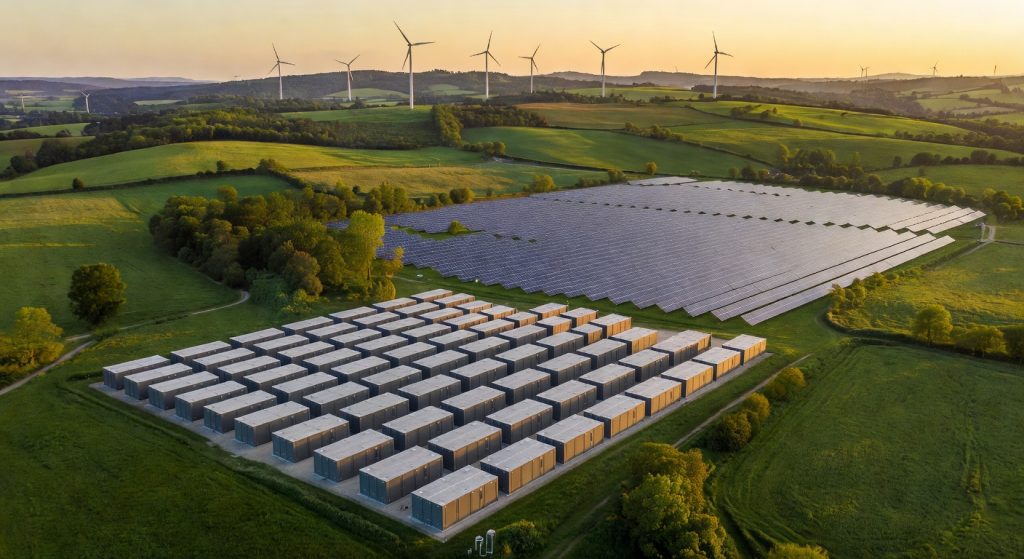
For years, the promise of a fully renewable energy system has run into the same wall: the sun doesn’t always shine, and the wind doesn’t always blow. Now, Europe is making a decisive move to knock that wall down. The European Union has awarded strategic project status under the Net-Zero Industry Act (NZIA) to a fully integrated battery energy storage system (BESS) manufacturing project in Bulgaria, operated by IPS. It is a signal that grid-scale storage is no longer a supporting act — it is becoming the backbone of the continent’s clean energy future.
Why Battery Storage Changes Everything for Solar and Wind
Renewable energy capacity in Europe has grown at a remarkable pace. Solar and wind now account for a rising share of electricity generation across the continent, with the EU targeting at least 42.5% of energy from renewables by 2030. But scaling up intermittent sources like solar panels and wind turbines without matching storage capacity creates a fundamental problem: energy is generated when nature allows, not necessarily when consumers need it.
Grid-scale battery energy storage systems solve this by capturing surplus electricity during peak generation periods and releasing it during demand spikes or low-generation windows. The benefits are substantial:
- Reduced curtailment — less wasted renewable electricity that grids cannot absorb in real time
- Improved grid stability — faster response to fluctuations than traditional gas peaker plants
- Lower consumer costs — smoothing price volatility that drives up household and industrial energy bills
- Enhanced energy security — reducing dependence on imported fossil fuels and their geopolitical risks
The UN has recently reinforced this economic case, noting that renewable energy is now among the cheapest sources of power in many global markets, with solar and offshore wind costs continuing to fall. Storage is the final lever that makes these cost advantages fully available to grids, utilities, and households alike.
Europe’s Industrial Strategy: Building the Supply Chain at Home
The strategic status granted to IPS’s Bulgarian project is about more than one factory. It reflects a broader and urgent ambition: to localise clean-tech manufacturing and reduce Europe’s exposure to supply chain vulnerabilities that became painfully visible during the pandemic and the energy crisis triggered by Russia’s invasion of Ukraine.
The Net-Zero Industry Act, which entered into force in 2024, sets a target for Europe to manufacture at least 40% of its annual clean technology needs domestically by 2030. Battery storage sits at the top of that priority list, alongside solar panels, wind turbines, electrolysers for green hydrogen production, and heat pumps for energy efficiency in buildings.
A fully integrated BESS manufacturing project — covering cell production, module assembly, and system integration — is particularly valuable because it keeps the entire value chain within European borders. This matters for resource management, quality control, carbon footprint, and jobs. It also mirrors moves being made globally: in Brazil’s Amazon region, for instance, large-scale battery procurement is already being used to integrate renewable generation in remote and hard-to-serve areas, demonstrating that storage is a universal solution across very different geographies and grid conditions.
Implications for Citizens, Industry, and Policymakers
For citizens, a more storage-rich grid means greater reliability, fewer price spikes, and a cleaner electricity mix — with real implications for everything from home heating to electric vehicle charging. For businesses, it means more predictable energy costs and a stronger platform for electrifying industrial processes, including those tied to green hydrogen and water management in energy-intensive sectors. For policymakers, it underscores the need to align permitting, grid investment, and industrial policy so that storage projects can be built at the speed the energy transition demands.
The continued restructuring across wind, electrolyser, and storage sectors — with new factories, major funding rounds, and shifting project pipelines reported across the industry — suggests the market is maturing rapidly. Europe’s task is to ensure its regulatory and financial frameworks keep pace.
Key takeaway: Granting strategic status to an integrated battery storage manufacturer in Bulgaria is a concrete step in Europe’s effort to turn renewable energy ambition into operational reality. Grid-scale storage is not a future technology — it is available now, costs are falling, and the EU is right to treat it as critical infrastructure. The energy transition will be won or lost on the grid, and storage is how Europe intends to win it.