EU Green Deal: From Strategy to Regulation — What the Latest Policy Shifts Mean for Business and Citizens
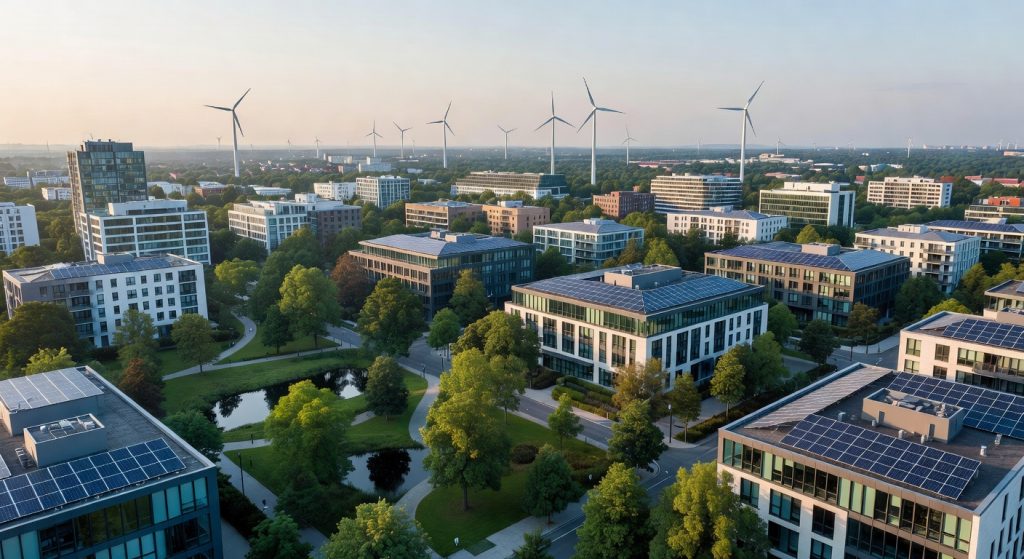
The European Union’s Green Deal was never just a vision document. Launched in 2019, it was always intended to become a dense architecture of binding rules, financial mechanisms, and sector-by-sector targets. In 2025, that architecture is largely built — and the pressure on businesses, regions, and governments to comply is intensifying. Understanding where the Green Deal stands today is essential for anyone navigating Europe’s shifting regulatory and economic landscape.
A Legal Framework Taking Shape: Targets, Timelines, and Traction
At the heart of the EU Green Deal is a legally binding commitment to climate neutrality by 2050, with an intermediate milestone of cutting greenhouse gas emissions by at least 55% compared to 1990 levels by 2030 — a target enshrined in the European Climate Law. These are not aspirational figures; they carry legal weight and drive a cascade of sector-specific regulations across energy, transport, industry, land use, and finance.
According to analysis from the Stockholm Environment Institute (SEI) EU Green Policy Tracker and the European Sustainable Development Network (ESDN), the majority of Commission Green Deal initiatives have already been formally adopted or are currently under negotiation. This signals a critical shift: the EU has moved from the strategy phase into the implementation and enforcement phase. For companies and public authorities, this means the window for voluntary alignment is closing — compliance is becoming the baseline.
Carbon Markets and the CBAM: Reshaping Industrial Competitiveness
One of the most consequential tools in the EU’s climate policy toolkit is the Carbon Border Adjustment Mechanism (CBAM). Designed to prevent carbon leakage — the risk that emissions-intensive production simply relocates outside the EU to avoid carbon costs — CBAM places a carbon price on imports of goods such as steel, cement, aluminium, fertilisers, and electricity from non-EU countries with weaker climate rules.
CBAM entered its transitional phase in October 2023, with full implementation scheduled for 2026. Its implications extend well beyond Europe’s borders: it is already influencing global supply chain decisions and industrial investment strategies, as exporters to the EU face pressure to decarbonise or absorb additional costs. For European manufacturers operating under the EU Emissions Trading System (ETS), CBAM levels the competitive playing field — a key concern as carbon prices have fluctuated but remain a significant operational factor.
The broader carbon market landscape continues to evolve, with the reformed ETS expanding to cover new sectors including buildings and road transport from 2027. This expansion will affect millions of households and businesses across the bloc, making carbon pricing a mainstream economic reality rather than a niche industrial concern.
Just Transition and Sustainability Reporting: The Human and Corporate Dimensions
Climate policy that ignores social consequences risks political backlash — and the EU knows it. The Just Transition Fund, part of a broader Just Transition Mechanism worth over €55 billion, is specifically designed to support regions, communities, and workers most exposed to the phaseout of fossil fuels and carbon-intensive industries. Coal-dependent regions in Poland, Germany, and the Western Balkans are among the primary beneficiaries, receiving funding for retraining, economic diversification, and infrastructure renewal.
On the corporate side, sustainability reporting has become a central pillar of Green Deal implementation. The Corporate Sustainability Reporting Directive (CSRD) — now applying to large companies and progressively extending to smaller firms — requires detailed disclosure on environmental impact, climate risks, and transition plans. Combined with updated energy efficiency rules and land-use frameworks, these requirements are pushing companies toward:
- Cleaner operational practices and measurable emissions reductions
- Greater transparency on climate-related financial risks
- Investment in green infrastructure and renewable energy sourcing
- Alignment with EU taxonomy standards for sustainable finance
Implications for Businesses, Citizens, and Policymakers
The Green Deal’s transition from strategy to regulation has concrete implications across society. Businesses face a tightening compliance environment: carbon pricing, mandatory reporting, and supply chain due diligence are no longer optional. Early movers who have invested in decarbonisation and transparent reporting are better positioned for both regulatory compliance and investor confidence. Citizens, particularly in fossil-fuel-dependent regions, stand to benefit from just transition funding — but also face rising energy costs as carbon pricing expands, making social support mechanisms critical. Policymakers at national and regional level must accelerate implementation while managing the political sensitivities of rapid industrial change.
Key Takeaway
The EU Green Deal is no longer a promise — it is a regulatory reality reshaping how Europe produces energy, moves goods, runs businesses, and supports workers through change. With most major initiatives adopted or in negotiation, the focus has shifted decisively to implementation. For anyone operating in or trading with Europe, understanding the mechanics of environmental regulation, carbon markets, and sustainability reporting is not a future concern. It is an immediate strategic priority.