Regenerative Agriculture Gets a Financial Boost: Corporate Giants and Farmers Align on Sustainable Food Systems
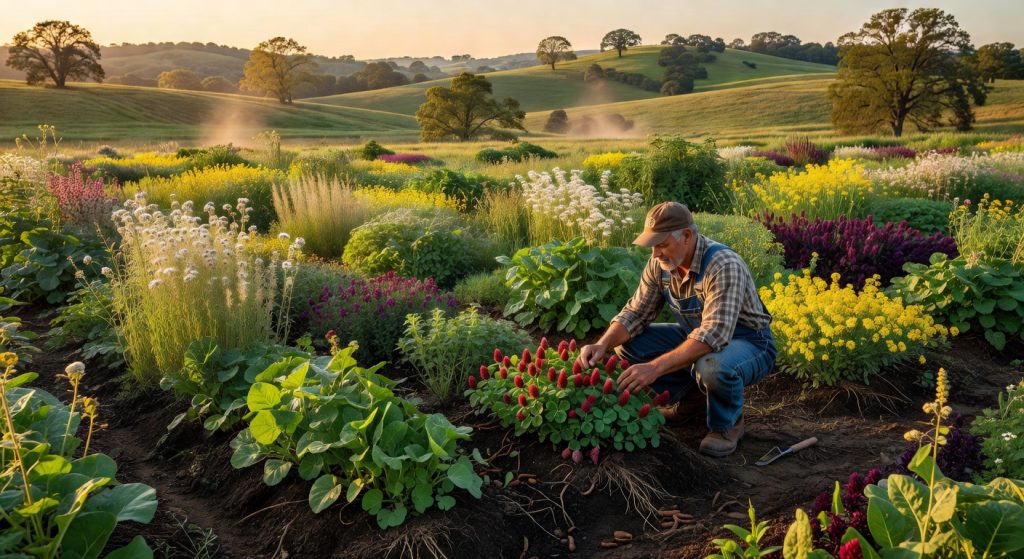
A quiet but significant shift is reshaping how sustainable agriculture is financed. In recent weeks, a cluster of announcements — spanning lending programs, carbon credit deals, and direct farmer incentives — signals that regenerative agriculture is moving from niche practice to mainstream investment target. For European observers watching the slow reform of the EU’s Common Agricultural Policy, these developments offer both inspiration and a cautionary lens.
New Money for Regenerative Farming: Loans, Incentives, and Carbon Markets
The most headline-grabbing development comes from the United States, where Farmers Business Network (FBN) and the Walton family — heirs to the Walmart fortune — have launched what they describe as a “first-of-its-kind” lending program. The initiative offers preferential loan conditions to farmers who adopt regenerative agriculture practices, such as cover cropping, reduced tillage, and integrated pest management. The timing is deliberate: the US farm economy is under strain, and federal funding for conservation programs remains uncertain.
Meanwhile, PepsiCo is making two parallel moves. In Brazil’s Cerrado — one of the world’s most biodiverse and threatened savannahs — the company is piloting a hybrid payment scheme for regenerative agriculture across 7,000 acres, with plans to scale to 30,000 acres. The goal: reduce chemical inputs and rebuild soil health across a critical supply chain node. Separately, PepsiCo has backed a low-carbon ammonia deal with TalusAg, targeting fertilizer emission reductions across its global supply chains — a direct response to the growing pressure on supply chain sustainability.
On the carbon markets front, Amazon has committed $30 million to rice carbon credits in India, aiming to reduce 685,000 tonnes of methane — a potent greenhouse gas released during flooded rice cultivation. This is one of the largest single agriculture-based carbon credit investments to date, and it underscores how agroecology-adjacent practices are being monetised at scale.
Why Supply Chain Decarbonisation Is Driving Corporate Action
These moves are not purely philanthropic. Corporations are under mounting regulatory and reputational pressure to clean up their agricultural supply chains. In Europe, the Corporate Sustainability Reporting Directive (CSRD) and the forthcoming Supply Chain Due Diligence rules are forcing companies to account for Scope 3 emissions — those generated by suppliers and raw material production. Food and beverage giants like PepsiCo source enormous quantities of grain, rice, and oilseeds; their upstream emissions dwarf what happens inside their factories.
Fertiliser production alone accounts for roughly 1–2% of global energy consumption and generates significant CO₂. Low-carbon ammonia, as targeted by the TalusAg deal, is one of the few credible pathways to decarbonising this sector. For European agri-food companies watching from Brussels or Milan, these US and global pilots offer a preview of what compliance — and competitive differentiation — may look like within the decade.
The 2025 US budget reconciliation bill also deserves attention: it secures an additional $2 billion per year for Farm Bill conservation programs. While the EU’s CAP eco-schemes remain underfunded and inconsistently implemented across member states, the US is quietly building a financial architecture that rewards farmers for environmental outcomes.
Implications for European Farmers and Policymakers
Europe has long positioned itself as a leader in sustainable agriculture through the Farm to Fork Strategy and biodiversity targets. Yet the financing gap for farmers willing to transition remains vast. What these global developments reveal is a growing toolkit:
- Blended finance models — combining private lending with sustainability incentives — can reduce transition risk for individual farmers.
- Direct corporate payments for verified regenerative practices offer income diversification beyond commodity prices.
- Carbon and methane credits, if properly regulated, can unlock new revenue streams for smallholders and large producers alike.
- Low-carbon input substitution (such as green ammonia) can reduce both emissions and input cost volatility.
European institutions and agri-food businesses should study these models critically. Carbon markets, in particular, require robust verification to avoid greenwashing — a risk that regulators in Brussels are increasingly alert to.
Key takeaway: The convergence of private capital, corporate supply chain strategy, and public conservation funding is creating a new financial ecosystem for regenerative agriculture. Europe has the regulatory ambition; what it needs now is the financial architecture to match. The global race to fund sustainable food systems has begun — and the winners will be those who move from policy aspiration to bankable farmer incentives.