Renewable Energy at a Crossroads: Grid Rules, Plummeting Costs, and a Plastic-to-Hydrogen Breakthrough
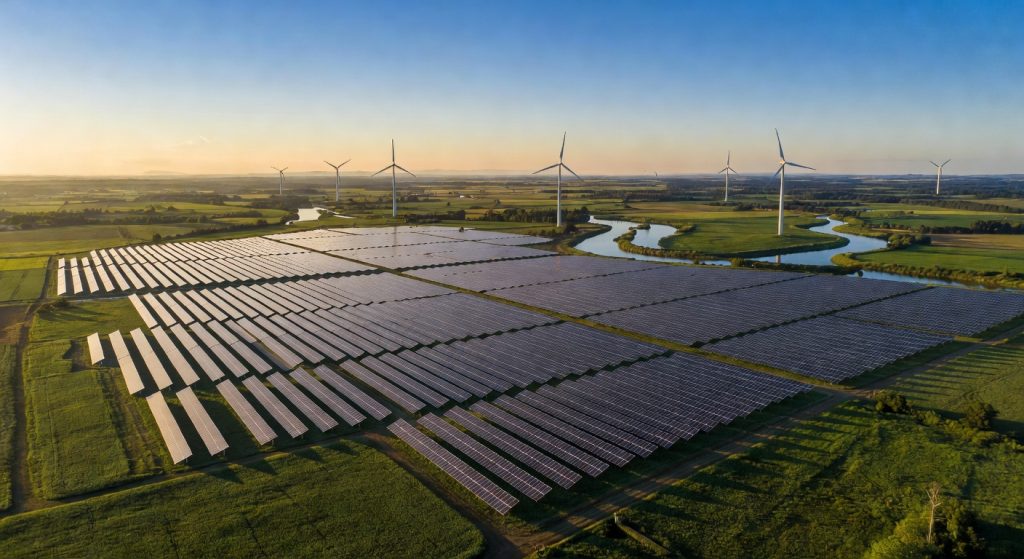
The global shift toward renewable energy is no longer a slow, incremental process — it is happening in surges, driven by policy mandates, collapsing technology costs, and unexpected scientific breakthroughs. In the space of just a few months, the sector has seen new grid stability rules reshape how solar and wind operators do business, storage records shattered in the United States, and a laboratory discovery that could one day turn plastic pollution into clean hydrogen fuel. For European citizens, professionals, and policymakers watching from across the Atlantic, these developments carry lessons that are directly relevant to the continent’s own clean energy ambitions.
Tighter Grid Rules: A Necessary Growing Pain for Renewables
In the United States, the North American Electric Reliability Corporation (NERC) has issued a landmark mandate requiring all owners of inverter-based resources — primarily solar and wind installations — to register with the regulator by May 15, 2026, or face significant financial penalties. The rule targets a genuine technical challenge: as grids absorb more variable renewable generation, the risk of instability grows if those resources are not properly catalogued and managed.
This is not a uniquely American problem. Europe’s own grid operators, coordinated through ENTSO-E, have long grappled with integrating high shares of solar and wind into national and cross-border networks. The EU’s Electricity Market Reform, finalised in 2024, similarly pushes for greater transparency and technical standards from renewable generators. The NERC precedent underscores a universal truth: energy efficiency at the system level requires not just clean megawatts, but disciplined resource management.
Separately, PJM Interconnection — the largest grid operator in the US — has resumed processing power project applications in a region facing acute generation shortfalls. This signals that, despite short-term compliance costs, the pipeline for new renewable capacity is accelerating, not stalling.
Solar and Storage Costs Are Falling Faster Than Expected
If regulation is one engine of the transition, economics is the other — and the numbers are increasingly compelling. According to the International Renewable Energy Agency (IRENA), the cost of Concentrated Solar Power (CSP) plummeted by 70% between 2010 and 2023, with capital expenditure dropping between 58% and 68% over the same period. New CSP projects featuring 100+ hours of thermal storage are now under development, a milestone that effectively turns solar into a dispatchable, round-the-clock energy source.
Meanwhile, the United States added a record 14.1 GW of energy storage in the first half of 2024 alone, according to the US Department of Energy’s Quarterly Solar Update. The post-Inflation Reduction Act landscape has also triggered announcements of over 95 GW of domestic solar manufacturing capacity, reshaping supply chains and creating thousands of industrial jobs.
For Europe, these figures matter. The continent is racing to reduce dependence on imported energy and build sovereign clean-tech manufacturing under the Net-Zero Industry Act. The American experience demonstrates that the right policy incentives — combined with falling costs — can unlock industrial-scale deployment within just a few years.
A Sunlight-Powered Catalyst Turns Plastic Waste into Hydrogen Fuel
Perhaps the most striking development of recent weeks comes from the laboratory. Scientists announced on May 4, 2026 (via ScienceDaily) a sunlight-driven catalytic process capable of converting plastic waste directly into hydrogen fuel. The dual benefit is significant: the technology simultaneously addresses two of the planet’s most pressing environmental crises — the plastic pollution emergency and the need for scalable clean hydrogen production.
Europe is already a global leader in hydrogen strategy, with the REPowerEU plan targeting 10 million tonnes of domestic green hydrogen production by 2030. Technologies that can generate hydrogen from waste streams — using solar energy as the only input — could dramatically improve the economics of that ambition while tackling plastic pollution in rivers, soils, and oceans. The intersection of water security, waste management, and clean energy makes this one of the most promising research directions of the decade.
What This Means for Europe’s Energy Future
Taken together, these developments point to a renewable energy sector that is maturing rapidly — but unevenly. The key implications for European stakeholders include:
- Grid regulation must keep pace with deployment: As solar and wind shares rise, technical standards and registration frameworks become non-negotiable for system reliability.
- Storage is the missing link — and it is becoming affordable: CSP with long-duration storage and battery records in the US show that intermittency is a solvable problem.
- Industrial policy works: The IRA’s manufacturing boom offers a clear model for Europe’s own green industrial strategy.
- Waste-to-hydrogen could redefine circular economy goals: Integrating plastic recycling with clean energy production is a genuinely new frontier.
Key takeaway: The renewable energy transition is accelerating on multiple fronts simultaneously — regulatory, economic, and scientific. Europe has both the ambition and the policy architecture to lead; the challenge now is execution at speed and scale.