From Amsterdam’s Ad Ban to GM’s Green Milestone: How Cities and Corporations Are Reshaping Sustainability in 2025
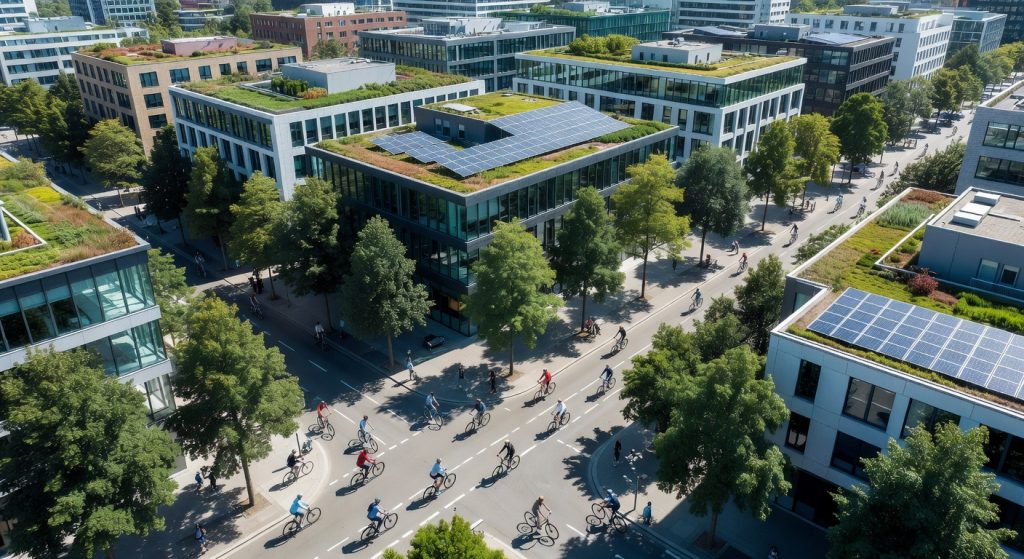
A Dutch city banning advertisements for burgers and petrol. An American automaker running entirely on renewable electricity. A US court blocking a government attempt to stall nearly 57 gigawatts of clean energy. In the space of a few weeks, a cluster of developments has signalled something important: the architecture of sustainable business and green policy is being rebuilt — from both the top down and the bottom up.
Amsterdam Sets a New Standard for Green Urban Policy
Amsterdam has become one of the most closely watched cities in Europe after formally implementing a ban on advertising meat and fossil fuel products across public spaces. The Dutch capital joins a growing coalition of more than 50 cities — the vast majority of them European — that have moved to restrict promotions for high-emission goods and services. The policy reflects a broader understanding that consumer behaviour does not exist in a vacuum: it is shaped, in part, by the commercial messages that surround us every day.
The implications for corporate responsibility are significant. Brands that have built revenue streams on advertising carbon-intensive products in urban environments will need to adapt their marketing strategies — or face exclusion from some of Europe’s most affluent consumer markets. For sustainability advocates, the Amsterdam model is a proof of concept: cities can act as regulatory laboratories, testing policy levers that national governments have been slower to pull.
This kind of municipal activism also has a direct connection to sustainable finance. As ESG frameworks increasingly incorporate supply chain emissions and brand exposure to regulatory risk, companies with heavy fossil fuel or unsustainable food advertising portfolios may find themselves scrutinised more closely by investors assessing long-term value.
Corporate Milestones: GM, Henkel, and the Race to Decarbonise
On the corporate side, General Motors has reached a landmark that no other US automaker has achieved: 100% renewable energy across all its American operations, with 70% renewable matching achieved globally as of 2025. Beyond the environmental headline, GM’s move carries a clear business logic — locking in lower, more predictable energy costs while reducing exposure to carbon pricing mechanisms that are expanding across key markets.
Meanwhile, consumer goods giant Henkel has set revised 2030 sustainability targets following a post-2025 strategy review, with a focus on recycled plastic content and emissions reductions across its value chain. In the food sector, Mars and Ofi have announced a partnership on regenerative agriculture in Ecuador, targeting a measurable cut in the carbon footprint of cocoa supply chains — a move that speaks directly to the growing investor and regulatory pressure on Scope 3 emissions.
These developments are not isolated acts of corporate goodwill. They reflect the maturing of ESG as a business discipline: targets are becoming more specific, timelines more binding, and the connection between sustainability performance and access to capital more direct. The circular economy is increasingly embedded in corporate planning, not as a communications exercise, but as a structural response to resource scarcity and regulatory direction.
Policy and Legal Wins Accelerate the Renewable Energy Transition
In the United States, a federal court issued a preliminary injunction blocking Trump administration actions that had effectively frozen approximately 57 GW of wind and solar projects valued at around $905 million. The ruling is a significant signal that the legal framework protecting clean energy investment retains its force, even under political pressure — and it matters for European companies and investors with exposure to US renewable energy markets.
Separately, the US Environmental Protection Agency launched the ‘Feed It Onward’ initiative, a national programme targeting food waste reduction and food security — a policy area that sits squarely at the intersection of environmental sustainability and social equity. A parallel agreement between the US and Mexico to address the Tijuana River sewage crisis adds a cross-border environmental dimension, demonstrating that green policy increasingly requires multilateral cooperation.
What This Means for Businesses and Decision-Makers
Taken together, these developments point to a sustainability landscape that is accelerating on multiple fronts simultaneously. For green business leaders, the key implications include:
- Regulatory exposure is expanding: Amsterdam’s ad ban will not remain an outlier. Companies should audit their marketing and product strategies against the trajectory of European urban policy.
- Renewable energy is becoming a competitive baseline: GM’s milestone raises the bar. Investors and procurement teams are increasingly treating clean energy sourcing as a minimum standard, not a differentiator.
- Supply chain decarbonisation is non-negotiable: The Mars-Ofi partnership and Henkel’s revised targets reflect a shift toward Scope 3 accountability that ESG reporting frameworks are rapidly codifying.
- Legal and political risk cuts both ways: The US court ruling shows that clean energy investment has legal protections — but also that policy volatility remains a material risk factor.
Key takeaway: The transition to a sustainable economy is no longer a future scenario — it is an active, uneven, and sometimes contested process happening now. Cities like Amsterdam are rewriting the rules of commercial space. Corporations like GM are demonstrating that decarbonisation at scale is operationally achievable. And courts are, in some jurisdictions, holding the line on clean energy commitments. For anyone operating at the intersection of sustainability and business strategy, 2025 is proving to be a year of consequential moves.