Renewables, Carbon Removal, and Food Waste: The ESG Stories Shaping Global Sustainability in 2025
Sustainability and ESG are no longer peripheral concerns for boardrooms and policymakers — they are the central battleground where economic strategy, environmental responsibility, and political will collide. This week’s global developments offer a vivid snapshot of that tension: a US court blocking attempts to derail clean energy, corporations doubling down on carbon removal and regenerative supply chains, and governments tackling food waste with new cross-border agreements. For European citizens, professionals, and decision-makers, these signals carry direct implications for the future of green business and climate policy.
A Court Victory for Renewables: What the US Ruling Means for Clean Energy
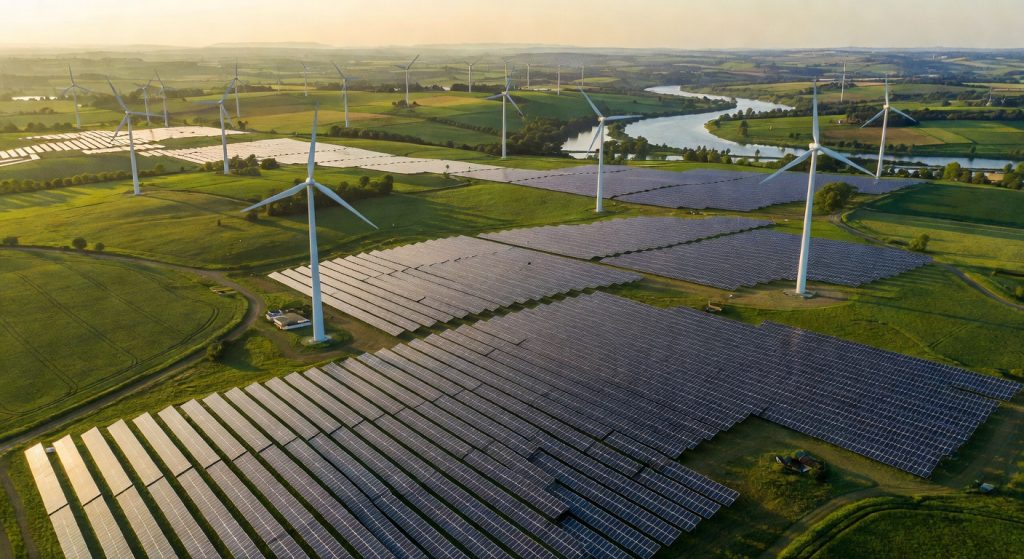
In a significant legal development, a US federal court issued a preliminary injunction blocking the Trump administration’s attempts to stifle wind and solar development. The ruling protects approximately 57 gigawatts of renewable energy projects — enough to power tens of millions of homes — and safeguards an estimated $905 million in clean energy investments that had been placed in regulatory limbo.
The case underscores a recurring tension in sustainability policy: the gap between long-term climate commitments and short-term political decisions. For European observers, the ruling is both reassuring and cautionary. The EU has largely maintained its legislative momentum through the Green Deal and REPowerEU, but the US experience demonstrates how quickly policy reversals can destabilise investor confidence and delay critical infrastructure.
Energy security — a theme acutely felt across Europe since 2022 — is directly tied to the speed of renewable deployment. Delays in clean energy projects do not simply slow decarbonisation; they extend dependence on fossil fuel imports and expose economies to price volatility. The court’s intervention is a reminder that independent institutions play a vital role in holding the line on sustainability commitments, even when political winds shift.
Corporate ESG in Action: Carbon Removal, Regenerative Agriculture, and Circular Economy
Beyond the courtroom, the private sector is accelerating its own sustainability agenda — with mixed but largely encouraging signals.
JPMorgan has signed a 10-year deal with carbon removal company Graphyte, purchasing 60,000 metric tons of biomass-based carbon removals. This transaction places sustainable finance at the frontier of corporate climate strategy, moving beyond carbon offsets toward durable, verifiable removal solutions. For the European market, where the EU’s Carbon Removal Certification Framework is still taking shape, deals like this set a benchmark for what high-integrity carbon finance can look like.
Mars and Ofi have launched a five-year regenerative agriculture project in Ecuador, targeting emissions reductions across the cocoa supply chain. This initiative exemplifies the circular economy in practice: rebuilding soil health, reducing chemical inputs, and cutting Scope 3 emissions — the notoriously difficult upstream emissions that account for the majority of most food companies’ carbon footprints.
Meanwhile, Henkel has revised its sustainability targets, setting new 2030 goals for recycled plastic content and coatings innovation, recalibrated after lessons learned from its 2025 milestones. This kind of transparent target adjustment — rather than quietly abandoning ambitions — reflects a maturing approach to corporate responsibility that European regulators and consumers increasingly expect under frameworks like the Corporate Sustainability Reporting Directive (CSRD).
Food Waste and Cross-Border Cooperation: Small Policies, Big Impact
The US Environmental Protection Agency’s new ‘Feed It Onward’ initiative aims to reduce food waste while strengthening food security — a dual goal that resonates strongly in a European context where roughly 88 million tonnes of food are wasted annually, according to EU estimates. Simultaneously, a US-Mexico memorandum of understanding addresses the long-running Tijuana River sewage crisis, demonstrating that environmental progress often requires cross-border political cooperation rather than unilateral action.
These developments echo the EU’s own Farm to Fork Strategy and its targets to halve food waste by 2030. The lesson is consistent: food system sustainability demands coordination across supply chains, borders, and sectors.
Implications for European Businesses and Policymakers
- Regulatory resilience matters: The US court ruling highlights why embedding sustainability in law — not just policy — protects long-term investment in renewables and green infrastructure.
- Scope 3 is the next frontier: Corporate initiatives like Mars-Ofi signal that leading companies are moving beyond their own operations to tackle supply chain emissions — a direction the CSRD will increasingly mandate.
- Carbon removal needs standards: JPMorgan’s deal with Graphyte underlines the urgency of establishing credible, EU-level certification for carbon removals to unlock sustainable finance at scale.
- Food waste is a climate issue: Reducing food loss is one of the highest-impact, lowest-cost climate interventions available — and it deserves the same policy urgency as energy transition.
Key Takeaway
This week’s ESG landscape reveals a world in which courts, corporations, and governments are all active players in the sustainability transition — sometimes pulling in the same direction, sometimes in opposition. For Europe, the message is clear: maintaining strong institutions, ambitious corporate responsibility standards, and cross-sector cooperation is not idealism. It is the practical foundation of a competitive, resilient, and genuinely green economy.