Heat-Tolerant Rice and Agtech Investment: How Gene Editing Is Reshaping Sustainable Agriculture
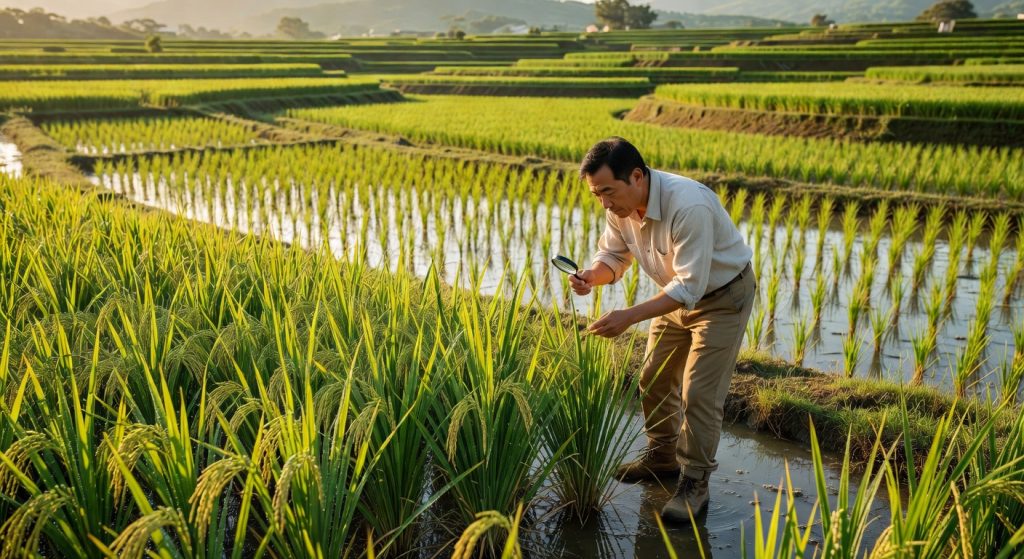
A quiet revolution is taking place in a glasshouse somewhere in the United Kingdom. Alora, a British agri-biotech company, has achieved what many scientists considered a distant goal: a variety of gene-edited rice that not only survives extreme heat but thrives in it. With yields up to 273% higher than conventional rice under temperatures exceeding 40°C, the breakthrough arrives at a moment when climate change is already disrupting food systems across three continents. As Europe grapples with its own agricultural vulnerabilities — from Mediterranean droughts to shifting growing seasons in Central Europe — this development deserves serious attention.
The Science Behind the Breakthrough: What Gene Editing Means for Climate-Resilient Crops
Alora’s results are striking by any measure. In glasshouse trials, their gene-edited rice varieties recorded 53% and 43% higher yields under normal temperature conditions compared to standard varieties. Under heat stress above 40°C, those figures jumped to 273% and 103%, respectively. The company is now preparing the UK’s first large-scale rice field trial, involving 17,000 plants — a significant step from controlled environments to real-world conditions.
This is not an isolated case. Across the globe, gene-editing is emerging as one of the most promising tools in the sustainable agriculture toolkit. In Kenya, blight-resistant potatoes developed through similar techniques are reducing the need for chemical fungicides. In the US and Argentina, GM wheat varieties are advancing toward commercial approval. What unites these efforts is a shared goal: building food systems resilient enough to feed a growing population on a warming planet.
From a European perspective, the regulatory landscape remains more cautious. The EU’s revised legislation on New Genomic Techniques (NGTs), still moving through member state ratification, aims to create a more proportionate framework for precision-bred crops — distinguishing them from older GMO categories. Alora’s progress in the UK, which post-Brexit operates under a more permissive regulatory environment, may well accelerate pressure on Brussels to finalise its own approach.
Agtech Investment and the Race to Decarbonise Food Supply Chains
Gene editing is only one piece of a much larger puzzle. Across the agtech sector, capital is flowing toward innovations that address both productivity and supply chain sustainability. Recent weeks have seen a cluster of significant funding rounds:
- Bonsai Robotics secured $15 million for automated fruit harvesters, targeting labour shortages and reducing food waste at harvest.
- CH4 Global is scaling production of methane-reducing feed additives — a critical intervention given that livestock account for roughly 14.5% of global greenhouse gas emissions.
- Sound Agriculture raised $25 million for sustainable fertiliser alternatives, directly addressing one of the most carbon-intensive inputs in conventional farming.
Meanwhile, AgroLiquid’s acquisition of Monty’s Plant Food signals growing consolidation around soil health — a cornerstone of agroecology and regenerative farming approaches that European policymakers have increasingly championed under the Farm to Fork strategy.
These investments reflect a broader industry recognition: that the transition to sustainable food systems is not just an ethical imperative, but a commercial opportunity. For European agri-food businesses navigating the Green Deal’s ambitious targets, these developments offer both inspiration and competitive benchmarks.
Policy Signals: Conservation Wins, Deregulation Risks, and What Europe Should Watch
The policy environment shaping these innovations is, however, deeply uneven. In the United States, the 2025 Farm Bill budget reconciliation has secured $2 billion per year in additional mandatory funding for five key conservation programmes — a meaningful win for farmers investing in nature-positive practices. Yet the confirmation of Lee Zeldin as EPA administrator, welcomed by agriculture groups for his deregulation stance and support for year-round E15 biofuel access, introduces uncertainty around environmental safeguards.
For European observers, the contrast is instructive. The EU’s Common Agricultural Policy reform process, however imperfect, has maintained a structural commitment to linking public funding with environmental conditionality. As US policy oscillates, Europe has an opportunity — and arguably a responsibility — to demonstrate that sustainable agriculture and food security are complementary, not competing, goals.
Key Takeaway
Alora’s heat-tolerant rice is more than a scientific milestone — it is a signal of the direction travel in global food innovation. Combined with accelerating agtech investment in automation, emissions reduction, and soil health, the pieces of a more resilient, sustainable food system are beginning to assemble. Europe’s role is to ensure that its regulatory frameworks, research funding, and trade policies keep pace — and that the benefits of these breakthroughs reach farmers and communities most exposed to climate risk, not just the best-funded markets.